Results by title
100 books match the query 'Microeconomics' and 9 start with s

Scanner Data and Price Indexes
Edited by Robert C. Feenstra and Matthew D. Shapiro
University of Chicago Press, 2003
Every time you buy a can of tuna or a new television, its bar code is scanned to record its price and other information. These "scanner data" offer a number of attractive features for economists and statisticians, because they are collected continuously, are available quickly, and record prices for all items sold, not just a statistical sample. But scanner data also present a number of difficulties for current statistical systems.
Scanner Data and Price Indexes assesses both the promise and the challenges of using scanner data to produce economic statistics. Three papers present the results of work in progress at statistical agencies in the U.S., United Kingdom, and Canada, including a project at the U.S. Bureau of Labor Statistics to investigate the feasibility of incorporating scanner data into the monthly Consumer Price Index. Other papers demonstrate the enormous potential of using scanner data to test economic theories and estimate the parameters of economic models, and provide solutions for some of the problems that arise when using scanner data, such as dealing with missing data.
Scanner Data and Price Indexes assesses both the promise and the challenges of using scanner data to produce economic statistics. Three papers present the results of work in progress at statistical agencies in the U.S., United Kingdom, and Canada, including a project at the U.S. Bureau of Labor Statistics to investigate the feasibility of incorporating scanner data into the monthly Consumer Price Index. Other papers demonstrate the enormous potential of using scanner data to test economic theories and estimate the parameters of economic models, and provide solutions for some of the problems that arise when using scanner data, such as dealing with missing data.
[more]

Secret Origins of Modern Microeconomics
Dupuit and the EngineersRobert B. Ekelund Jr. and Robert F. Hébert
University of Chicago Press, 1999
How did contemporary microeconomic theory emerge? Who were its chief architects? Conventional wisdom points largely to the work of Alfred Marshall (1842-1924) and his colleagues in England in the late nineteenth century. In this highly original and important contribution to the history of economic thought, Robert Ekelund and Robert Hébert convincingly argue that the intellectual tradition of microeconomic inquiry was initiated by members of the Corps des Ingénieurs des Ponts et Chaussées (French corps of state civil engineers), most notably Jules Dupuit (1804-66). Using documents previously unavailable in English, the authors present a cohesive and original picture of French economic thought that solidly documents the contributions of Dupuit and his colleagues. This is a seminal work about the foundations of modern microeconomics.
"A very fine piece of work that provides material I have never seen before, is well written, and has undoubtable merits."—William Baumol, C.V. Starr Center for Applied Economics, New York University
"By bringing to the forefront the achievements of French engineer Jules Dupuit, this work changes our view of the history of microeconomics. Secret Origin of Modern Microeconomics is a commentary on our discipline's mythology of origins: it reminds us that, in the construction and maintenance of canonical authority, the recoginition of founding fathers requires simultaneous, often subtle, gestures of exclusion."—Philippe Fontaine, école Normale Supèrieure de Cachan
[more]
Social Class
How Does It Work?Annette Lareau
Russell Sage Foundation, 2008
Class differences permeate the neighborhoods, classrooms, and workplaces where we lead our daily lives. But little is known about how class really works, and its importance is often downplayed or denied. In this important new volume, leading sociologists systematically examine how social class operates in the United States today. Social Class argues against the view that we are becoming a classless society. The authors show instead the decisive ways social class matters—from how long people live, to how they raise their children, to how they vote. The distinguished contributors to Social Class examine how class works in a variety of domains including politics, health, education, gender, and the family. Michael Hout shows that class membership remains an integral part of identity in the U.S.—in two large national surveys, over 97 percent of Americans, when prompted, identify themselves with a particular class. Dalton Conley identifies an intangible but crucial source of class difference that he calls the "opportunity horizon"—children form aspirations based on what they have seen is possible. The best predictor of earning a college degree isn't race, income, or even parental occupation—it is, rather, the level of education that one's parents achieved. Annette Lareau and Elliot Weininger find that parental involvement in the college application process, which significantly contributes to student success, is overwhelmingly a middle-class phenomenon. David Grusky and Kim Weeden introduce a new model for measuring inequality that allows researchers to assess not just the extent of inequality, but also whether it is taking on a more polarized, class-based form. John Goldthorpe and Michelle Jackson examine the academic careers of students in three social classes and find that poorly performing students from high-status families do much better in many instances than talented students from less-advantaged families. Erik Olin Wright critically assesses the emphasis on individual life chances in many studies of class and calls for a more structural conception of class. In an epilogue, journalists Ray Suarez, Janny Scott, and Roger Hodge reflect on the media's failure to report hardening class lines in the United States, even when images on the nightly news—such as those involving health, crime, or immigration—are profoundly shaped by issues of class. Until now, class scholarship has been highly specialized, with researchers working on only one part of a larger puzzle. Social Class gathers the most current research in one volume, and persuasively illustrates that class remains a powerful force in American society.
[more]
Social Exchange
Barter as Economic and Cultural Activism in Medellín, ColombiaBrian J. Burke
Rutgers University Press, 2022
Money occupies a powerful place in our lives – it is a problem, a goal, and motivator, a measure of self-worth and national progress, and even an influence on how we relate to each other and to nature – but what happens when communities start to reinvent money and markets? Over the last twenty-five years, grassroots activists in Medellín, Colombia, have used barter markets and community currencies as one strategy to re-weave a social fabric shredded by violence and to establish an economy founded on respect and reciprocity rather than exploitation. In Social Exchange, Brian J. Burke provides a deep ethnographic investigation of this activism and its effects. This story draws us into the cultural and material effects of capitalism and narco-violence, while also helping us understand what new radical imaginations look like and how people bring them to life. The result is an intimate glimpse of urban life in Latin America, as well as a broader analysis of non-capitalist or post-capitalist possibility.
[more]
Social Inequality
Kathryn Neckerman
Russell Sage Foundation, 2004
Inequality in income, earnings, and wealth has risen dramatically in the United States over the past three decades. Most research into this issue has focused on the causes—global trade, new technology, and economic policy—rather than the consequences of inequality. In Social Inequality, a group of the nation's leading social scientists opens a wide-ranging inquiry into the social implications of rising economic inequality. Beginning with a critical evaluation of the existing research, they assess whether the recent run-up in economic inequality has been accompanied by rising inequality in social domains such as the quality of family and neighborhood life, equal access to education and health care, job satisfaction, and political participation. Marcia Meyers and colleagues find that many low-income mothers cannot afford market-based child care, which contributes to inequality both at the present time—by reducing maternal employment and family income—and through the long-term consequences of informal or low-quality care on children's educational achievement. At the other end of the educational spectrum, Thomas Kane links the growing inequality in college attendance to rising tuition and cuts in financial aid. Neil Fligstein and Taek-Jin Shin show how both job security and job satisfaction have decreased for low-wage workers compared with their higher-paid counterparts. Those who fall behind economically may also suffer diminished access to essential social resources like health care. John Mullahy, Stephanie Robert, and Barbara Wolfe discuss why higher inequality may lead to poorer health: wider inequality might mean increased stress-related ailments for the poor, and it might also be associated with public health care policies that favor the privileged. On the political front, Richard Freeman concludes that political participation has become more stratified as incomes have become more unequal. Workers at the bottom of the income scale may simply be too hard-pressed or too demoralized to care about political participation. Social Inequality concludes with a comprehensive section on the methodological problems involved in disentangling the effects of inequality from other economic factors, which will be of great benefit to future investigators. While today's widening inequality may be a temporary episode, the danger is that the current economic divisions may set in motion a self-perpetuating cycle of social disadvantage. The most comprehensive review of this quandary to date, Social Inequality maps out a new agenda for research on inequality in America with important implications for public policy.
[more]
Social Norms and Economic Institutions
Kenneth J. Koford and Jeffrey B. Miller, Editors
University of Michigan Press, 1991
Economists, philosophers, and legal scholars come together in Social Norms and Economic Institutions to examine how economists' rational decision-making models are influenced by ethical values and social norms. Economists find it difficult to include considerations of ethical values and social norms in their behavioral models, for these factors are neither goods nor constraints in the usual sense. And, while custom and social norms influence individual behavior, economists have not determined how they affect aggregate economic outcomes. Editors Kenneth J. Koford and Jeffrey B. Miller argue persuasively that these powerful societal and cultural forces influence decision making in important ways that cannot be captured by models that take into account only self-interested behavior. The contributors address such questions as how norms change, how a common sense of fairness can survive in a world of heterogeneous values, how such principles can help to determine appropriate penalties for corporate misconduct, and how fairness can be an important element in determining a "fair" bargaining equilibrium in contract negotiations. Sociologists, philosophers, business ethicists, legal scholars, and economists alike will appreciate the value of this volume in enriching their understanding of how ethical values and social norms can be incorporated in standard behavioral models.
[more]

Staircases or Treadmills?
Labor Market Intermediaries and Economic Opportunity in a Changing EconomyChris Benner
Russell Sage Foundation, 2007
Globalization, technological change, and deregulation have made the American marketplace increasingly competitive in recent decades, but for many workers this "new economy" has entailed heightened job insecurity, lower wages, and scarcer benefits. As the job market has grown more volatile, a variety of labor market intermediaries—organizations that help job seekers find employment—have sprung up, from private temporary agencies to government "One-Stop Career Centers." In Staircases or Treadmills? Chris Benner, Laura Leete, and Manuel Pastor investigate what approaches are most effective in helping workers to secure jobs with decent wages and benefits, and they provide specific policy recommendations for how job-matching organizations can better serve disadvantaged workers. Staircases or Treadmills? is the first comprehensive study documenting the prevalence of all types of labor market intermediaries and investigating how these intermediaries affect workers' employment opportunities. Benner, Leete, and Pastor draw on years of research in two distinct regional labor markets—"old economy" Milwaukee and "new economy" Silicon Valley—including a first-of-its-kind random survey of the prevalence and impacts of intermediaries, and a wide range of interviews with intermediary agencies' staff and clients. One of the main obstacles that disadvantaged workers face is that social networks of families and friends are less effective in connecting job-seekers to stable, quality employment. Intermediaries often serve as a substitute method for finding a job. Which substitute is chosen, however, matters: The authors find that the most effective organizations—including many unions, community colleges, and local non-profits—actively foster contacts between workers and employers, tend to make long-term investments in training for career development, and seek to transform as well as satisfy market demands. But without effective social networks to help workers locate the best intermediaries, most rely on private temporary agencies and other organizations that offer fewer services and, statistical analysis shows, often channel their participants into jobs with low wages and few benefits. Staircases or Treadmills? suggests that, to become more effective, intermediary organizations of all types need to focus more on training workers, teaching networking skills, and fostering contact between workers and employers in the same industries. A generation ago, rising living standards were broadly distributed and coupled with relatively secure employment. Today, many Americans fear that heightened job insecurity is overshadowing the benefits of dynamic economic growth. Staircases or Treadmills? is a stimulating guide to how private and public job-matching institutions can empower disadvantaged workers to share in economic progress.
[more]
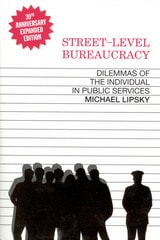
Street-Level Bureaucracy, 30th Anniversary Edition
Dilemmas of the Individual in Public ServiceMichael Lipsky
Russell Sage Foundation, 2010
First published in 1980, Street-Level Bureaucracy received critical acclaim for its insightful study of how public service workers, in effect, function as policy decision makers, as they wield their considerable discretion in the day-to-day implementation of public programs. Three decades later, the need to bolster the availability and effectiveness of healthcare, social services, education, and law enforcement is as urgent as ever. In this thirtieth anniversary expanded edition, Michael Lipsky revisits the territory he mapped out in the first edition to reflect on significant policy developments over the last several decades. Despite the difficulties of managing these front-line workers, he shows how street-level bureaucracies can be and regularly are brought into line with public purposes. Street-level bureaucrats—from teachers and police officers to social workers and legal-aid lawyers—interact directly with the public and so represent the frontlines of government policy. In Street-Level Bureaucracy, Lipsky argues that these relatively low-level public service employees labor under huge caseloads, ambiguous agency goals, and inadequate resources. When combined with substantial discretionary authority and the requirement to interpret policy on a case-by-case basis, the difference between government policy in theory and policy in practice can be substantial and troubling. The core dilemma of street-level bureaucrats is that they are supposed to help people or make decisions about them on the basis of individual cases, yet the structure of their jobs makes this impossible. Instead, they are forced to adopt practices such as rationing resources, screening applicants for qualities their organizations favor, "rubberstamping" applications, and routinizing client interactions by imposing the uniformities of mass processing on situations requiring human responsiveness. Occasionally, such strategies work out in favor of the client. But the cumulative effect of street-level decisions made on the basis of routines and simplifications about clients can reroute the intended direction of policy, undermining citizens' expectations of evenhanded treatment. This seminal, award-winning study tells a cautionary tale of how decisions made by overburdened workers translate into ad-hoc policy adaptations that impact peoples' lives and life opportunities. Lipsky maintains, however, that these problems are not insurmountable. Over the years, public managers have developed ways to bring street-level performance more in line with agency goals. This expanded edition of Street-Level Bureaucracy underscores that, despite its challenging nature, street-level work can be made to conform to higher expectations of public service.
[more]
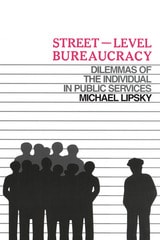
Street-Level Bureaucracy
Dilemmas of the Individual in Public ServiceMichael Lipsky
Russell Sage Foundation, 1983
Street-Level Bureaucracy is an insightful study of how public service workers, in effect, function as policy decision makers, as they wield their considerable discretion in the day-to-day implementation of public programs.
[more]