Results by title
188 books match the query 'Middle Eastern' and 10 start with s
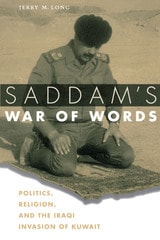
Saddam's War of Words
Politics, Religion, and the Iraqi Invasion of KuwaitBy Jerry M. Long
University of Texas Press, 2004
From a Western perspective, the Persian Gulf War of 1990-1991 largely fulfilled the first President Bush's objective: "In, out, do it, do it right, get gone. That's the message." But in the Arab world, the causes and consequences of Saddam Hussein's invasion of Kuwait and his subsequent defeat by a U.S.-led coalition were never so clear-cut. The potent blend of Islam and Arab nationalism that Saddam forged to justify the unjustifiable—his invasion of a Muslim state—gained remarkable support among both Muslims and Arabs and continued to resonate in the Middle East long after the fighting ended. Indeed, as this study argues in passing, it became a significant strand in the tangled web of ideologies and actions that led to the attacks of 9/11.
This landmark book offers the first in-depth investigation of how Saddam Hussein used Islam and Arab nationalism to legitimate his invasion of Kuwait in the eyes of fellow Muslims and Arabs, while delegitimating the actions of the U.S.-led coalition and its Arab members. Jerry M. Long addresses three fundamental issues: how extensively and in what specific ways Iraq appealed to Islam during the Kuwait crisis; how elites, Islamists, and the elusive Arab "street," both in and out of the coalition, responded to that appeal and why they responded as they did; and the longer-term effects that resulted from Saddam's strategy.
Sara
Prison Memoir of a Kurdish RevolutionarySakine Cansiz
Pluto Press, 2019
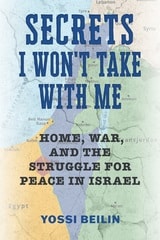
Secrets I Won't Take with Me
Home, War, and the Struggle for Peace in IsraelYossi Beilin
University of Alabama Press, 2025
An Israeli political leader’s riveting first-hand account of pivotal moments from recent Israeli history, including the Oslo Peace Accords, the founding of the Birthright Initiative, the assassination of Yitzhak Rabin, the rise of the Israeli far right, and more
In Secrets I Won't Take with Me, Yossi Beilin, a key Israeli political and ministerial leader, offers an intimate and candid memoir that chronicles pivotal events in the nation’s recent history. From the crucible of its founding to the complexities of the modern era, Beilin reveals an insider’s perspective and previously undocumented insights about the events that have and continue to shape Israel.
Beginning his career as an academic and a journalist, Beilin became the spokesperson of the Labor Party in 1977. Among his many career highlights include the chairmanship of the Meretz-Yachad Party, Minister of Justice, Minister of Religious Affairs, and Deputy Finance Minister, and perhaps most significantly, as Deputy Foreign Minister during the Israel-PLO Oslo Peace Accords. As a key architect of the Oslo Peace Accords, he shares unprecedented details of the negotiations that defined an era.
Beyond diplomacy, Beilin illuminates his role in shaping Israel’s identity, from steering Israel away from its alliance with apartheid South Africa to the foundation of the influential Birthright program. With unflinching honesty, Beilin navigates the triumphs and tragedies of a nation, from the euphoria of the Six-Day War to the heartbreak of Yitzhak Rabin’s assassination. A deeply personal memoir of one man’s life interwoven with a nation’s, Beilin’s stunning account of his career serves as a masterful tour d’horizon of Israel’s recent past and evolving future.
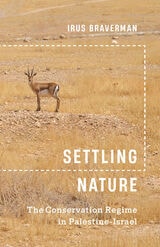
Settling Nature
The Conservation Regime in Palestine-IsraelIrus Braverman
University of Minnesota Press, 2023
A study of Palestine-Israel through the unexpected lens of nature conservation
Settling Nature documents the widespread ecological warfare practiced by the state of Israel. Recruited to the front lines are fallow deer, gazelles, wild asses, griffon vultures, pine trees, and cows—on the Israeli side—against goats, camels, olive trees, hybrid goldfinches, and akkoub—which are affiliated with the Palestinian side. These nonhuman soldiers are all the more effective because nature camouflages their tactical deployment as such.
Drawing on more than seventy interviews with Israel’s nature officials and on observations of their work, this book examines the careful orchestration of this animated warfare by Israel’s nature administration on both sides of the Green Line. Alongside its powerful protection of wildlife biodiversity, the territorial reach of Israel’s nature protection is remarkable: to date, nearly 25 percent of the country’s total land mass is assigned as a park or a reserve. Settling Nature argues that the administration of nature advances the Zionist project of Jewish settlement and the corresponding dispossession of non-Jews from this space.

Sin
Selected Poems of Forugh FarrokhzadSholeh Wolpe
University of Arkansas Press, 2010
Soft Weapons
Autobiography in TransitGillian Whitlock
University of Chicago Press, 2007
Azar Nafisi’s Reading Lolita in Tehran,Marjane Satrapi’s comics, and “Baghdad Blogger” Salam Pax’s Internet diary are just a few examples of the new face of autobiography in an age of migration, globalization, and terror. But while autobiography and other genres of life writing can help us attend to people whose experiences are frequently unseen and unheard, life narratives can also be easily co-opted into propaganda. In Soft Weapons, Gillian Whitlock explores the dynamism and ubiquity of contemporary life writing about the Middle East and shows how these works have been packaged, promoted, and enlisted in Western controversies.
Considering recent autoethnographies of Afghan women, refugee testimony from Middle Eastern war zones, Jean Sasson’s bestsellers about the lives of Arab women, Norma Khouri’s fraudulent memoir Honor Lost, personal accounts by journalists reporting the war in Iraq, Satrapi’s Persepolis, Nafisi’s book, and Pax’s blog, Whitlock explores the contradictions and ambiguities in the rapid commodification of life memoirs. Drawing from the fields of literary and cultural studies, Soft Weapons will be essential reading for scholars of life writing and those interested in the exchange of literary culture between Islam and the West.
Spoiling the Stories
The Rise of Israeli Women's FictionTamar Merin
Northwestern University Press, 2016

Strangers in Light Coats
Selected Poems, 2014–2020Ghassan Zaqtan
Seagull Books, 2023
Ghassan Zaqtan is not only one of the most significant Palestinian poets at work today, but one of the most important poets writing in Arabic. Since the publication of his first collection in 1980, Zaqtan’s presence as a poet has evolved with the same branching and cumulative complexity as his poems—an invisible system of roots insistently pushing through the impacted soil of political and national narratives.
Strangers in Light Coats is the third collection of Zaqtan’s poetry to appear in English. It brings together poems written between 2014 and 2020 drawn from six volumes of poetry. Catching and holding the smallest particles of observation and experience in their gravity, the poems sprout and grow as though compelled, a trance of process in which fable, myth, and elegy take form only to fall apart and reconfigure, each line picked apart by the next and brought into the new body.

Strip
PoemsJessica Abughattas
University of Arkansas Press, 2020
“The mystery that Abughattas composes is always moving toward an impossible freeing of the self from its numerous frames. Yet frame by frame . . . she suspends our disbelief, catalogs those potentialities in an America always ready to shoot, direct, and produce the film of itself. Strip is ‘in love with possibility,’ ‘in praise of here I am, here I’ve been,’ USA style. Strip celebrates the body—its rise and fall, ebb and flow, in a carnival of parties—restlessly, shamelessly, searching for a way out…. Even as Abughattas claims that ‘I can’t believe sometimes I have a body,’ her poems teem with an awareness of the body’s unavoidable centrality in our lives—in how we view our lives, and how others view them; in how they progress, and how they end; in how they become meaningful, and how they are stripped of meaning. And no stripping escapes memory. Whether in terms of dispossession or sexuality, admiration or pity, Abughattas renders her treatment of the body with candor and poignancy. . . . The most startling moments in Abughattas’s poems, however, depend not on shocking or intimate details—but on the ‘I’ pulling away from the self, abandoning the ego, and gazing outward. She tries to see something else, to escape the body’s restraints.”
—Fady Joudah and Hayan Charara, from the Preface
Struggles for Political Change in the Arab World
Regimes, Oppositions, and External Actors after the SpringEdited by Lisa Blaydes, Amr Hamzawy, and Hesham Sallam
University of Michigan Press, 2022
The advent of the Arab Spring in late 2010 was a hopeful moment for partisans of progressive change throughout the Arab world. Authoritarian leaders who had long stood in the way of meaningful political reform in the countries of the region were either ousted or faced the possibility of political if not physical demise. The downfall of long-standing dictators as they faced off with strong-willed protesters was a clear sign that democratic change was within reach. Throughout the last ten years, however, the Arab world has witnessed authoritarian regimes regaining resilience, pro-democracy movements losing momentum, and struggles between the first and the latter involving regional and international powers.
This volume explains how relevant political players in Arab countries among regimes, opposition movements, and external actors have adapted ten years after the onset of the Arab Spring. It includes contributions on Egypt, Morocco, Kuwait, Saudi Arabia, Syria, Algeria, Sudan, Lebanon, Iraq, Jordan, Yemen, and Tunisia. It also features studies on the respective roles of the United States, China, Iran, and Turkey vis-à-vis questions of political change and stability in the Arab region, and includes a study analyzing the role of Saudi Arabia and its allies in subverting revolutionary movements in other countries.