Results by title
64 books match the query 'Mining' and 6 start with s
Searchlight
The Camp That Didn't FailHarry Reid
University of Nevada Press, 2007
Seeing Underground
Maps, Models, and Mining Engineering in AmericaEric C. Nystrom
University of Nevada Press, 2014
Starting in the late nineteenth century, mining engineers developed a new set of practices, artifacts, and discourses to visualize complex, pitch-dark three-dimensional spaces. These maps and models became necessary tools in creating and controlling those spaces. They made mining more understandable, predictable, and profitable. Nystrom shows that this new visual culture was crucial to specific developments in American mining, such as implementing new safety regulations after the Avondale, Pennsylvania fire of 1869 killed 110 men and boys; understanding complex geology, as in the rich ores of Butte, Montana; and settling high-stakes litigation, such as the Tonopah, Nevada, Jim Butler v. West End lawsuit, which reached the US Supreme Court.
Nystrom demonstrates that these neglected artifacts of the nineteenth and early twentieth centuries have much to teach us today. The development of a visual culture helped create a new professional class of mining engineers and changed how mining was done. Seeing Undergound is the winner of the 2015 Mining History Association’s Clark Spence Award for the best book on mining history.
Smoke and Tailings
An Environmental History of Butte and Anaconda, Montana, 1880–1930Fredric L. Quivik
University of Nevada Press, 2026
Butte’s history, a long-standing subject of historical inquiry, gains new depth as Quivik examines the technological developments pioneered by local mining companies. He challenges the simplistic narrative of a powerful corporation imposing its will on helpless agricultural communities. Local communities mounted strong opposition to the industry’s polluting methods; Quivik acknowledges this dynamic while also revealing efforts by the Anaconda Copper Mining Company to address environmental issues. The company developed and implemented technical solutions to minimize resource waste and mitigate damage, driven by both economic interests and litigation pressures. While these advancements lessened some of the environmental harm, they were insufficient to prevent long-term consequences. The operations in Butte and Anaconda ultimately created the largest Superfund complex in the United States, requiring billions of dollars in remediation.
Quivik’s nuanced approach opens the “black box” of technology, showing how innovations both alleviated and exacerbated the environmental challenges of mining, milling, and smelting. In addition to contributing to the rich literature on smelter smoke, this book breaks new ground by examining the underexplored environmental impacts of tailings, offering a fresh perspective on the intersection of industry, technology, and environmental change. The cultural landscapes of Butte and Anaconda retain many features of the region’s history of both environmental degradation and remediation. Smoke and Tailings is an essential addition to the study of Butte’s industrial and ecological history.

Stampede To Timberline
Ghost Towns & MiningMuriel Sibell Wolle
Ohio University Press, 1974
The author searched the Colorado Rockies from the time she saw and sketched her first ghost town until she had rediscovered and painted the vanishing mining camps. Twenty-two maps give the location of each one and serve as a guide for those who want to reach them by car or jeep, by horseback or on foot.
The hardships of the early prospectors, the strikes they made, the gold and silver mines they uncovered, the towns they established, and the rise and fall of their fortunes are vividly recorded.
Names and dates are given of the earliest finds, of the most important mines and the money they made, of the newspapers printed, and of the hotels, churches and theaters erected. The difficult supply routes into the rocky fastnesses are also clearly traced. But all these facts are humanized by an author who is an artist rather than a historian, and to whom all this mining in the Colorado Rockies is essentially the story of heroic pioneer effort—the men and women behind the deeds.
The book contains 212 separate sketches made by the artist-author on the spot at the oftentimes remote and completely deserted mining camps. These pictures, as well as her 1200 other lithographic sketches of Colorado towns, form an invaluable record of places which are rapidly disappearing under the ravages of fire, wind and snow.
State Crime on the Margins of Empire
Rio Tinto, the War on Bougainville and Resistance to MiningKristian Lasslett
Pluto Press, 2014
This book offers a pioneering window into the elusive workings of state-corporate crime within the mining industry. It follows a campaign of resistance organised by indigenous activists on the island of Bougainville, who struggled to close a Rio Tinto owned copper mine, and investigates the subsequent state-corporate response, which led to the shocking loss of some 10,000 lives.
Drawing on internal records and interviews with senior officials, Kristian Lasslett examines how an articulation of capitalist growth mediated through patrimonial politics, imperial state-power, large-scale mining, and clan-based, rural society, prompted an ostensibly ‘responsible’ corporate citizen, and liberal state actors, to organise a counterinsurgency campaign punctuated with gross human rights abuses.
State Crime on the Margins of Empire represents a unique intervention rooted in a classical Marxist tradition that challenges positivist streams of criminological scholarship, in order to illuminate with greater detail the historical forces faced by communities in the global south caught in the increasingly violent dynamics of the extractive industries.
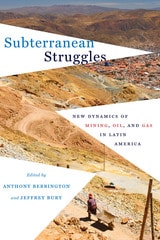
Subterranean Struggles
New Dynamics of Mining, Oil, and Gas in Latin AmericaEdited by Anthony Bebbington and Jeffrey Bury
University of Texas Press, 2013