Results by title
73 books match the query 'Modern (late 19th Century to 1945)' and 2 start with s
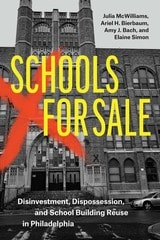
Schools for Sale
Disinvestment, Dispossession, and School Building Reuse in PhiladelphiaJulia McWilliams, Ariel H. Bierbaum, Amy J. Bach and Elaine Simon
University of Chicago Press, 2026
A surprising look at what happens to the actual school buildings in the wake of school closures.
School districts across the United States have closed thousands of schools since 2000 to cope with chronic underfunding and budget crises, declining enrollment, and poorly maintained buildings. Our knowledge about school closures has focused on battles over closure decision-making and the impacts of closing schools on communities of color in the immediate aftermath of these decisions. But what of the large, sometimes magisterial, formerly public spaces once at the center of community life? How do these now vacant buildings change daily life in the surrounding neighborhood?
In Schools for Sale, Julia McWilliams, Ariel H. Bierbaum, Amy J. Bach, and Elaine Simon examine how school closures change the spatial and social arrangements of neighborhoods. Following a series of school closures in Philadelphia, the authors draw from research in urban studies, education, planning, and geography to explain how race, place, and capital merge to influence the trajectory of closed schools in Black and Brown communities and their surrounding neighborhoods. Some closed schools are repurposed as charter schools, upending the role those buildings have historically played in bringing communities together. Other buildings are sold for commercial development, caught up in cycles of gentrification even as developers foster programs to support community members. Others are left vacant or are demolished in the heart of their neighborhoods, decisions that reflect not only disinvestment in Black communities but the sobering reality of environmental racism.
Drawing needed attention to one of the significant consequences of school closures, Schools for Sale imparts a deeper understanding of the connections between place, race, and education amid broader urban transformations, prompting us to consider how school districts can work toward a new vision for public education and community development.
[more]
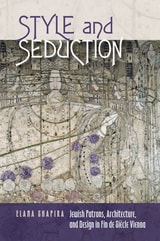
Style and Seduction
Jewish Patrons, Architecture, and Design in Fin de Siècle ViennaElana Shapira
Brandeis University Press, 2016
A recent surge of interest in Jewish patronage during the golden years of Vienna has led to the question, Would modernism in Vienna have developed in the same fashion had Jewish patrons not been involved? This book uniquely treats Jewish identification within Viennese modernism as a matter of Jews active fashioning of a new language to convey their aims of emancipation along with their claims of cultural authority. In this provocative reexamination of the roots of Viennese modernism, Elana Shapira analyzes the central role of Jewish businessmen, professionals, and writers in the evolution of the city’s architecture and design from the 1860s to the 1910s. According to Shapira, these patrons negotiated their relationship with their non-Jewish surroundings and clarified their position within Viennese society by inscribing Jewish elements into the buildings, interiors, furniture, and design objects that they financed, produced, and co-designed. In the first book to investigate the cultural contributions of the banker Eduard Todesco, the steel tycoon Karl Wittgenstein, the textile industrialist Fritz Waerndorfer, the author Peter Altenberg, the tailor Leopold Goldman, and many others, Shapira reconsiders theories identifying the crisis of Jewish assimilation as a primary creative stimulus for the Jewish contribution to Viennese modernism. Instead, she argues that creative tensions between Jews and non-Jews—patrons and designers who cooperated and arranged well-choreographed social encounters with one another—offer more convincing explanations for the formation of a new semantics of modern Viennese architecture and design than do theories based on assimilation. This thoroughly researched and richly illustrated book will interest scholars and students of Jewish studies, Vienna and Viennese culture, and modernism.
[more]