Results by title
99 books match the query 'Muslims' and 3 start with s

States of Grace
Senegalese in Italy and the New European ImmigrationDonald Martin Carter
University of Minnesota Press, 1997
States of Grace was first published in 1997. Minnesota Archive Editions uses digital technology to make long-unavailable books once again accessible, and are published unaltered from the original University of Minnesota Press editions.
Leaving their depleted fields for better prospects, Senegalese immigrants have made their way to Italy in significant numbers. What this migration means, in the context of both the migratory traditions and conditions of Africa and the history and future of the European nation-state, is the subject of this timely and ambitious book.
Focusing on Turin, the northern Italian point of entry for so many Senegalese, States of Grace chronicles the arrival and formation of a transnational African Islamic community in a largely Catholic Western European country, one that did not have immigrant legislation until 1991. With no colonial relation to Italy, the Senegalese represent the vanguard of population movements expanding outside of the arch of former colonial powers.
Donald Martin Carter locates the Senegalese migration in the context of past African internal and international migration and of present crises in West African agriculture. He also shows how the Senegalese migration, constituting a "phenomenon" and catalyzing new immigration restrictions among European states, calls into question the European interstate system, the future of the nation-state, and the nature of its relationship with non-European states.
Throughout Europe, protectionist immigration policies are often crafted in chauvinist and racist tones in which "migrants" is a euphemism for blacks, Arabs, and Asians. States of Grace uses Senegalese migration to demonstrate that racial conceptions are crucial to understanding the classifications of non-national "outside" and internal "other." The book is a bracing encounter with the ever-increasing cultural and ethnic heterogeneity that is the new and pressing reality of European society.
Donald Martin Carter is visiting assistant professor of anthropology at Johns Hopkins University.
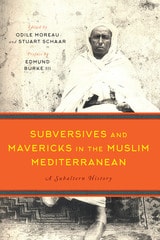
Subversives and Mavericks in the Muslim Mediterranean
A Subaltern HistoryEdited by Odile Moreau and Stuart Schaar; preface by Edmund Burke III
University of Texas Press, 2016
Subaltern studies, the study of non-elite or underrepresented people, have revolutionized the writing of Middle Eastern history. Subversives and Mavericks in the Muslim Mediterranean represents the next step in this transformation. The book explores the lives of eleven nonconformists who became agents of political and social change, actively organizing new forms of resistance—against either colonial European regimes or the traditional societies in which they lived—that disrupted the status quo, in some cases, with dramatic results. These case studies highlight cross-border connections in the Mediterranean world, exploring how these channels were navigated.
Chapters in the book examine the lives of subversives and mavericks, such as Tawhida ben Shaykh, the first Arab woman to receive a medical degree; Mokhtar al-Ayari, a radical Tunisian labor leader; Nazli Hanem, Kmar Bayya, and Khiriya bin Ayyad, three aristocractic women who resisted the patriarchal structures of their societies by organizing and participating in intellectual salons for men and women and advocating social reform; Qaid Najim al-Akhsassi, an ex-slave and military officer, who fought against French and Spanish colonial expansion; and Boubeker al-Ghandjawi, a nearly illiterate trader who succeeded, though his diverse connections, in establishing important relations between the Moroccan sultan and the representative of the British government. Although based on individual and local perspectives, Subversives and Mavericks in the Muslim Mediterranean reveals new and unrecognized trans-local connections across the Muslim world, illuminating our understanding of these societies beyond narrow elite circles.
Suspect Communities
Anti-Muslim Racism and the Domestic War on TerrorNicole Nguyen
University of Minnesota Press, 2019
The first major qualitative study of “countering violent extremism” in key U.S. cities
Suspect Communities is a powerful reassessment of the U.S. government’s “countering violent extremism” (CVE) program that has arisen in major cities across the United States since 2011. Drawing on an interpretive qualitative study, it examines how the concept behind CVEaimed at combating homegrown terrorism by engaging Muslim community members, teachers, and religious leaders in monitoring and reporting on young peoplehas been operationalized through the everyday work of CVE actors, from high-level national security workers to local community members, with significant penalties for the communities themselves.
Nicole Nguyen argues that studying CVE provides insight into how the drive to bring liberal reforms to contemporary security regimes through “community-driven” and “ideologically ecumenical” programming has in fact further institutionalized anti-Muslim racism in the United States. She forcefully contends that the U.S. security state has designed CVE to legitimize and shore up support for the very institutions that historically have criminalized, demonized, and dehumanized communities of color, while appearing to learn from and attenuate past practices of coercive policing, racial profiling, and political exclusion.
By undertaking this analysis, Suspect Communities offers a vital window into the inner workings of the U.S. security state and the devastating impact of CVE on local communities.