Results by title
78 books match the query 'National security' and 10 start with s

Saving the Security State
Exceptional Citizens in Twenty-First-Century AmericaInderpal Grewal
Duke University Press, 2017

Secret Service
National Security in an Age of Open InformationJonathan Evans
Haus Publishing, 2020

Securing the Sacred
Religion, National Security, and the Western StateRobert M. Bosco
University of Michigan Press, 2014
Despite significant theoretical distinctions between securitization on the domestic and the international levels, he finds that the outcome of addressing religion within the context of security hinges upon partnerships. Whereas states may harness the power of international allies, they cannot often find analogous domestic allies; therefore, states that attempt to securitize religion at home are more vulnerable to counterattack and more likely to abandon their efforts. Securing the Sacred makes a significant contribution to the fields of political theory, international relations, Islamic studies, and security/military studies.

Security Integration in Europe
How Knowledge-based Networks Are Transforming the European UnionMai'a K. Davis Cross
University of Michigan Press, 2013
The European Union has made remarkable, unprecedented advances in both external and internal security integration. "Epistemic communities" of ambassadors, military generals, scientists, and other experts who supersede national governments in the diplomacy of security decision making are taking advantage of their shared expertise, common culture, professional norms, and frequent meetings to forge new levels of collaboration. Mai'a K. Davis Cross brings together numerous personal interviews and recent government documents across five separate case studies to construct a microsociological account of how EU governance really works and what future role the EU is likely to play internationally.

Security V. Liberty
Conflicts Between National Security and Civil Liberties in American HistoryDaniel Farber
Russell Sage Foundation, 2008
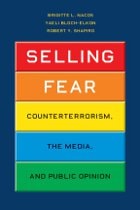
Selling Fear
Counterterrorism, the Media, and Public OpinionBrigitte L. Nacos, Yaeli Bloch-Elkon, Robert Y. Shapiro
University of Chicago Press, 2011
While we’ve long known that the strategies of terrorism rely heavily on media coverage of attacks, Selling Fear is the first detailed look at the role played by media in counterterrorism—and the ways that, in the wake of 9/11, the Bush administration manipulated coverage to maintain a climate of fear.
Drawing on in-depth analysis of counterterrorism in the years after 9/11—including the issuance of terror alerts and the decision to invade Iraq—the authors present a compelling case that the Bush administration hyped fear, while obscuring civil liberties abuses and concrete issues of preparedness. The media, meanwhile, largely abdicated its watchdog role, choosing to amplify the administration’s message while downplaying issues that might have called the administration’s statements and strategies into question. The book extends through Hurricane Katrina, and the more skeptical coverage that followed, then the first year of the Obama administration, when an increasingly partisan political environment presented the media, and the public, with new problems of reporting and interpretation.
Selling Fear is a hard-hitting analysis of the intertwined failures of government and media—and their costs to our nation.
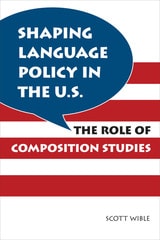
Shaping Language Policy in the U.S.
The Role of Composition StudiesScott Wible
Southern Illinois University Press, 2013
In Shaping Language Policy in the U.S.: The Role of Composition Studies, author Scott Wible explores the significance and application of two of the Conference on College Composition and Communication’s key language policy statements: the 1974 Students’ Right to Their Own Language resolution and the 1988 National Language Policy. Wible draws from a wealth of previously unavailable archived material and professional literature to offer for the first time a comprehensive examination of these policies and their legacies that continue to shape the worlds of rhetoric, politics, and composition.
Wible demonstrates the continued relevance of the CCCC’s policies, particularly their role in influencing the recent, post-9/11 emergence of a national security language policy. He discusses in depth the role the CCCC’s language policy statements can play in shaping the U.S. government’s growing awareness of the importance of foreign language education, and he offers practical discussions of the policies’ pedagogical, professional, and political implications for rhetoric and composition scholars who engage contemporary debates about the politics of linguistic diversity and language arts education in the United States. Shaping Language Policy in the U.S. reveals the numerous ways in which the CCCC language policies have usefully informed educators’ professional practices and public service and investigates how these policies can continue to guide scholars and teachers in the future.
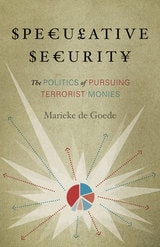
Speculative Security
The Politics of Pursuing Terrorist MoniesMarieke de Goede
University of Minnesota Press, 2012
Since the terrorist acts of September 11, 2001, finance and security have become joined in new ways to produce particular targets of state surveillance. In Speculative Security, Marieke de Goede describes how previously unscrutinized practices such as donations and remittances, especially across national borders, have been affected by security measures that include datamining, asset freezing, and transnational regulation. These “precrime” measures focus on transactions that are perfectly legal but are thought to hold a specific potential to support terrorism. The pursuit of suspect monies is not simply an issue of financial regulation, she shows, but a broad political, social, and even cultural phenomenon with profound effects on everyday life.
Speculative Security offers a range of examples that illustrate the types of security interventions employed today, including the extralegal targeting and breaking up of the al-Barakaat financial network that was accompanied by raids in the United States, asset freezes in Sweden, and the incarceration of a money remitter at Guantánamo Bay. De Goede develops the paradigm of “speculative security” as a way to understand the new fusing of finance and security, denoting the speculative nature of both the means and the ends of the war on terrorist financing.
Ultimately, de Goede reveals how the idea of creating “security” appeals to multiple imaginable—and unimaginable—futures in order to enable action in the present.

Spirits of the Cold War
Contesting Worldviews in the Classical Age of American Security StrategyNed O'Gorman
Michigan State University Press, 2012
In spring of 1953, newly elected President Eisenhower sat down with his staff to discuss the state of American strategy in the cold war. America, he insisted, needed a new approach to an urgent situation. From this meeting emerged Eisenhower’s teams of “bright young fellows,” charged with developing competing policies, each of which would come to shape global politics. In Spirits of the Cold War, Ned O’Gorman argues that the early Cold War was a crucible not only for contesting political strategies, but also for competing conceptions of America and its place in the world. Drawing on extensive archival research and wide reading in intellectual and rhetorical histories, this comprehensive account shows cold warriors debating “worldviews” in addition to more strictly instrumental tactical aims. Spirits of the Cold War is a rigorous scholarly account of the strategic debate of the early Cold War—a cultural diagnostic of American security discourse and an examination of its origins.

Surveillance in the Time of Insecurity
Monahan, Torin
Rutgers University Press, 2010
Surveillance in the Time of Insecurity fuses advanced theoretical accounts of state power and neoliberalism with original research from the social settings in which insecurity dynamics play out in the new century. Torin Monahan explores the counterterrorism-themed show 24, Rapture fiction, traffic control centers, security conferences, public housing, and gated communities, and examines how each manifests complex relationships of inequality, insecurity, and surveillance. Alleviating insecurity requires that we confront its mythic dimensions, the politics inherent in new configurations of security provision, and the structural obstacles to achieving equality in societies.