163 books match the query 'Nationalism & Patriotism' and 8 start with s

cover of Sabra and Shatila: September 1982

Sabra and Shatila

September 1982

Bayan Nuwayhed Al-Hout

Pluto Press, 2004

The book covers the history of the Sabra and Shatila massacre, which took place over three bloody days in the Lebanese capital Beirut. It was committed against Palestinian refugees by Lebanese militias, aided and supervised by the Israeli Army, which had encircled the district.

Now available for the first time in English, this classic book is the most comprehensive, authoritative account of what happened and who was responsible. The author, Bayan Nuwayhed al-Hout, was a Professor at the Lebanese University at the time. Driven by the horror of what occurred, she interviewed survivors and set up an oral history project immediately after the massacre to preserve testimonies. This book is the result.

Following a general introduction, the first part contains interviews mainly with victims' families. The second part analyses statistical data and attempts to determine the number of victims. The conclusion, 'Who Was Responsible?', sheds light on the various parties responsible.

Over five-hundred pages long, illustrated with photographs and maps, unrivalled in detail and scope, this book is a courageous attempt to make sense of what happened and an important political document in its own right.

[more]
cover of Searching for Home Abroad: Japanese Brazilians and Transnationalism

Searching for Home Abroad

Japanese Brazilians and Transnationalism

Jeffrey Lesser, ed.

Duke University Press, 2003

During the first half of the twentieth century, Japanese immigrants entered Brazil by the tens of thousands. In more recent decades that flow has been reversed: more than 200,000 Japanese-Brazilians and their families have relocated to Japan. Examining these significant but rarely studied transnational movements and the experiences of Japanese-Brazilians, the essays in Searching for Home Abroad rethink complex issues of ethnicity and national identity. The contributors—who represent a number of nationalities and disciplines themselves—analyze how the original Japanese immigrants, their descendants in Brazil, and the Japanese-Brazilians in Japan sought to fit into the culture of each country while confronting both prejudice and discrimination.

The concepts of home and diaspora are engaged and debated throughout the volume. Drawing on numerous sources—oral histories, interviews, private papers, films, myths, and music—the contributors highlight the role ethnic minorities have played in constructing Brazilian and Japanese national identities. The essayists consider the economic and emotional motivations for migration as well as a range of fascinating cultural outgrowths such as Japanese secret societies in Brazil. They explore intriguing paradoxes, including the feeling among many Japanese-Brazilians who have migrated to Japan that they are more "Brazilian" there than they were in Brazil. Searching for Home Abroad will be of great interest to scholars of immigration and ethnicity in the Americas and Asia.

Contributors. Shuhei Hosokawa, Angelo Ishi, Jeffrey Lesser, Daniel T. Linger, Koichi Mori, Joshua Hotaka Roth, Takeyuki (Gaku) Tsuda, Keiko Yamanaka, Karen Tei Yamashita

[more]
cover of Serbian Orthodox Fundamentals: The Quest for an Eternal Identity

Serbian Orthodox Fundamentals

The Quest for an Eternal Identity

Christos Mylonas

Central European University Press, 2003

This book is a comprehensive exposition of the interaction of a national (the Serbian people) and a religiou (the Orthodox Christian faith) content, in the formation of a distinctive national identity and a mode of being. Its interdisciplinary approach, drawing on sociology, social anthropology, theology, political theory, Balkan historiography, and Serbian folklore, is deployed to provide a powerful and original analysis of how Serbian Orthodoxy has resulted in the sacralisation of the Serbian nation by framing the parameters of its existence. Addresses the following questions: what 'makes' a Serb? Are meaningful assumptions possible by introducing Serbian Orthodoxy as the primal point of reference? Why does religion appear to have an especially strong appeal?
[more]
cover of Spectres of Fascism: Historical, Theoretical and International Perspectives

Spectres of Fascism

Historical, Theoretical and International Perspectives

Samir Gandesha

Pluto Press, 2020

Concerns over the rise of fascism have been preoccupied with the Trump presidency and the Brexit vote in the UK, yet, globally, we are witnessing a turn towards anti-democratic and illiberal forces. From the tragic denouement of the Egyptian Revolution to the consolidation of the so-called Gujarat Model in India under the leadership of Prime Minister Narendra Modi and the consolidation of the power of Turkish President Recep Tayyip Erdogan, to the recent election of Jair Bolsonaro in Brazil, fascist ideology, aesthetics and fascist personalities appear across the globe. Spectres of Fascism makes a significant contribution to the unfolding discussion on whether what we are witnessing today is best understood as a return to classic twentieth-century ‘fascism,’ or some species of what has been called ‘post-fascism.’ Applying a uniquely global perspective, it combines analyses of historical contexts, theoretical approaches and contemporary geopolitics.
[more]
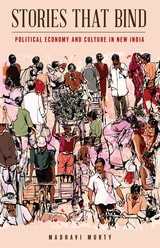
cover of Stories That Bind: Political Economy and Culture in New India

Stories That Bind

Political Economy and Culture in New India

Madhavi Murty

Rutgers University Press, 2022

Stories that Bind: Political Economy and Culture in New India examines the assertion of authoritarian nationalism and neoliberalism; both backed by the authority of the state and argues that contemporary India should be understood as the intersection of the two. More importantly, the book reveals, through its focus on India and its complex media landscape that this intersection has a narrative form, which author, Madhavi Murty labels spectacular realism. The book shows that the intersection of neoliberalism with authoritarian nationalism is strengthened by the circulation of stories about “emergence,” “renewal,” “development,” and “mobility” of the nation and its people. It studies stories told through film, journalism, and popular non-fiction along with the stories narrated by political and corporate leaders to argue that Hindu nationalism and neoliberalism are conjoined in popular culture and that consent for this political economic project is crucially won in the domain of popular culture.

Moving between mediascapes to create an archive of popular culture, Murty advances our understanding of political economy through material that is often seen as inconsequential, namely the popular cultural story. These stories stoke our desires (e.g. for wealth), scaffold our instincts (e.g. for a strong leadership) and shape our values.

 
[more]
cover of Strangers in the Land: Patterns of American Nativism, 1860-1925

Strangers in the Land

Patterns of American Nativism, 1860-1925

Higham, John

Rutgers University Press, 1988

Nativism has been hard for historians to define. The word is distinctively American, a product of a specific chain of events in eastern American cities in the late 1830's and early 1840's. Yet it has a meaning so broad and indefinite that sometimes it seems to refer to a perennial human experience. Does nativism consist only of a particular complex of attitudes dominant in the anti-foreign crusade of the mid-nineteenth century? Or does it extend to every occasion when native inhabitants of a country turn their faces or raise their hands against strangers in their midst? What is nativism?
[more]
cover of Struggle over Identity: The Official and the Alternative "Belarusianness"

Struggle over Identity

The Official and the Alternative "Belarusianness"

Nelly Bekus

Central European University Press, 2010

Rejecting the cliché about “weak identity and underdeveloped nationalism,” Bekus argues for the co-existence of two parallel concepts of Belarusianness—the official and the alternative one—which mirrors the current state of the Belarusian people more accurately and allows for a different interpretation of the interconnection between the democratization and nationalization of Belarusian society.

The book describes how the ethno-symbolic nation of the Belarusian nationalists, based on the cultural capital of the Golden Age of the Belarusian past (17th century) competes with the “nation” institutionalized and reified by the numerous civic rituals and social practices under the auspices of the actual Belarusian state.

Comparing the two concepts not only provides understanding of the logic that dominates Belarusian society’s self-description models, but also enables us to evaluate the chances of alternative Belarusianness to win this unequal struggle over identity. 

[more]
cover of Surplus Citizens: Struggle and Nationalism in the Greek Crisis

Surplus Citizens

Struggle and Nationalism in the Greek Crisis

Dimitra Kotouza

Pluto Press, 2018

The crisis in Greece has elicited the full spectrum of responses - from optimism for a left parliamentary politics inspired by Syriza's electoral victory, to pessimism about the intransigence of the EU and calls for the reinstatement of full national sovereignty in Europe. In Surplus Citizens, Dimitra Kotouza questions the terms of the debate by demonstrating how the national framing of social contestation posed obstacles to transformative collective action, but also how this framing has been challenged. Analysing the increasing superfluousness of subordinate classes in Greece as part of a global phenomenon with racialised and gendered dimensions, the book interrogates the strengths, contradictions and limits of collective action and identity in the crisis, from the movement of the squares and neighbourhood assemblies, to new forms of labour activism, environmental struggles, immigrant protests, anti-fascism and pro-refugee activism. Arguing against the strategic fixation on unified identities and pointing instead to the transformative potential of internal dispute within movements, Surplus Citizens highlights the relevance of a discussion of Greece to collective action beyond it, as we continue to traverse a global financial crisis that has provoked conflicts over nationalism, immigration and the rise of neo-fascism.
[more]