Results by title
72 books match the query 'Nature conservation' and 6 start with s
Safari Nation
A Social History of the Kruger National ParkJacob S. T. Dlamini
Ohio University Press, 2020
Saving the Big Sky
A Chronicle of Land Conservation in MontanaBruce A. Bugbee
Oregon State University Press, 2025
Winner of the 2026 Western Writers of America Spur Award for Best Western Contemporary Nonfiction
Winner of the 2025 Nature and the Environment National Outdoor Book Award
“The essential purpose of Saving the Big Sky is to inspire the reader to help conserve even more of Montana,” write Bruce Bugbee, Robert Kiesling, and John Wright in this compelling study of how six million acres of biodiverse land were conserved in Montana over the past fifty years. Indigenous and non-Indigenous knowledge about land stewardship has evolved and since the 1970s tribes, nonprofit organizations, land trusts, and government agencies have conserved land in many creative ways. Beautifully illustrated with more than ninety color photographs and thirty detailed maps, Saving the Big Sky showcases land conservation achievements across eight regions of the state: the Rocky Mountain Front, the Blackfoot Valley, the Greater Yellowstone, the Missoula Region, the Helena Region, Northwest Montana, the Flathead Indian Reservation, and the American Prairie.
Land protection is shown to work best when large, intact, connected landscapes can be conserved, rather than small, fragmented, isolated parcels. Conservationists have found that landowners in Montana more widely accept conservation easements and other voluntary, financially compensating tools that respect private property rights. The brilliant images and striking before-and-after maps featured here celebrate the ranches, farms, wildlife habitats, and scenic open spaces that are forever safeguarded.
In documenting conservation accomplishments and suggesting what more can be done, Saving the Big Sky invites readers to participate in conserving Montana—or whatever cherished landscape they call home.
Science, Conservation, and National Parks
Edited by Steven R. Beissinger, David D. Ackerly, Holly Doremus, and Gary E. Machlis
University of Chicago Press, 2016
Examining the major challenges of parks and protected areas throughout the world, contributors provide answers to a number of key conservation questions, such as: How should stewardship address climate change, urban encroachment and pollution, and invasive species? How can society, especially youth, become more engaged with nature and parks, and are there models to guide interactions between parks and their neighbors? What are appropriate conservation objectives for parks in the Anthropocene? Charting a course for the parks of the next century, Science, Conservation, and National Parks is certain not only to catalyze the continued evolution of US park conservation policy, but also to be an inspiration for parks, conservation, and management worldwide.
Serengeti III
Human Impacts on Ecosystem DynamicsEdited by A. R. E. Sinclair, Craig Packer, Simon A. R. Mduma, and John M. Fryxel
University of Chicago Press, 2008
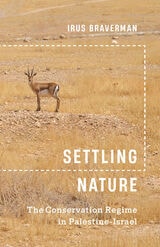
Settling Nature
The Conservation Regime in Palestine-IsraelIrus Braverman
University of Minnesota Press, 2023
A study of Palestine-Israel through the unexpected lens of nature conservation
Settling Nature documents the widespread ecological warfare practiced by the state of Israel. Recruited to the front lines are fallow deer, gazelles, wild asses, griffon vultures, pine trees, and cows—on the Israeli side—against goats, camels, olive trees, hybrid goldfinches, and akkoub—which are affiliated with the Palestinian side. These nonhuman soldiers are all the more effective because nature camouflages their tactical deployment as such.
Drawing on more than seventy interviews with Israel’s nature officials and on observations of their work, this book examines the careful orchestration of this animated warfare by Israel’s nature administration on both sides of the Green Line. Alongside its powerful protection of wildlife biodiversity, the territorial reach of Israel’s nature protection is remarkable: to date, nearly 25 percent of the country’s total land mass is assigned as a park or a reserve. Settling Nature argues that the administration of nature advances the Zionist project of Jewish settlement and the corresponding dispossession of non-Jews from this space.
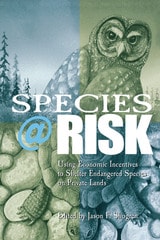
Species at Risk
Using Economic Incentives to Shelter Endangered Species on Private LandsEdited by Jason F. Shogren
University of Texas Press, 2005
Protecting endangered species of animals and plants is a goal that almost everyone supports in principle—but in practice private landowners have often opposed the regulations of the Endangered Species Act, which, they argue, unfairly limits their right to profit from their property. To encourage private landowners to cooperate voluntarily in species conservation and to mitigate the economic burden of doing so, the government and nonprofit land trusts have created a number of incentive programs, including conservation easements, leases, habitat banking, habitat conservation planning, safe harbors, candidate conservation agreements, and the "no surprise" policy.
In this book, lawyers, economists, political scientists, historians, and zoologists come together to assess the challenges and opportunities for using economic incentives as compensation for protecting species at risk on private property. They examine current programs to see how well they are working and also offer ideas for how these programs could be more successful. Their ultimate goal is to better understand how economic incentive schemes can be made both more cost-effective and more socially acceptable, while respecting a wide range of views regarding opportunity costs, legal standing, biological effectiveness, moral appropriateness, and social context.