Results by title
97 books match the query 'Naval' and 5 start with s
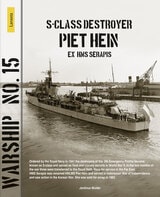
S-class destroyer Piet Hein (ex HMS Serapis)
Jantinus Mulder
Amsterdam University Press, 2024

SS Australis
Bert Lamers
Amsterdam University Press, 2024
ss 'America' for the United States Lines. The ship was sold to the Greek Chandris Lines in 1964 and served until 1977 very succesfully on the route Western-Europe-Australia-New Zealand. Later the route became a full round-the-world-service. After her Australian period the liner sailed under the names of 'America' (for the third time), 'Italis', 'Noga', 'Alferdoss' and finally 'American Star'. In this volume of Liners the history of the great liner from when she was purchased by the Greek interest in 1964 until her sad wracking in January 1994.
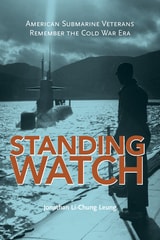
Standing Watch
American Submarine Veterans Remember the Cold War EraJonathan Li-Chung Leung
University of Alabama Press, 2019
Featuring interviews from seventeen veteran submariners, Standing Watch: American Submarine Veterans Remember the Cold War Era offers the perspective of the submariners themselves—lending them a voice and paying homage to their service. Jonathan Li-Chung Leung provides an original glimpse into a world of unique challenges and characters, a life isolated and submerged, and a duty defined by the juxtaposition of monotonous routine and unparalleled excitement.
These personal accounts of life below the surface offer readers a front-row seat to close encounters with Soviet submarines and the naval blockade during the Cuban Missile Crisis, as well as an intimate understanding of daily life onboard the vessels, the culture of military discipline, and the religious-like fervor exercised in honoring traditions big and small. By applying first-hand perspectives to a larger thematic overview, this book uses authentic narratives to deliver a lively and colorful picture of the Silent Service.
Set against the backdrop of sobering geo-political disputes and their own role as the nation’s defenders against a seemingly ambiguous super-enemy, these veterans focus on their responsibilities and reflect on careers built on the simple axioms of pride and service. This invigorating and unalloyed account is an unprecedented addition to the existing literature on naval and military history.
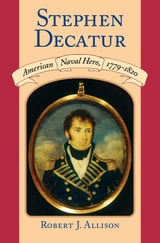
Stephen Decatur
American Naval Hero, 1779-1820Robert J. Allison
University of Massachusetts Press, 2005
Born to a prominent Philadelphia family in 1779, Stephen Decatur at age twenty-five became the youngest man ever to serve as a captain in the U.S. Navy. His intrepid heroism, leadership, and devotion to duty made him a perfect symbol of the aspirations of the growing nation. Leading men to victory in Tripoli, the War of 1812, and the Algerian war of 1815, and coining the phrase “Our country, right or wrong,” Decatur created an enduring legend of bravery, celebrated in poetry, song, paintings, and the naming of dozens of towns—from Georgia to Alabama to Illinois.
After the War of 1812, Decatur moved to Washington to help direct naval policy. His close friendships with James Madison, John Quincy Adams, and other political leaders soon made him a rising star in national politics. He and his wife Susan made their elegant home on Lafayette Square near the White House a center of Washington society. The capital and the entire nation were shocked in 1820 when Decatur died at the age of forty-one in a duel with a rival navy captain.
In this carefully researched and well-written biography, historian Robert Allison tells the story of Decatur's eventful life at a time when the young republic was developing its own identity—when the American people were deciding what kind of nation they would become. Although he died prematurely, Decatur played a significant role in the shaping of that national identity.

Struggle for the Gulf Borderlands
The Creek War and the Battle of New Orleans, 1812-1815Frank L. Owsley
University of Alabama Press, 2000
Using American, British, and Spanish documents, many previously unknown, Frank Owsley’s study establishes the Creek War and the struggle to control the Gulf borderlands as integral parts of the War of 1812. The war between the United States and a large part of the Creek nation is usually studied as local or regional history. These documentary sources, however, show the larger picture. They show Spain to have been a major influence in the Creek War and indicate the extent to which the British were aiding the Indians and using them to redirect American troops. On the other hand, Andrew Jackson, in charge of the American forces on the Gulf Coast, emerged from the conflict as a first-rate military commander. His victories on the Gulf gave the West a leader and aided in shifting political power from the eastern seaboard to the South and West.
Owsley concludes that the victories in the Gulf region were of sufficient magnitude to justify the claim that the War of 1812 was not a draw but a decisive American victory and that had there been a general of Jackson's caliber on the northern frontier, the United States might have had a clear-cut victory there.
As a result of the war, the United States held its claim on Louisiana, annexed the Mobile district, forced Spain out of Florida, and broke the power of the southern Indians, thus opening vast lands for settlement from the new nation on the eastern seaboard.