121 books match the query 'Neoliberalism' and 8 start with s

cover of Saving the Security State: Exceptional Citizens in Twenty-First-Century America

Saving the Security State

Exceptional Citizens in Twenty-First-Century America

Inderpal Grewal

Duke University Press, 2017
In Saving the Security State Inderpal Grewal traces the changing relations between the US state and its citizens in an era she calls advanced neoliberalism. Marked by the decline of US geopolitical power, endless war, and increasing surveillance, advanced neoliberalism militarizes everyday life while producing the “exceptional citizens”—primarily white Christian men who reinforce the security state as they claim responsibility for protecting the country from racialized others. Under advanced neoliberalism, Grewal shows, others in the United States strive to become exceptional by participating in humanitarian projects that compensate for the security state's inability to provide for the welfare of its citizens. In her analyses of microfinance programs in the global South, security moms, the murders at a Sikh temple in Wisconsin, and the post-9/11 crackdown on Muslim charities, Grewal exposes the fissures and contradictions at the heart of the US neoliberal empire and the centrality of race, gender, and religion to the securitized state.
[more]
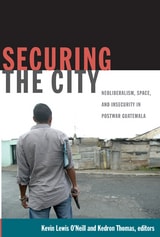
cover of Securing the City: Neoliberalism, Space, and Insecurity in Postwar Guatemala

Securing the City

Neoliberalism, Space, and Insecurity in Postwar Guatemala

Kevin Lewis O Neill and Kedron Thomas, eds.

Duke University Press, 2011

Unprecedented crime rates have made Guatemala City one of the most dangerous cities in the world. Following a peace process that ended Central America’s longest and bloodiest civil war and impelled the transition from a state-centric economy to the global free market, Guatemala’s neoliberal moment is now strikingly evident in the practices and politics of security. Postwar violence has not prompted public debates about the conditions that permit transnational gangs, drug cartels, and organized crime to thrive. Instead, the dominant reaction to crime has been the cultural promulgation of fear and the privatization of what would otherwise be the state’s responsibility to secure the city. This collection of essays, the first comparative study of urban Guatemala, explores these neoliberal efforts at security. Contributing to the anthropology of space and urban studies, this book brings together anthropologists and historians to examine how postwar violence and responses to it are reconfiguring urban space, transforming the relationship between city and country, and exacerbating deeply rooted structures of inequality and ethnic discrimination.

Contributors. Peter Benson, Manuela Camus, Avery Dickins de Girón, Edward F. Fischer, Deborah Levenson, Thomas Offit, Kevin Lewis O’Neill, Kedron Thomas, Rodrigo José Véliz
[more]
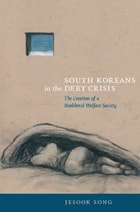
cover of South Koreans in the Debt Crisis: The Creation of a Neoliberal Welfare Society

South Koreans in the Debt Crisis

The Creation of a Neoliberal Welfare Society

Jesook Song

Duke University Press, 2009

South Koreans in the Debt Crisis is a detailed examination of the logic underlying the neoliberal welfare state that South Korea created in response to the devastating Asian Debt Crisis (1997–2001). Jesook Song argues that while the government proclaimed that it would guarantee all South Koreans a minimum standard of living, it prioritized assisting those citizens perceived as embodying the neoliberal ideals of employability, flexibility, and self-sufficiency. Song demonstrates that the government was not alone in drawing distinctions between the “deserving” and the “undeserving” poor. Progressive intellectuals, activists, and organizations also participated in the neoliberal reform project. Song traces the circulation of neoliberal concepts throughout South Korean society, among government officials, the media, intellectuals, NGO members, and educated underemployed people working in public works programs. She analyzes the embrace of partnerships between NGOs and the government, the frequent invocation of a pervasive decline in family values, the resurrection of conservative gender norms and practices, and the promotion of entrepreneurship as the key to survival.

Drawing on her experience during the crisis as an employee in a public works program in Seoul, Song provides an ethnographic assessment of the efforts of the state and civilians to regulate social insecurity, instability, and inequality through assistance programs. She focuses specifically on efforts to help two populations deemed worthy of state subsidies: the “IMF homeless,” people temporarily homeless but considered employable, and the “new intellectuals,” young adults who had become professionally redundant during the crisis but had the high-tech skills necessary to lead a transformed post-crisis South Korea.
[more]
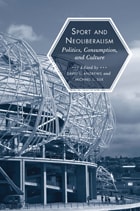
cover of Sport and Neoliberalism: Politics, Consumption, and Culture

Sport and Neoliberalism

Politics, Consumption, and Culture

David L. Andrews

Temple University Press, 2012

Offering new approaches to thinking about sports and political ideologies, Sport and Neoliberalism explores the structures, formations, and mechanics of neoliberalism. The editors and contributors to this original and timely volume examine the intersection of sport as a national pastime and also an engine for urban policy—e.g., stadium building—as well as a powerful force for influencing our understanding of the relationship between culture, politics, and identity.

Sport and Neoliberalism examines the ways the neoliberal project creates priorities for civic society and how, in effect, it turns many aspects of sport into a vehicle of public governance. From the relationship between sport and the neo-liberal state, through the environmental dimensions of neo-liberal sport, to the political biopolitics of obesity, the essays in this volume explore the ways in which the “logics” of neoliberalism are manifest as powerful public pedagogies through the realm of popular culture.

Contributors include: Michael Atkinson, Ted Butryn, C. L. Cole, Norman Denzin, Grant Farred, Jessica Francombe, Caroline Fusco, Michael D. Giardina, Mick Green, Leslie Heywood, Samantha King, Lisa McDermott, Mary G. McDonald, Toby Miller, Mark Montgomery, Joshua I. Newman, Jay Scherer, Kimberly S. Schimmel, and Brian Wilson

In the series Sporting, edited by Amy Bass
[more]
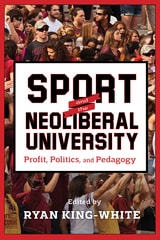
cover of Sport and the Neoliberal University: Profit, Politics, and Pedagogy

Sport and the Neoliberal University

Profit, Politics, and Pedagogy

King-White, Ryan

Rutgers University Press, 2018

College students are now regarded as consumers, not students, and nowhere is the growth and exploitation of the university more obvious than in the realm of college sports, where the evidence is in the stadiums built with corporate money, and the crowded sporting events sponsored by large conglomerates. 

The contributors to Sport and the Neoliberal University examine how intercollegiate athletics became a contested terrain of public/private interests. They look at college sports from economic, social, legal, and cultural perspectives to cut through popular mythologies regarding intercollegiate athletics and to advocate for increased clarity about what is going on at a variety of campuses with regard to athletics. Focusing on current issues, including the NCAA, Title IX, recruitment of high school athletes, and the Penn State scandal, among others, Sport and the Neoliberal University shows the different ways institutions, individuals, and corporations are interacting with university athletics in ways that are profoundly shaped by neoliberal ideologies.  

[more]
cover of State Anti-Intellectualism and the Politics of Gender and Race: Illiberal France and Beyond

State Anti-Intellectualism and the Politics of Gender and Race

Illiberal France and Beyond

Éric Fassin

Central European University Press, 2024

Eric Fassin examines the trend of State anti-intellectualism in France using the nation as a case study to demonstrate that this tendency is not limited to ostensibly illiberal regimes. He argues that today’s world requires an examination of this phenomenon beyond Cold War geopolitical divisions and highlights a global shift towards authoritarian neoliberalism. His book is a plea for the political urgency of intellectual work in a global moment of political anti-intellectualism.
The book covers the period from President Sarkozy to Prime Minister Valls and includes both firsthand and public cases of attacks against academics, not only in France, but also in Brazil, Hungary, Russia, Turkey, and the United States, with examples of State racism and the argument of the State against antiracism. The book also considers issues of censorship and cancel culture, concluding with Fassin’s firsthand account of attacks on him from the far-right.
[more]
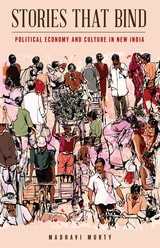
cover of Stories That Bind: Political Economy and Culture in New India

Stories That Bind

Political Economy and Culture in New India

Madhavi Murty

Rutgers University Press, 2022

Stories that Bind: Political Economy and Culture in New India examines the assertion of authoritarian nationalism and neoliberalism; both backed by the authority of the state and argues that contemporary India should be understood as the intersection of the two. More importantly, the book reveals, through its focus on India and its complex media landscape that this intersection has a narrative form, which author, Madhavi Murty labels spectacular realism. The book shows that the intersection of neoliberalism with authoritarian nationalism is strengthened by the circulation of stories about “emergence,” “renewal,” “development,” and “mobility” of the nation and its people. It studies stories told through film, journalism, and popular non-fiction along with the stories narrated by political and corporate leaders to argue that Hindu nationalism and neoliberalism are conjoined in popular culture and that consent for this political economic project is crucially won in the domain of popular culture.

Moving between mediascapes to create an archive of popular culture, Murty advances our understanding of political economy through material that is often seen as inconsequential, namely the popular cultural story. These stories stoke our desires (e.g. for wealth), scaffold our instincts (e.g. for a strong leadership) and shape our values.
 
[more]
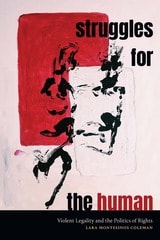
cover of Struggles for the Human: Violent Legality and the Politics of Rights

Struggles for the Human

Violent Legality and the Politics of Rights

Lara Montesinos Coleman

Duke University Press, 2024

In Struggles for the Human, Lara Montesinos Coleman blends ethnography, political philosophy, and critical theory to reorient debates on human rights through attention to understandings of legality, ethics, and humanity in anticapitalist and decolonial struggle. Drawing on her extensive involvement with grassroots social movements in Colombia, Coleman observes that mainstream expressions of human rights have become counterparts to capitalist violence, even as this discourse disavows capitalism’s deadly implications. She rejects claims that human rights are inherently tied to capitalism, liberalism, or colonialism, instead showing how human rights can be used to combat these forces. Coleman demonstrates that social justice struggles that are rooted in marginalized communities’ lived experiences can reframe human rights in order to challenge oppressive power structures and offer a blueprint for constructing alternative political economies. By examining the practice of redefining human rights away from abstract universals and contextualizing them within concrete struggles for justice, Coleman reveals the transformative potential of human rights and invites readers to question and reshape dominant legal and ethical narratives.
[more]