Results by title
126 books match the query 'New England' and 6 start with s
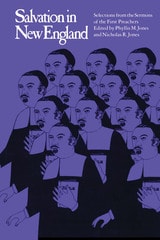
Salvation in New England
Selections from the Sermons of the First PreachersEdited by Phyllis M. Jones and Nicholas R. Jones
University of Texas Press, 1977
The sermon as crafted by the early New England preachers was the most prominent literary form of its day, yet the earliest Puritan texts have as a rule been available only in rare-book collections. This anthology of sermons of the first generation of preachers fills a serious gap in American literature. The preachers collected here, the most widely published of their time, were among the eighty or more who emigrated to Massachusetts Bay during the 1630s. They are John Cotton of Boston, Thomas Shepard of Cambridge, and Thomas Hooker of Hartford, the three foremost "lights of the western churches," and two eminent colleagues, Peter Bulkeley of Concord and John Davenport, first of New Haven and later of Boston.
The selections are chosen to be representative of the lengthy works from which they are drawn, to reflect the major concerns and styles of the preachers' work as a whole, and to demonstrate the genre of the sermon as developed by the early American Puritans. Not only does this anthology represent an important contribution to literary history, but the sermons also illustrate a doctrine uniquely elaborated in this period—a consistent and emphatic narrative, mythlike in its repetition and heroics, of the progress of the soul from a state of nature to a state of salvation. This theme may be seen as a three-stage-development, although individual sermons may vary. These stages—preparation, vocation, and regeneration—determine the order of the selections.
The editors' introductory material supplies a comprehensive and thorough discussion of the early New England sermons, concentrating on their role, history, structure, style, and subject matter. A separate essay on the texts of the sermons describes the relationship between the early printed versions and their form as delivered in the pulpit. The introduction preceding each selection presents original research on the historical circumstances of the preaching and publication of the work from which the sermon is drawn. The editors have also provided brief biographies of the preacfiers represented here, an annotated list of recommended background reading, and the most exhaustive checklist available of authoritative editions of the sermons of these five preachers.
This book will be useful to colonial specialists as well as to students of early American literature, religion, and history. The texts are critically edited for readability, with modernized spelling and annotations of unfamiliar phrases and allusions.
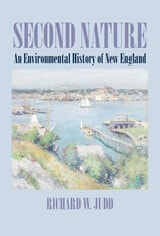
Second Nature
An Environmental History of New EnglandRichard W. Judd
University of Massachusetts Press, 2014
Winner of the 2014 New England Historical Association's James P. Hanlan Book Award
Bounded by the St. Lawrence Valley to the north, Lake Champlain to the west, and the Gulf of Maine to the east, New England may be the most cohesive region in the United States, with a long and richly recorded history. In this book, Richard W. Judd explores the mix of ecological process and human activity that shaped that history over the past 12,000 years. He traces a succession of cultures through New England's changing postglacial environment down to the 1600s, when the arrival of Europeans interrupted this coevolution of nature and culture.
A long period of tension and warfare, inflected by a variety of environmental problems, opened the way for frontier expansion. This in turn culminated in a unique landscape of forest, farm, and village that has become the embodiment of what Judd calls “second nature”—culturally modified landscapes that have superseded a more pristine “first nature.”
In the early 1800s changes in farm production and industrial process transformed central New England, while burgeoning markets at the geographical margins brought rapid expansion in fishing and logging activities. Although industrialization and urbanization severed connections to the natural world, the dominant cultural expression of the age, Romanticism, provided new ways of appreciating nature in the White Mountains and Maine woods. Spurred by these Romantic images and by a long tradition of local resource management, New England gained an early start in rural and urban conservation.
In the 1970s environmentalists, inspired by a widespread appreciation for regional second-nature landscapes, moved quickly from battling pollution and preserving wild lands to sheltering farms, villages, and woodlands from intrusive development. These campaigns, uniquely suited to the region's land-use history, ecology, and culture, were a fitting capstone to the environmental history of New England.

Seeking the One Great Remedy
Francis George Shaw and Nineteenth-Century ReformLorien Foote
Ohio University Press, 2003
A radical abolitionist and early feminist, Francis George Shaw (1809–1882) was a prominent figure in American reform and intellectual circles for five decades. He rejected capitalism in favor of a popular utopian socialist movement; during the Civil War and Reconstruction, he applied his radical principles to the Northern war effort and to freedmen’s organizations.
A partnership with Henry George in the late 1870s provided an international audience for Shaw’s alternative vision of society. Seeking the One Great Remedy is the biography of this remarkable and influential man. In compelling detail, author Lorien Foote depicts the many aspects and exploits of the Shaw family. Their activities provide a perspective on the course of American reform that calls into question previous interpretations of the reform movement of this period.
Francis George Shaw is perhaps best known as the father of Robert Gould Shaw, subject of the movie Glory. Francis and his wife, Sarah Blake Shaw, achieved considerable notoriety for their activities, including their effort to shape public opinion during the Civil War. Turning the tragic death of their son into a public relations and propaganda triumph, they altered Northern opinion about the war and shaped a historical perception of the famous Massachusetts Fifty-fourth that continues today.
Seeking the One Great Remedy argues that social radicalism was pervasive among elite reformers before and after the Civil War and finds in the dramatic story of Francis George Shaw a model of that cause.
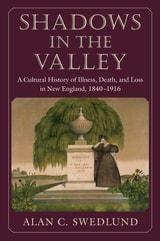
Shadows in the Valley
A Cultural History of Illness, Death, and Loss in New England, 1840-1916Alan Swedlund
University of Massachusetts Press, 2010
How does the experience of sickness, death, and loss change over time? We know that the incidence and virulence of particular diseases have varied from one period to another, as has their medical treatment. But what was it like for the individuals who suffered and died from those illnesses, for the health practitioners and institutions that attended to them, and for the families who buried and mourned them?
In Shadows in the Valley, Alan Swedlund addresses these questions by closely examining the history of mortality in several small communities in western Massachusetts from the mid-nineteenth to the early twentieth century—from just before the acceptance of the germ theory of disease through the early days of public health reform in the United States. This was a time when most Americans lived in rural areas or small towns rather than large cities. It was also a time when a wide range of healing practices was available to the American public, and when the modern form of Western medicine was striving for dominance and authority. As Swedlund shows, this juncture of competing practices and ideologies provides a rich opportunity for exploring the rise of modern medicine and its impact on the everyday lives of ordinary Americans.
To indicate how individuals in different stages of their lives were exposed to varying assaults on their health, the book is structured in a way that superimposes what the author calls “life-course time” onto chronological time. Thus the early chapters look at issues of infancy and childhood in the 1840s and 1850s and the last chapters at the problems of old age after 1900. The reader becomes familiar with specific individuals and families as they cope with the recurrent loss of children, struggle to understand the causes of new contagions, and seek to find meaning in untimely death. By using a broad time frame and a narrow geographical lens, Swedlund is able to engage with both the particularities and generalities of evolving medical knowledge and changing practice, and to highlight the differences in personal as well as collective responses to illness and loss.

Spirit of the New England Tribes
Indian History and Folklore, 1620–1984William S. Simmons
University Press of New England, 1986

Summer Light
Roxana Robinson
University Press of New England, 1995