Results by title
52 books match the query 'Noncitizens' and 6 start with s
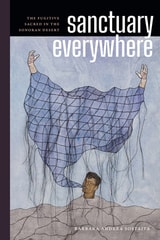
Sanctuary Everywhere
The Fugitive Sacred in the Sonoran DesertBarbara Andrea Sostaita
Duke University Press, 2024

Sans Papiers
The Social and Economic Lives of Young Undocumented MigrantsAlice Bloch, Nando Sigona, and Roger Zetter
Pluto Press, 2014
Undocumented migration is a huge global phenomenon, yet little is known about the reality of life for those involved. Sans Papiers combines a contemporary account of the theoretical and policy debates with an in-depth exploration of the lived experiences of undocumented migrants in the UK from Zimbabwe, China, Brazil, Ukraine and Turkish Kurdistan.
Built around their voices, the book provides a unique understanding of migratory processes, gendered experiences and migrant aspirations. Moving between the uniqueness of individual experience and the search for commonalities, the book explores the ambiguities and contradictions of being an undocumented migrant.
With its insights into personal experiences alongside analysis of wider policy issues, Sans Papiers will have wide appeal for students, academics, policy-makers and practitioners.
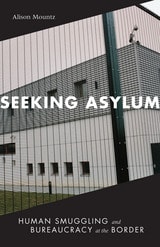
Seeking Asylum
Human Smuggling and Bureaucracy at the BorderAlison Mountz
University of Minnesota Press, 2010
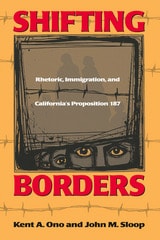
Shifting Borders
Rhetoric, Immigration And Prop 187Kent Ono
Temple University Press, 2002
"Like articles representing the positions of proponents of the measure, those representing opponents constructing the nation as potentially in danger as a result of undocumented immigration."
How do we learn to recognize the damning effects of good rhetorical intentions? And where will we find arguments which escape this trap that permeates the liberal social policy world? Shifting Borders uses an evaluation of the debate over California Proposition 187 to demonstrate how this quandary is best understood by close interrogation of mainstream reports and debates and by bringing to the fore voices that are often left out of mediated discussions.
It is these voices outside the mainstream, so-called "outlaw" discourses, that hold the best possibilities for real social change. To illustrate their claim, the authors present dominant and outlaw discourses around Proposition 187, from television reports, internet chat sites, and religious discourse to coverage of the Los Angeles Times. Their critique ably demonstrates how difficult it is to maintain a position outside the mainstream, but also how important it is for the press, citizens and scholars to actively search out such voices. The findings are organized through a model that provides an innovative method for understanding events and arguments through their rhetorical and communicative construction. In a world where the mediated word defines so much of what we know, Shifting Borders provides a lucid introduction to analyzing the spoken and written word that constitutes political debate in contemporary U.S. culture. In doing so, it makes an important contribution to any future development of progressive political strategy.
postamble();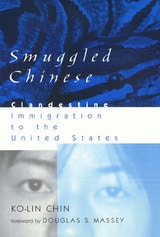
Smuggled Chinese
Ko-Lin Chin
Temple University Press, 1999
When the Golden Venture ran aground off New York's coast in 1993 and ten of the 260 Chinese on board drowned, the public outcry about human smuggling became front-page news. Probing into the causes and consequences of this clandestine traffic, Ko-lin Chin has interviewed more than 300 people -- smugglers, immigrants, government officials, and business owners -- in the United States, China, and Taiwan. Their poignant and chilling testimony describes a flourishing industry in which smugglers -- big and little snakeheads -- command fees as high as $30,000 to move desperate but hopeful men and women around the world. For many who survive the hunger, filthy and crowded conditions, physical and sexual abuse, and other perils of the arduous journey, life in the United States, specifically in New York's Chinatown, is a disappointment if not a curse. Few will return to China, though, because their families depend on the money and status gained by having a relative in the States.
In Smuggled Chinese, Ko-lin Chin puts a human face on this intractable international problem, showing how flaws in national policies and lax law enforcement perpetuate the cycle of desperation and suffering. He strongly believes, however, that the problem of human smuggling will continue as long as China's citizens are deprived of fundamental human rights and economic security.
Smuggled Chinese will engage readers interested in human rights, Asian and Asian American studies, urban studies, and sociology.
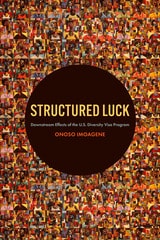
Structured Luck
Downstream Effects of the U.S. Diversity Visa ProgramOnoso Imoagene
Russell Sage Foundation, 2024
Combining ethnographic observation in Africa and interviews with immigrants, their family members, and friends from Ghana and Nigeria, Imoagene demonstrates that the visa program is a process of “structured luck,” from how people hear about the lottery, who registers for it, and who participates in it to the application requirements for the visa. In Ghana and Nigeria, people often learn about the lottery through friends, colleagues, or relatives who persuade them to enter for the perceived benefits of receiving a visa: opportunities for upward mobility, permanent legal status, and the ability to bring along family members. Though anyone can enter the lottery, not everyone who wins obtains a visa. The visa application process requires proof of a high school diploma or artisan skills, a medical exam, a criminal background check, an interview with U.S. consular officers, and payment of fees. Such requirements have led to the growth of visa entrepreneurs, who often charge exorbitant fees to steer immigrants through the process. Visa recipients who were on track to obtain university degrees at home often leave in the middle of their studies for the United States but struggle to continue their education due to high U.S. tuition costs. And though their legal status allows them to escape the demoralizing situations that face the undocumented, these immigrants lack the social support that the government sometimes provides for refugees and other migrants. Ultimately, Imoagene notes, the real winner of the visa lottery is not the immigrants themselves but the United States, which benefits from their relatively higher levels of education. Consequently, she argues, the U.S. must do more to minimize the visa program’s negative consequences.
Structured Luck illuminates the trauma, resilience, and determination of immigrants who come to the United States through the Diversity Visa Program and calls for the United States to develop policies that will better integrate them into society.