Results by title
78 books match the query 'North' and 5 start with s
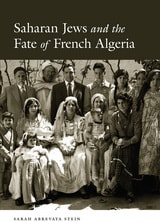
Saharan Jews and the Fate of French Algeria
Sarah Abrevaya Stein
University of Chicago Press, 2014
Drawing on materials from thirty archives across six countries, Stein tells the story of colonial imposition on a desert community that had lived and traveled in the Sahara for centuries. She paints an intriguing historical picture—of an ancient community, trans-Saharan commerce, desert labor camps during World War II, anthropologist spies, battles over oil, and the struggle for Algerian sovereignty. Writing colonialism and decolonization into Jewish history and Jews into the French Saharan one, Saharan Jews and the Fate of French Algeria is a fascinating exploration not of Jewish exceptionalism but of colonial power and its religious and cultural differentiations, which have indelibly shaped the modern world.

Saharan Winds
Energy Systems and Aeolian Imaginaries in Western SaharaAllan, Joanna
West Virginia University Press, 2024
Winner, ASLE-UKI Critical Book Prize, 2025
Finalist, Ecocritical Book Award, 2025, Association for the Study of Literature and Environment (ASLE)
Longlisted, Bread and Roses Award for Radical Publishing, 2025
Saharan Winds contributes to a fairer energy horizon by illuminating the role of imaginaries--how we understand energy sources such as wind and the meanings we attach to wind--in determining the wider politics, whether oppressive or just, associated with energy systems. This book turns to various cultures and communities across different time periods in one space, Western Sahara, to explore how wind imaginaries affect the development, management, and promotion of windfarms; the distribution of energy that windfarms produce; and, vitally, the type of politics mediated by all these elements combined. Highlighting the wind-fueled oppression of colonial energy systems, the book shows the potential offered by nomadic, Indigenous wind imaginaries for contributing to a fairer energy future.
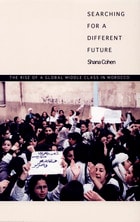
Searching for a Different Future
The Rise of a Global Middle Class in MoroccoShana Cohen
Duke University Press, 2004
Cohen delves into the rupture that has occurred between the middle class, the individual, and the nation in Morocco and elsewhere around the world. Combining institutional economic analysis with cultural theory and ethnographic observation including interviews with seventy young adults in Casablanca and Rabat, she reveals how young, urban, educated Moroccans conceive of their material, social, and political conditions. She finds that, for the most part, they perceive improvement in their economic and social welfare apart from the types of civic participation commonly connected with nationalism and national identity. In answering classic sociological questions about how the evolution of capitalism influences identity, Cohen sheds new light on the measurable social and economic consequences of globalization and on its less tangible effects on individuals’ perception of their place in society and prospects in life.

Sex, France, and Arab Men, 1962–1979
Todd Shepard
University of Chicago Press, 2017
Sex, France, and Arab Men is a history of how and why—from the upheavals of French Algeria in 1962 through the 1970s—highly sexualized claims about Arabs were omnipresent in important public French discussions, both those that dealt with sex and those that spoke of Arabs. Shepard explores how the so-called sexual revolution took shape in a France profoundly influenced by the ongoing effects of the Algerian revolution. Shepard’s analysis of both events alongside one another provides a frame that renders visible the ways that the fight for sexual liberation, usually explained as an American and European invention, developed out of the worldwide anticolonial movement of the mid-twentieth century.

Steaming to the North
The First Summer Cruise of the US Revenue Cutter Bear, Alaska and Chukotka, Siberia, 1886Katherine C. Donahue and David C. Switzer
University of Alaska Press, 2014
Steaming to the North follows the Bear from May to October 1886 as it takes its first summer cruise from San Francisco up to Point Barrow and back again. This is the first book to exhibit the photographs taken by 3rd Lt. Charles Kennedy of New Bedford, introducing rarely seen photos of the last sail-and-steam whaling ships, capturing early interactions of Natives with white whalemen and explorers, and showing lives otherwise lost to time. Essays follow the logbook of the cruise and allow readers to vividly ride alongside the crew on a history-making voyage.