Results by title
69 books match the query 'Nursing' and 7 start with s
Safe in a Midwife's Hands
Birthing Traditions from Africa to the American SouthLinda Janet Holmes
The Ohio State University Press, 2023
Shaping Nursing Science and Improving Health
The Michigan LegacyShaké Ketefian, editor
Michigan Publishing Services, 2016
The work covers selectively the development of nursing science over a period of some thirty years which was undertaken by nursing faculty and the School’s PhD Alumni. The account of the strategic development of a program of research across bio-behavioral phenomena, health promotion/risk reduction, women’s health and nursing and health care systems is instructive. Substantive contributions have been made across the selected areas; of note also is the impact of translational science on health outcomes of individuals and communities. The accounts of the purposeful development of health informatics in nursing and leadership as scholarship are also highly developed. The book is a valuable contribution to the literature on how nursing research at Michigan is helping transform the lives of patients, families and communities.

Shaping the Motherhood of Indigenous Mexico
Vania Smith-Oka
Vanderbilt University Press, 2013
The cash transfer program is Oportunidades, which enrolls more than a fifth of Mexico's population. It expects mothers to become involved in their children's lives at three nodes--health, nutrition, and education. If women do not comply with the standards of modern motherhood, they are dropped from the program and lose the bi-monthly cash payments. Smith-Oka explores the everyday implementation of the program and its unintended consequences.
The mothers are often berated by clinicians for having too many children (Smith-Oka provides background on the history of eugenics and population control in Mexico) and for other examples of their "backward" ways. An entire chapter focuses on the humor indigenous women use to cope with disrespectful comments. Ironically, this form of resistance allows the women to accept the situation that controls their behavior.

Spiritual Caregiving
Healthcare As A MinistryVerna Benner Carson
Templeton Press, 2004
With today's cumbersome insurance procedures, government regulations, endless paperwork, and concerns about malpractice rates, many health care professionals are asking: "Why am I doing this? Am I making a difference to my patients? Is there a better way—and if so, what is it?" In this book, Carson and Koenig examine the state of the health care system with the goal of providing healthcare professionals and caregivers the inspiration and practical tools to reclaim their sense of purpose.
The book begins with an evaluation of the current system from the perspective of the spiritual vision that initially motivated and nourished many caregivers. The authors then pose a vision of a health care system that supports and nurtures the spirituality of patients and their families, of which some elements already exist.
An overview is provided on the preparation necessary for health care professionals to offer spiritual care when there are major implications—for people with chronic illnesses, psychiatric issues, devastating injuries, and those preparing for surgery, facing death, and those living with chronic pain. Also explored are ways that health professionals and caregivers can maintain their own spiritual health even as they work to bring about healing, comfort, and solace to others.
Woven throughout the book are the personal narratives of physicians, nurses, chaplains, health care educators, community resource workers, administrators, therapists, and psychologists—all from a wide range of religious traditions. Their examples inspire and assist professionals in renewing the spiritual focus of health care.
Spiritual Dimensions of Nursing Practice
Revised EditionVerna Benner Carson
Templeton Press, 2008
Ever since the first edition of Verna Benner Carson's Spiritual Dimensions of Nursing Practice went out of print, second-hand copies have been highly sought after by practitioners in the field and nursing school faculty who appreciated the comprehensive scope of the seminal work on spirituality and health. In this highly anticipated revised edition, Carson and her co-editor, Harold G. Koenig, have thoroughly revised and updated this classic in the field.
Spirituality and Health Research
Methods, Measurements, Statistics, and ResourcesHarold G Koenig
Templeton Press, 2011
In Spirituality and Health Research: Methods, Measurement, Statistics, and Resources, Dr. Harold G. Koenig leads a comprehensive overview of this complex subject. Dr. Koenig is one of the world’s leading authorities on the relationship between spirituality and health, and a leading researcher on the topic. As such, he is distinctively qualified to author such a book.
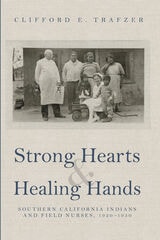
Strong Hearts and Healing Hands
Southern California Indians and Field Nurses, 1920–1950Clifford E. Trafzer
University of Arizona Press, 2021
Over time, field nurses and Native people formed a positive working relationship that resulted in the decline of mortality from infectious diseases. Many Native Americans accepted and used Western medicine to fight pathogens, while also continuing Indigenous medicine ways. Nurses helped control tuberculosis, measles, influenza, pneumonia, and a host of gastrointestinal sicknesses. In partnership with the community, nurses quarantined people with contagious diseases, tested for infections, and tracked patients and contacts. Indians turned to nurses and learned about disease prevention. With strong hearts, Indians eagerly participated in the tuberculosis campaign of 1939–40 to x-ray tribal members living on twenty-nine reservations. Through their cooperative efforts, Indians and health-care providers decreased deaths, cases, and misery among the tribes of Southern California.