Results by title
74 books match the query 'Origin' and 3 start with s

Show of Hands
A Natural History of Sign LanguageDavid F. Armstrong
Gallaudet University Press, 2011
Most scholarly speculation on the origin of human language has centered around speech. However, the growing understanding of sign languages on human development has transformed the debate on language evolution. David F. Armstrong’s new book Show of Hands: A Natural History of Sign Language casts a wide net in history and geography to explain how these visible languages have enriched human culture in general and how their study has expanded knowledge of the human condition.
Armstrong addresses the major theories of language evolution, including Noam Chomsky’s thesis of an innate human “organ” for language and Steven Pinker’s contention that there is language and not-language without any gradations between gesture and language. This engrossing survey proceeds with William C. Stokoe’s revival of the early anthropological cognitive-linguistic model of gradual development through the iconicity of sign languages. Armstrong ranges far to reveal the nature of sign languages, from the anatomy of early human ancestors to telling passages by Shakespeare, Dickens, and Pound, to the astute observations of Socrates, Lucretius, and Abbé de l’Epée on sign communication among deaf people. Show of Hands illustrates the remarkable development of sign languages in isolated Bedouin communities and among Australian indigenous peoples. It also explores the ubiquitous benefits of “Deaf Gain” and visual communication as they dovetail with the Internet and its mushrooming potential for the future.
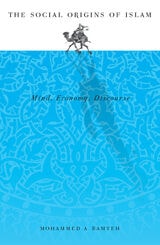
Social Origins Of Islam
Mind, Economy, DiscourseMohammed Bamyeh
University of Minnesota Press, 1999
Explores the genesis of Islam for insight into the nature of ideological transformation.
The story of the origins of Islam provides a rich and suggestive example of sweeping cultural transformation. Incorporating both innovation and continuity, Islam built upon the existing cultural patterns among the peoples of the Arabian peninsula even as it threatened to eradicate these same patterns. In this provocative interdisciplinary study, Mohammed A. Bamyeh combines perspectives from sociology, literary studies, anthropology, and economic history to examine the cultural ecology that fostered Islam.
Highlighting the pivotal connections in pre-Islamic society between the emergence of certain economic practices (such as trade and money-based exchange), worldview (as rendered in pre-Islamic literature and theology), and the reconfiguration of transtribal patterns of solidarity and settlement, Bamyeh finds in the genesis of Islam a sophisticated model for examining ideological transformation in general.At the heart of Bamyeh’s enterprise are close readings of both the Qur’an and the pre-Islamic poetry that preceded it. Bamyeh uncovers in these texts narrative and pedagogical content, poetic structure, use of metaphor, and historical references that are suggestive of societies in transition. He also explores the expressive limits of the pre-Islamic literature and its transmutation into Qur’anic speech in the wake of social transformation. Emphasizing the organic connections between belief structures, economic formations, and modes of discourse in pre-Islamic Arabia, The Social Origins of Islam explains how various material and discursive changes made the idea of Islam possible at a particular point in history. More broadly, it persuasively demonstrates how grand cultural shifts give rise to new systems of faith.
Super Imperialism
The Origin and Fundamentals of U.S. World DominanceMichael Hudson
Pluto Press, 2003