Results by title
74 books match the query 'Paleontology' and 5 start with s
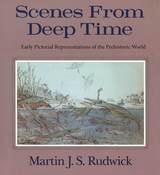
Scenes from Deep Time
Early Pictorial Representations of the Prehistoric WorldMartin J. S. Rudwick
University of Chicago Press, 1992
How did the earth look in prehistoric times? Scientists and artists collaborated during the half-century prior to the publication of Darwin's Origin of Species to produce the first images of dinosaurs and the world they inhabited. Their interpretations, informed by recent fossil discoveries, were the first efforts to represent the prehistoric world based on sources other than the Bible. Martin J. S. Rudwick presents more than a hundred rare illustrations from the eighteenth and nineteenth centuries to explore the implications of reconstructing a past no one has ever seen.
[more]
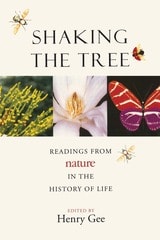
Shaking the Tree
Readings from Nature in the History of LifeEdited by Henry Gee
University of Chicago Press, 2000
Nature has published news about the history of life ever since its first issue in 1869, in which T. H. Huxley ("Darwin's bulldog") wrote about Triassic dinosaurs. In recent years, the field has enjoyed a tremendous flowering due to new investigative techniques drawn from cladistics (a revolutionary method for charting evolutionary relationships) and molecular biology.
Shaking the Tree brings together nineteen review articles written for Nature over the past decade by many of the major figures in paleontology and evolution, from Stephen Jay Gould to Simon Conway Morris. Each article is brief, accessible, and opinionated, providing "shoot from the hip" accounts of the latest news and debates. Topics covered include major extinction events, homeotic genes and body plans, the origin and evolution of the primates, and reconstructions of phylogenetic trees for a wide variety of groups. The editor, Henry Gee, gives new commentary and updated references.
Shaking the Tree is a one-stop resource for engaging overviews of the latest research in the history of life on Earth.
[more]
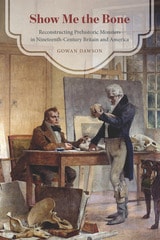
Show Me the Bone
Reconstructing Prehistoric Monsters in Nineteenth-Century Britain and AmericaGowan Dawson
University of Chicago Press, 2016
Nineteenth-century paleontologists boasted that, shown a single bone, they could identify or even reconstruct the extinct creature it came from with infallible certainty—“Show me the bone, and I will describe the animal!” Paleontologists such as Georges Cuvier and Richard Owen were heralded as scientific virtuosos, sometimes even veritable wizards, capable of resurrecting the denizens of an ancient past from a mere glance at a fragmentary bone. Such extraordinary feats of predictive reasoning relied on the law of correlation, which proposed that each element of an animal corresponds mutually with each of the others, so that a carnivorous tooth must be accompanied by a certain kind of jawbone, neck, stomach, limbs, and feet.
Show Me the Bone tells the story of the rise and fall of this famous claim, tracing its fortunes from Europe to America and showing how it persisted in popular science and literature and shaped the practices of paleontologists long after the method on which it was based had been refuted. In so doing, Gowan Dawson reveals how decisively the practices of the scientific elite were—and still are—shaped by their interactions with the general public.
Show Me the Bone tells the story of the rise and fall of this famous claim, tracing its fortunes from Europe to America and showing how it persisted in popular science and literature and shaped the practices of paleontologists long after the method on which it was based had been refuted. In so doing, Gowan Dawson reveals how decisively the practices of the scientific elite were—and still are—shaped by their interactions with the general public.
[more]
Species and Speciation in the Fossil Record
Edited by Warren D. Allmon and Margaret M. Yacobucci
University of Chicago Press, 2016
Although the species is one of the fundamental units of biological classification, there is remarkably little consensus among biologists about what defines a species, even within distinct sub-disciplines. The literature of paleobiology, in particular, is littered with qualifiers and cautions about applying the term to the fossil record or equating such species with those recognized among living organisms. In Species and Speciation in the Fossil Record, experts in the field examine how they conceive of species of fossil animals and consider the implications these different approaches have for thinking about species in the context of macroevolution.
After outlining views of the Modern Synthesis of evolutionary disciplines and detailing the development within paleobiology of quantitative methods for documenting and analyzing variation within fossil assemblages, contributors explore the challenges of recognizing and defining species from fossil specimens—and offer potential solutions. Addressing both the tempo and mode of speciation over time, they show how with careful interpretation and a clear species concept, fossil species may be sufficiently robust for meaningful paleobiological analyses. Indeed, they demonstrate that the species concept, if more refined, could unearth a wealth of information about the interplay between species origins and extinctions, between local and global climate change, and greatly deepen our understanding of the evolution of life.
After outlining views of the Modern Synthesis of evolutionary disciplines and detailing the development within paleobiology of quantitative methods for documenting and analyzing variation within fossil assemblages, contributors explore the challenges of recognizing and defining species from fossil specimens—and offer potential solutions. Addressing both the tempo and mode of speciation over time, they show how with careful interpretation and a clear species concept, fossil species may be sufficiently robust for meaningful paleobiological analyses. Indeed, they demonstrate that the species concept, if more refined, could unearth a wealth of information about the interplay between species origins and extinctions, between local and global climate change, and greatly deepen our understanding of the evolution of life.
[more]
Stratigraphic Paleobiology
Understanding the Distribution of Fossil Taxa in Time and SpaceMark E. Patzkowsky and Steven M. Holland
University of Chicago Press, 2012
Whether the fossil record should be read at face value or whether it presents a distorted view of the history of life is an argument seemingly as old as many fossils themselves. In the late 1700s, Georges Cuvier argued for a literal interpretation, but in the early 1800s, Charles Lyell’s gradualist view of the earth’s history required a more nuanced interpretation of that same record. To this day, the tension between literal and interpretive readings lies at the heart of paleontological research, influencing the way scientists view extinction patterns and their causes, ecosystem persistence and turnover, and the pattern of morphologic change and mode of speciation.
With Stratigraphic Paleobiology, Mark E. Patzkowsky and Steven M. Holland present a critical framework for assessing the fossil record, one based on a modern understanding of the principles of sediment accumulation. Patzkowsky and Holland argue that the distribution of fossil taxa in time and space is controlled not only by processes of ecology, evolution, and environmental change, but also by the stratigraphic processes that govern where and when sediment that might contain fossils is deposited and preserved. The authors explore the exciting possibilities of stratigraphic paleobiology, and along the way demonstrate its great potential to answer some of the most critical questions about the history of life: How and why do environmental niches change over time? What is the tempo and mode of evolutionary change and what processes drive this change? How has the diversity of life changed through time, and what processes control this change? And, finally, what is the tempo and mode of change in ecosystems over time?
[more]