59 books match the query 'Palestinian Arabs' and 3 start with s

cover of Sabra and Shatila: September 1982

Sabra and Shatila

September 1982

Bayan Nuwayhed Al-Hout

Pluto Press, 2004

The book covers the history of the Sabra and Shatila massacre, which took place over three bloody days in the Lebanese capital Beirut. It was committed against Palestinian refugees by Lebanese militias, aided and supervised by the Israeli Army, which had encircled the district.

Now available for the first time in English, this classic book is the most comprehensive, authoritative account of what happened and who was responsible. The author, Bayan Nuwayhed al-Hout, was a Professor at the Lebanese University at the time. Driven by the horror of what occurred, she interviewed survivors and set up an oral history project immediately after the massacre to preserve testimonies. This book is the result.

Following a general introduction, the first part contains interviews mainly with victims' families. The second part analyses statistical data and attempts to determine the number of victims. The conclusion, 'Who Was Responsible?', sheds light on the various parties responsible.

Over five-hundred pages long, illustrated with photographs and maps, unrivalled in detail and scope, this book is a courageous attempt to make sense of what happened and an important political document in its own right.

[more]
cover of Second Life: A West Bank Memoir

Second Life

A West Bank Memoir

Janet Gunn

University of Minnesota Press, 1995
Second Life was first published in 1995.“Having sat out the U.S. civil rights movement and the Vietnam war protest during the sixties, I joined my first cause in the late eighties, a middle-aged academic on the other side of the world.” So writes Janet Varner Gunn, who from 1988 to 1990 took time out from university teaching to do human rights work on the West Bank. During that time she became involved with the case of Mohammad Abu Aker, a Palestinian teenager who was critically shot during a stone-throwing demonstration. The years following Mohammad’s injury, during which he was deemed a “living martyr” of the Intifada and which ended with his eventual death at nineteen in 1990, are recounted in this deeply personal book. Gunn interweaves her account of Mohammad’s medical struggles and the politics surrounding his symbolic place in the Intifada with her own story of loss and recovery. As a human rights worker for whom Mohammad initially represented a “case,” Gunn was involved in getting him the medical care he needed to survive. As a scholar, she became fascinated by the way Mohammad’s injury and subsequent “second life” took on a larger significance because of its timing, which coincided with the declaration of an independent Palestine. The book contains rich accounts of the “small news” of daily life in Deheishe, the refugee camp where Mohammad lived with his family. Gunn describes the laughter with which residents of the camp have learned to meet the violent disruption of their daily lives, hoping that her readers will “be moved not by the victimization of an oppressive occupation but by the examples of hope and steadfastness I discovered in Deheishe’s holding on for dear life.” Janet Varner Gunn has taught in the Department of English at Rhodes University, Grahamstown, South Africa, after completing a Senior Fulbright Lectureship. She is the author of Autobiography: Toward a Poetics of Experience (1982).
[more]
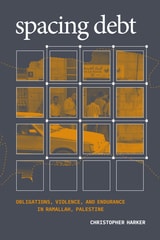
cover of Spacing Debt: Obligations, Violence, and Endurance in Ramallah, Palestine

Spacing Debt

Obligations, Violence, and Endurance in Ramallah, Palestine

Christopher Harker

Duke University Press, 2020

In Spacing Debt Christopher Harker demonstrates that financial debt is as much a spatial phenomenon as it is a temporal and social one. Harker traces the emergence of debt in Ramallah after 2008 as part of the financialization of the Palestinian economy under Israeli settler colonialism. Debt contributes to processes through which Palestinians are kept economically unstable and subordinate. Harker draws extensively on residents' accounts of living with the explosion of personal debt to highlight the entanglement of consumer credit with other obligatory relations among family, friends, and institutions. He offers a new geographical theorization of debt, showing how debt affects urban space, including the movement of bodies through the city, localized economies, and the political violence associated with occupation. Bringing cultural and urban imaginaries into conversation with monetized debt, Harker shows how debt itself becomes a slow violence embedded into the everyday lives of citizens. However, debt is also a means through which Palestinians practice endurance, creatively adapting to life under occupation.
[more]