Results by title
93 books match the query 'Paris' and 3 start with s
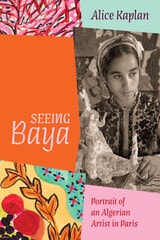
Seeing Baya
Portrait of an Algerian Artist in ParisAlice Kaplan
University of Chicago Press, 2024
The first biography of the Algerian artist Baya Mahieddine, celebrated in mid-twentieth-century Paris, her life shrouded in myth.
On a flower farm in colonial Algeria, a servant and field worker known as Baya escaped the drudgery of her labor by coloring the skirts in fashion magazines. Three years later, in November 1947, her paintings and fanciful clay beasts were featured in a solo show in Paris. She wasn’t yet sixteen years old. In this first biography of Baya, Alice Kaplan tells the story of a young woman seemingly trapped in subsistence who becomes a sensation in the French capital, then mysteriously fades from the history of modern art—only to reemerge after independence as an icon of Algerian artistic heritage.
The toast of Paris for the 1947 season, Baya inspired colonialist fantasies about her “primitive” genius as well as genuine appreciation. She was featured in newspapers, on the radio, and in a newsreel; her art was praised by Breton and Camus, Marchand and Braque. At the dawn of Algerian liberation, her appearance in Paris was used to stage the illusion of French-Algerian friendship, while horrific French massacres in Algeria were still fresh in memory.
Kaplan uncovers the central figures in Baya’s life and the role they played in her artistic career. Among the most poignant was Marguerite Caminat-McEwen-Benhoura, who took Baya from her sister’s farm to Algiers, where Baya worked as Marguerite’s maid and was given paint and brushes. A complex and endearing character, Marguerite—and her Pygmalion ambitions—was decisive in shaping Baya’s destiny. Kaplan also looks closely at Baya’s earliest paintings with an eye to their themes, their palette and design, and their enduring influence.
In vivid prose that brings Baya’s story into the present, Kaplan’s book, the fruit of scrupulous research in Algiers, Blida, Paris, and Provence, allows us to see in a whole new light the beloved artist who signed her paintings simply “Baya.”
[more]
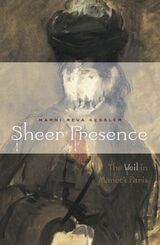
Sheer Presence
The Veil in Manet’s ParisMarni Reva Kessler
University of Minnesota Press, 2006
Tamar’s instrument of seduction in the Hebrew Bible, Penelope’s shroud in Homer’s Odyssey, accessory of brides as well as widows, and hallmark of the religious and the wealthy, the veil has historically been an intriguing signifier. Initially donned in France for liturgical purposes and later for masked balls and as a sun- and windscreen at the seashore, face-covering veils were adopted for fashionable urban use during the reign of Napoleon III. In Sheer Presence, Marni Reva Kessler demonstrates how this ubiquitous garment and its visual representations knot together many of the precepts of Parisian life. Considering the period from the beginning of Napoleon III’s rule in 1852 to 1889, when the Paris Universal Exhibition displayed veiled North African Muslims and other indigenous colonial peoples, Kessler deftly connects the increased presence of the veil on the streets and on canvas to Haussmann’s massive renovation of Paris. The fashion of veil wearing, she argues, was imbricated with broader concerns: fears of dust and disease fueled by Haussmannization and class mixing on the city streets, changes in ideals of youth and beauty, attempts to increase popular support for imperialism, and the development of modernist art practices. A veil was protection for the proper woman from the vices associated with the modern city, preserving—at least on the surface—her femininity and class superiority. Kessler explores these themes with close readings of paintings by Gustave Caillebotte, Edgar Degas, and Edouard Manet—including Manet’s perplexing portraits of artist Berthe Morisot—as well as photographs, images from the popular press, engravings, lithographs, and academic paintings. She also mines French fashion journals, etiquette books, novels, and medical publications for clues to the veil’s complex meanings during the period.Positioning the veil directly at the intersection of feminist, formalist, and social art history, Kessler offers a fresh perspective on period discourses of public health, seduction and sexuality, colonial stereotypes, and, ultimately, an emerging modernity.Marni Reva Kessler is assistant professor of art history at the University of Kansas.
[more]

Surrealism from Paris to Shanghai
Lauren Walden
Hong Kong University Press, 2024
Surrealism through the lens of China.
Surrealism from Paris to Shanghai is the first English language book dedicated to introducing Chinese Surrealism, enlarging the geographical authority of Surrealist studies beyond a Eurocentric prism of analysis. The book reveals the mutual cultural influence between China and the Western avant-garde, moving beyond notions of “copying from the West.” Utilizing primary source materials, particularly periodicals, Lauren Walden reveals the underexplored dissemination of Surrealism in Shanghai. Highlighting how Surrealism was applied across a broad political spectrum in Shanghai including anti-colonialism, communism, and nationalism, Walden also demonstrates why Shanghai’s former French concession became the birthplace of Surrealism in China.
Surrealism from Paris to Shanghai is the first English language book dedicated to introducing Chinese Surrealism, enlarging the geographical authority of Surrealist studies beyond a Eurocentric prism of analysis. The book reveals the mutual cultural influence between China and the Western avant-garde, moving beyond notions of “copying from the West.” Utilizing primary source materials, particularly periodicals, Lauren Walden reveals the underexplored dissemination of Surrealism in Shanghai. Highlighting how Surrealism was applied across a broad political spectrum in Shanghai including anti-colonialism, communism, and nationalism, Walden also demonstrates why Shanghai’s former French concession became the birthplace of Surrealism in China.
[more]