Results by title
56 books match the query 'Philadelphia (Pa.)' and 7 start with s

SUBURB IN THE CITY
Chestnut Hill, Philadelphia, 1850-1990David R. Contosta
The Ohio State University Press, 1995
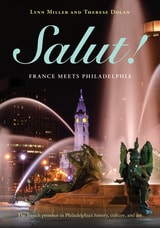
Salut!
France Meets PhiladelphiaLynn Miller and Therese Dolan
Temple University Press, 2021
One highly visible example of French influence on the city of Philadelphia is the Benjamin Franklin Parkway, modeled on the Champs-Élysées. In Salut!, Lynn Miller and Therese Dolan trace the fruitful, three-centuries-long relationship between the City of Brotherly Love and France. This detailed volume illustrates the effect of Huguenots settling in Philadelphia and 18-year-old William Penn visiting Paris, all the way up through more recent cultural offerings that have helped make the city the distinctive urban center it is today.
Salut! provides a magnifique history of Philadelphia seen through a particular cultural lens. The authors chronicle the French influence during colonial and revolutionary times. They highlight the contributions of nineteenth-century French philanthropists, such as Stephen Girard and the Dupont family. And they showcase the city’s vibrant visual arts community featuring works from the Philadelphia Museum of Art, the Rodin Museum, the Barnes Foundation, and the Joan of Arc sculpture, as well as studies of artists Thomas Eakins, Mary Cassatt, and Henry Ossawa Tanner. There is also a profile of renowned Le Bec-Fin chef Georges Perrier, who made Philadelphia a renowned culinary destination in the twentieth century.
With lavish illustrations and enthusiastic text, Salut!celebrates a potpourri of all things French in the Philadelphia region.
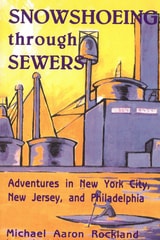
Snowshoeing Through Sewers
Adventures in New York City, New Jersey, and PhiladelphiaMichael Aaron Rockland
Rutgers University Press, 2008
In these ten alternately poetic and comic tales of adventure in the New York/Philadelphia corridor, the most densely populated chunk of America, Rockland walks and bikes areas meant only for cars and paddles through waters capable of dissolving canoes. He hikes the length of New York's Broadway, camps in New York City, treks across Philadelphia, pedals among the tractor trailers of Route 1 in New Jersey, and paddles around Manhattan and through the dark tunnels under Trenton.
Whereas Henry David Thoreau built his cabin on Walden Pond to get out of town, for Rockland, the challenge is to head into town. As he writes, "in the late twentieth century, a weed and trash-filled city lot . . . may be a better place than the wilderness to contemplate one's relationship to nature."
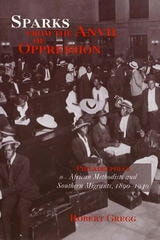
Sparks from the Anvil of Oppression
Philadelphia's African Methodists and Southern Migrants, 1890-1940Robert Gregg
Temple University Press, 1998
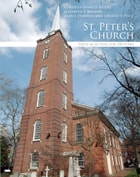
St. Peter's Church
Faith in Action for 250 YearsCornelia Frances Biddle
Temple University Press, 2011
Celebrating 250 years, St. Peter's Episcopal Church in the Society Hill neighborhood of Philadelphia, has witnessed a rich mixture of people and events that reflect critical periods of American political and cultural history. George Washington worshiped here as did abolitionists and slave holders, Whigs, Democrats, and Republicans. St. Peter's was a point of first contact for thousands of immigrants, and the church opened schools for immigrants to help them to acculturate to life in Philadelphia.
Opening a window onto colonial Philadelphia and the nation's histories, St. Peter's Church is a glorious testament to this National Historic Landmark. In addition to the stories and hundreds of black-and-white and color photographs, this handsome volume provides a history of the grounds, the churchyard, and the church itself-a classic example of eighteenth-century Philadelphia design that later incorporated the work of renown architects William Strickland, Thomas U. Walter, and Frank Furness.
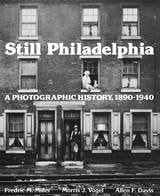
Still Philadelphia
Fredric Miller
Temple University Press, 1983
This is a book about Philadelphia and about photography, but it is not the usual book about either. On one level, this is the pictorial story of a great industrial metropolis in transition. It is the story of a railroad city, a city of trolleys and subways and horse-drawn vehicles, as it gradually succumbed to the automobile. It is the story of a city filled with neighborhood industry giving way to suburbs, to commuter travel, and to a change in the very nature of work. It is the story of a city spreading out, expanding and doubling in population in fifty years. It is the story of urban exuberance and vitality where ethnic groups mixed and mingled, but it is also the story of slums and poverty, crime and conflict. A Philadelphia family album, filled with pictures of ordinary people, Still Philadelphia focuses on the city of immigrants and industry, not on the lives and houses of the wealthy.
Strange Philadelphia
Stories from the City of Brotherly LoveLou Harry
Temple University Press, 1995
Most history books paint Philadelphia as a place of revolutionary greatness, but there exists a forgotten, alternative history of the City of Brotherly Love. For example, did you know that
•when Ben Franklin was Deputy Postmaster General for the American colonies, he ignored rival printers' requests for mailing priveleges. Instead, he loaded down the mail carriers with his own papers and enjoyed the use of a private delivery system that cut off the competition.
•
the Slinky was created by a marine engineer stationed in Philadelphia, who later became an evangelist and Bible salesman in Bolivia, leaving behind his wife, his children, and the Slinky fortune.
•
50,000 people gathered in Fairmount Park in 1953 hoping to see a vision of the Virgin Mary, who three schoolgirls claimed to have seen near a park bush. Though the Blessed Mother never did appear, visitors to the site left behind offerings of rosaries, flowers, crutches, and over $6,000.
•
while 11,000 spectators sat in the Spectrum waiting for the Ice Capades to begin, 32-mile-an-hour winds blew a chunk of the roof off the city's newly constructed stadium.
Find these and a hundred more "strange" and fascinating stories in this collection of vignettes. These pieces of the past can't be found in history books—they are surprising side bars to the famous and not-so-famous events and people of historical Philadelphia.