Results by title
130 books match the query 'Philosophers' and 4 start with s

S. L. Frank
The Life And Work Of A Russian Philosopher, 1877-1950Philip Boobbyer
Ohio University Press, 1995
“There are many reasons for writing a biography of Semyon Frank. Quite apart from his philosophy, he lived a remarkable life. Born in Moscow in 1877, he was exiled from Soviet Russia in 1922 and died in London in 1950. The son of a Jewish doctor, he became a revolutionary Social Democrat in his teens and finished his life as a Neoplatonist Christian. One of the Russian revisionist Marxists, he was then involved in the Kadet Party during the 1905 revolution before breaking with active political activity and turning to philosophy. He lived in Petrograd through the First World War until September 1917, after which he went to Saratov, where he experienced the chaos of the Russian Civil War. Living in Germany after his exile, he witnessed the rise of Hitler in Berlin, left for France in a hurry in 1937, and spent part of the war hiding from the Gestapo in the Grenoble mountains. It was a life that encompassed a lot of history.
”Yet along with this, Frank was arguably Russia’s greatest twentieth-century philosopher. Indeed, V.V. Zen‘kovskii, the historian of Russian philosophy, considered Frank ’in strength of philosophic vision … the most outstanding among Russian philosophers generally — not merely among those who share his ideas.‘ For its lucidity, conciseness, systematic character, and unity, Zen’kovskii considered Frank’s system ‘ the highest achievement … of Russian philosophy.’ Doubtless, Zen‘kovskii’s assessment is disputable, but his remarks emphasize Frank’s stature in the Russian tradition. In the style of German idealism, Frank constructed a comprehensive philosophical system, which he believed offered a coherent alternative to materialism. He was deeply worried by the implications of epistemological relativism and constructed a system of metaphysics designed to link epistemology and ontology, to bridge the gulf between thought and being. In addition, he attempted to express the idea of a personal God in philosophical language. His system also embraced social philosophy, anthropology, and ethics.“
— from the Introduction by the author
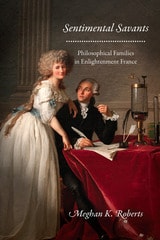
Sentimental Savants
Philosophical Families in Enlightenment FranceMeghan K. Roberts
University of Chicago Press, 2016
Sentimental Savants is the first book to explore the place of the family among the savants of the French Enlightenment, a group that openly embraced their families and domestic lives, even going so far as to test out their ideas—from education to inoculation—on their own children. Meghan K. Roberts delves into the lives and work of such major figures as Denis Diderot, Émilie Du Châtelet, the Marquis de Condorcet, Antoine Lavoisier, and Jérôme Lalande to paint a striking portrait of how sentiment and reason interacted in the eighteenth century to produce not only new kinds of knowledge but new kinds of families as well.
Socrates
Sean Sheehan
Haus Publishing, 2007
Socrates' Children
Modern: The 100 Greatest PhilosophersPeter Kreeft
St. Augustine's Press, 2016
This is the third of a four-volume history of philosophy . . . on ancient, medieval, modern, and contemporary philosophy. After the fourth volume is produced in paper, a one-volume clothbound edition, containing all four paperbound editions, will be published.
Kreeft focuses on the “big ideas” that have influenced present people and present times, and includes relevant biographical data, proportionate to its importance for each thinker. Moreover, the aim of the work is to stimulate philosophizing, controversy, and argument. It uses ordinary language and logic, not jargon and symbolic logic, and it is commonsensical (like Aristotle) and existential in the sense that it sees philosophy as something to be lived and experienced in life. Philosophy, after all, is not about philosophy but reality . . . about wisdom, life and death, good
and evil, and God.
Kreeft seeks to be simple and direct and clear. But it is not dumbed down and patronizing. It will stretch the reader, but it is meant for beginnings, not just scholars. It can be used for college classes or do-it-yourselfers. It emphasizes surprises; remember, “philosophy begins in wonder.” And it includes visual aids: charts, cartoons, line drawings, and drawings of each philosopher.