Results by title
314 books match the query 'Plants' and 13 start with s

Sacred Leaves of Candomblé
African Magic, Medicine, and Religion in BrazilBy Robert A. Voeks
University of Texas Press, 1997
Winner, Hubert Herring Book Award, Pacific Coast Council on Latin American Studies
Candomblé, an African religious and healing tradition that spread to Brazil during the slave trade, relies heavily on the use of plants in its spiritual and medicinal practices. When its African adherents were forcibly transplanted to the New World, they faced the challenge not only of maintaining their culture and beliefs in the face of European domination but also of finding plants with similar properties to the ones they had used in Africa.
This book traces the origin, diffusion, medicinal use, and meaning of Candomblé's healing pharmacopoeia—the sacred leaves. Robert Voeks examines such topics as the biogeography of Africa and Brazil, the transference—and transformation—of Candomblé as its adherents encountered both native South American belief systems and European Christianity, and the African system of medicinal plant classification that allowed Candomblé to survive and even thrive in the New World. This research casts new light on topics ranging from the creation of African American cultures to tropical rain forest healing floras.
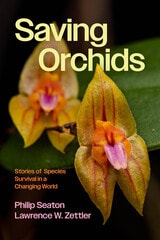
Saving Orchids
Stories of Species Survival in a Changing WorldPhilip Seaton and Lawrence W. Zettler
University of Chicago Press, 2025
A gorgeously illustrated ode to the beauty and significance of orchids—and to those fighting to save these unique plants across the globe.
Until recently, a myriad of lifeforms enriched our lives. In some places, listening to a nighttime chorus of frogs in the neighborhood marsh was an archetypal touchstone of childhood. Children would search for tadpoles, just steps away from native Lady’s Tresses orchids. Year by year, the chorus became quieter. Today, only a few frogs and orchids remain. Is this the world we want our children to inherit? Do we want orchids to slip through our fingers and, eventually, to vanish?
For biologists Philip Seaton and Lawrence W. Zettler, and the intrepid orchid defenders they introduce in this book, the answer is no. Seaton and Zettler have traveled the world over the past three decades, studying orchids—flagship species for plant conservation. Stunningly illustrated, this book is a culmination of stories about the people—young and old alike—dedicated to protecting these remarkable plants from extinction. In the 19th century, collectors removed, shipped, and sold vast numbers of orchids from the wild. Today, scientists strive to reverse this harm—to protect and rebuild remnants of orchids’ original habitats against human disruption, including climate change. Seaton and Zettler reveal these plants’ bizarre pollination partners, risky liaisons with fungi, and adaptation to human domestication to show that learning orchids’ scientific secrets—and finding human helpers—is key to these plants’ survival.

Sedges
CarexRobert H. Mohlenbrock. Illustrated by Paul Nelson
Southern Illinois University Press, 1999
Unique in several respects, Carex is by far the most numerous genus of plants in Illinois. Because of the vast number of species, the similarity of many of the species, and the relatively small size of the critical reproductive structures, the members of this genus are extremely confusing to identify. This book, with its detailed descriptions, key, and precise illustrations, should aid the interested person in the identification of these plants.
Since more than three-fourths of the species of Carex in Illinois are inhabitants of wetlands, an understanding of the genus is critical for those working in wetlands. Amateur and professional botanists will find the information extremely valuable, as well as environmental and conservation groups, garden clubs, farm bureaus, home extension groups, scout organizations, and school libraries. Persons working in natural areas programs and in rare and endangered species programs and those working on environmental impact assessments and wildlife management projects will also find the information pertinent.
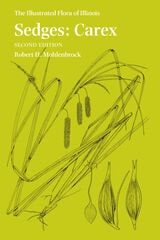
Sedges
CarexRobert H. Mohlenbrock
Southern Illinois University Press, 2011
Since the volume’s original publication in 1999, thirty-four additional species of plants have been recognized in Illinois. Some are discoveries from recent field work, some are from more thorough searches of herbaria, and others are from different taxonomic philosophies.
For each species of Carex in Illinois, there is a full illustration showing the habit of the plant and close-ups of various vegetative and reproductive structures that are crucial for the identification of the individual species. There is also a complete description of each species as well as a detailed discussion of the nomenclature and habitats. Range maps show the county distribution of each species in Illinois. A new and detailed key is provided for identification of the species.
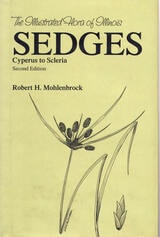
Sedges
Cyperus to ScleriaRobert H. Mohlenbrock
Southern Illinois University Press, 2001
This second edition of Sedges: Cyperus to Scleria brings up to date the identification of species of sedges in Illinois (except Carex) since publication of the first edition in 1976.
During the intervening years, several additions to the sedge flora of Illinois have been made, and many new distributional records have been added. Also, a large number of nomenclatural changes have taken place, resulting in several alterations of scientific names. New illustrations have been provided for all of the additions.
In his introductory material, Robert H. Mohlenbrock discusses the morphology of sedges and the habitats where they can be found. Although the semitechnical keys and descriptions are familiar to experienced botanists, he has simplified them as much as possible to accommodate the novice in sedge identification. He has also included a new key to the sedges and to each genus in which additional species have been added.
For each species, Mohlenbrock has provided a description, statement of habitat and range, Illinois distribution map, discussion, synonymy, and line illustrations showing its diagnostic features. Sedges: Cyperus to Scleria contains 128 illustrations.
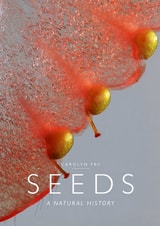
Seeds
A Natural HistoryCarolyn Fry
University of Chicago Press, 2016
With Seeds, Carolyn Fry offers a celebration of these vital but unassuming packages of life. She begins with a sweeping tour through human history, designed to help us understand why we should appreciate and respect these floral parcels. Wheat, corn, and rice, she reminds us, supply the foundations of meals eaten by people around the world. Countless medicines, oils, clothing materials, and building supplies are available only because of the versatility and variety of seed-bearing plants. Fry then provides a comprehensive history of the evolution of seeds, explaining the myriad ways that they have adapted, survived, and thrived across the globe. Delving deeper into the science of seeds, she reveals the fascinating processes of dormancy, reproduction, germination, and dispersal, and showcases the estimable work conservationists are doing today to gather and bank seeds in order to prevent species from going extinct.
Enriched by a stunning array of full-color images, Seeds offers a comprehensive exploration of some of the most enduring and essential players in the natural world.

Seventh Catalog of Vascular Plants of Ohio
Edited By Tom S. Cooperrider, Allison W. Cusick, and John T. Kartesz
The Ohio State University Press, 2001

Sex on the Kitchen Table
The Romance of Plants and Your FoodNorman C. Ellstrand
University of Chicago Press, 2018
In Sex on the Kitchen Table, Norman C. Ellstrand takes us on a vegetable-laced tour of this entire sexual adventure. Starting with the love apple (otherwise known as the tomato) as a platform for understanding the kaleidoscopic ways that plants can engage in sex, successive chapters explore the sex lives of a range of food crops, including bananas, avocados, and beets, finally ending with genetically engineered squash—a controversial, virus-resistant vegetable created by a process that involves the most ancient form of sex. Peppered throughout are original illustrations and delicious recipes, from sweet and savory tomato pudding to banana puffed pancakes, avocado toast (of course), and both transgenic and non-GMO tacos.
An eye-opening medley of serious science, culinary delights, and humor, Sex on the Kitchen Table offers new insight into fornicating flowers, salacious squash, and what we owe to them. So as we sit down to dine and ready for that first bite, let us say a special grace for our vegetal vittles: let’s thank sex for getting them to our kitchen table.
Shrubs Of The Great Basin
A Natural HistoryHugh N. Mozingo
University of Nevada Press, 1987
Mozingo presents the life histories of more than sixty species of both common and unusual shrubs, and discusses how shrubs grow, reproduce, and adapt to the extreme weather conditions that are part of daily life in the Great Basin. Drawings by Christine Stetter.
Shrubs and Vines of Iowa
Peter J. van der Linden, Donald R. Farrar
University of Iowa Press, 2016
Like trees, shrubs and vines are woody plants that are easy to observe year round. The first part of this book will help you identify them. Illustrated keys take you through the identification process one step at time; these are followed by images and descriptions of all but the rarest species. Noted naturalists Peter van der Linden and Donald Farrar also provide information about each species’ distribution, ecology, and uses. Summer and winter features are covered separately to facilitate identification at these two very different times of year.
Chapters about the culture and natural history of shrubs and vines explain why the plants grow where they do in nature and show how to use them effectively in outdoor spaces. Plants native to Iowa have much to offer to the landscaper: winter hardiness, resistance to drought and climatic extremes, and food and shelter for native wildlife and pollinators. Many natives are ornamental as well, providing attractive flowers, bright autumn displays, and colorful stems or fruits in winter. The authors offer tips for selecting, planting, and caring for these plants effectively. With native plants, you can create a landscape that is sustainable, authentic to place, and satisfying to you.
Iowa and midwestern arborists, conservationists, horticulturists, landscape architects, gardeners, and all those who appreciate the beauty and value of native plants will find Shrubs and Vines of Iowa immensely useful.
Snow Fleas and Chickadees
Everyday Observations in the SierraEve Quesnel
University of Nevada Press, 2025
Quesnel embraces the notion that to simply walk in one’s neighborhood is to familiarize oneself with the local flora and fauna, drawing attention to everyday things too often neglected. She argues that we can be complacent with what surrounds us, but with careful observation and research, we become acutely aware—and in awe of—nature’s everyday activities. The black bear’s hibernation techniques and mountain chickadee’s caching methods reveal just two of nature’s wily ways. Quesnel chases other curiosities as well, asking, “How does a spider create an orb web?” or, “How does a boulder the size of a small car end up alone in the woods?” In the introduction, she writes, “It is this ‘un-peeling’ of layers in nature that opens up our world.”
For anyone interested in nature writing, whether an armchair explorer, outdoor enthusiast, or science aficionado, Snow Fleas and Chickadees provides an entertaining and engaging discovery of the picturesque Sierra Nevada.
Spring Flora of Wisconsin
A Manual of Plants Growing without Cultivation and Flowering Before June 15Norman C. Fassett; Revised and enlarged by Olive S. Thomson
University of Wisconsin Press, 1976
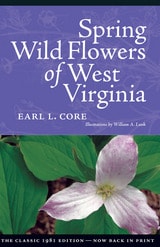
Spring Wildflowers of West Virginia
EARL L. CORE
West Virginia University Press, 2005
Back in print just in time for spring! Originally published in 1948, this is the germinal text on nearly 250 species of spring wildflowers found in West Virginia. Common or English names and scientific or Latin names are given for each species. The descriptions are in two sections: The first description includes the meaning of the name of the flower, uses, habitats, and ranges in West Virginia. Secondly, the plant itself is described in deep detail to help in identification. Each description is accompanied by a facing page detailed line drawing. This book is a must have for those interested in the beauty and science of West Virginia's spring flora. The author, Earl L. Core, also co-wrote the four-volume Flora of West Virginia. He received his bachelor's and master's degrees from West Virginia University and his doctorate from Columbia. He was a biology professor at WVU where the 75-acre arboretum managed by the university bears his name. The illustrator, William A. Lunk, received his doctorate at the University of Michigan and went on to become curator of their University Museums.