Results by title
207 books match the query 'Political participation' and 7 start with s

SLAPPs
Getting Sued for Speaking OutGeorge Pring
Temple University Press, 1996
In a democracy that for over 200 years has prided itself on public participation and citizen involvement in government, thousands have been and will be the targets of multi-million-dollar lawsuits. They will be sued for such "all-American" activities as circulating a petition, writing a letter to the editor, testifying at a public hearing, reporting violations of the law, filing an official complaint, lobbying for legislation, or otherwise communicating their views. Such cases, named "Strategic Lawsuits Against Public Participation," with their apropos acronym, SLAPPs, are a shocking abuse of one of our most basic political rights—the Right to Petition. So extensive and grievous is the phenomenon that Justice Nicholas Colabella remarked, "Short of a gun to the head, a greater threat to First Amendment expression can scarcely be imagined."
George W. Pring and Penelope Canan explore the full range of SLAPP stories in this first study of SLAPPs— retaliatory lawsuits by real estate developers; teachers; police; politicians; opponents of civil rights; consumers' rights; women's rights; and many others. This comprehensive book examines what happens to the targets of SLAPPs and what is happening to public participation in American politics. Addressing the ultimate dilemma—what can be done to turn the tables and fight back—Pring and Canan offer concrete, well-supported, balanced solutions for preventing, managing, and curing SLAPPs at all levels of government.

Senior Power or Senior Peril
Aged Communities and American Society in the Twenty-First CenturyBrittany H Bramlett
Temple University Press, 2015
In Senior Power or Senior Peril, Bramlett examines the assertions that the increasing number of older adult-concentrated communities across the United States form a growing bloc of senior power that will influence the redistribution of particularized welfare benefits to older adults at the expense of younger people. However, others suggest that political influence declines with old age. Bramlett uses interviews and on-site research at various senior communities to explore what qualities make an aged community politically unique, and the impact of the local aged context on residents' political knowledge, safety-net policy attitudes, efficacy, and political activity.
This path-breaking book identifies the political behaviors, attitudes, and political consciousness of both older and younger residents as it recounts the perceived and actual political power of seniors.
In the series The Social Logic of Politics, edited by Scott McClurg

Separate Destinations
Migration, Immigration, and the Politics of PlacesJames G. Gimpel
University of Michigan Press, 1999

Skepticism
Aryeh Botwinick
Temple University Press, 1990
Aryeh Botwinick argues for the recovery of a radical democratic tradition that emphasizes the role of individual participation in the development and control of social and political institutions. Such involvement implies philosophical skepticism—the assumption that the truth about what is the best course of action cannot be known with certainty and that, therefore, every person’s opinion has an equal claim to be considered. The crucial stumbling block to reappropriating this radical egalitarian tradition is the supposed unviability of a consistent skepticism. In an effort to chart a new course of philosophical inquiry into political matters, Botwinick grapples with the formulation of a consistent version of skepticism, claiming that it provides "a continually renewing impetus for the expansion of political participation."
Twentieth-century philosophers have, for the most part, opted for some version of mitigated skepticism, which, the author argues, "has blinded them to the radical political implications of skepticism." Underscoring a pattern of convergence between Anglo-American and Continental philosophy, Botwinick proposes a number of strategies to rehabilitate the rationality of participatory democratic political institutions by articulating an acceptable version of consistent skepticism.
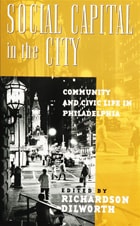
Social Capital in the City
Community and Civic Life in Philadelphiaedited by Richardson Dilworth
Temple University Press, 2006
Social Logic Of Politics
Personal Networs As Contextsedited by Alan S. Zuckerman
Temple University Press, 2005

Suspect Citizens
Women, Virtue, and Vice in Backlash PoliticsJocelyn Boryczka
Temple University Press, 2012
What drives the cycle of backlashes against women’s ongoing struggle for equality, freedom, and inclusion in American politics? In her innovative and provocative book, Suspect Citizens, Jocelyn Boryczka presents a feminist conceptual history that shows how American politics have largely defined women in terms of their reproductive and socializing functions. This framework not only denies women full citizenship, but also devalues the active political engagement of all citizens who place each other and their government under suspicion.
Developing the gendered dynamics of virtue and vice, Boryczka exposes the paradox of how women are perceived as both virtuous moral guardians and vice-ridden suspect citizens capable of jeopardizing the entire nation’s exceptional future. She uses wide-ranging examples from the Puritans and contemporary debates over sex education to S&M lesbian feminists and the ethics of care to show how to move beyond virtue and vice to a democratic feminist ethics.
Suspect Citizens advances a politics of collective responsibility and belonging.