Results by title
58 books match the query 'Pop Vocal' and 8 start with s
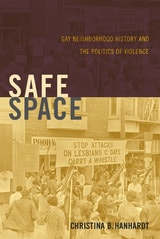
Safe Space
Gay Neighborhood History and the Politics of ViolenceChristina B. Hanhardt
Duke University Press, 2013
Since the 1970s, a key goal of lesbian and gay activists has been protection against street violence, especially in gay neighborhoods. During the same time, policymakers and private developers declared the containment of urban violence to be a top priority. In this important book, Christina B. Hanhardt examines how LGBT calls for "safe space" have been shaped by broader public safety initiatives that have sought solutions in policing and privatization and have had devastating effects along race and class lines.
Drawing on extensive archival and ethnographic research in New York City and San Francisco, Hanhardt traces the entwined histories of LGBT activism, urban development, and U.S. policy in relation to poverty and crime over the past fifty years. She highlights the formation of a mainstream LGBT movement, as well as the very different trajectories followed by radical LGBT and queer grassroots organizations. Placing LGBT activism in the context of shifting liberal and neoliberal policies, Safe Space is a groundbreaking exploration of the contradictory legacies of the LGBT struggle for safety in the city.
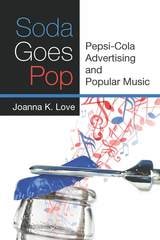
Soda Goes Pop
Pepsi-Cola Advertising and Popular MusicJoanna K. Love
University of Michigan Press, 2019
Soda Goes Pop investigates these and other vital questions around the evolving relationships between popular music and corporate advertising. Joanna K. Love joins musical analysis, historical research, and cultural theory to trace parallel shifts in these industries over eight decades. In addition to scholarly and industry resources, she draws on first-hand accounts, pop culture magazines, trade press journals, and other archival materials. Pepsi’s longevity as an influential American brand, its legendary commercials, and its pioneering, relentless pursuit of alliances with American musical stars makes the brand a particularly instructive point of focus. Several of the company’s most famous ad campaigns are prime examples of the practice of redaction, whereby marketers select, censor, and restructure musical texts to fit commercial contexts in ways that revise their aesthetic meanings and serve corporate aims. Ultimately, Love demonstrates how Pepsi’s marketing has historically appropriated and altered images of pop icons and the meanings of hit songs, and how these commercials shaped relationships between the American music business, the advertising industry, and corporate brands.
Soda Goes Pop is a rich resource for scholars and students of American studies, popular culture, advertising, broadcast media, and musicology. It is also an accessible and informative book for the general reader, as Love’s musical and theoretical analyses are clearly presented for non-specialist audiences and readers with varying degrees of musical knowledge.
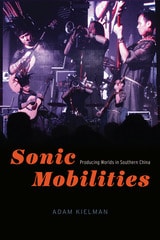
Sonic Mobilities
Producing Worlds in Southern ChinaAdam Kielman
University of Chicago Press, 2022
Guangzhou is a large Chinese city like many others. With a booming economy and abundant job opportunities, it has become a magnet for rural citizens seeking better job prospects as well as global corporations hoping to gain a foothold in one of the world’s largest economies. This openness and energy have led to a thriving popular music scene that is every bit the equal of Beijing’s. But the musical culture of Guangzhou expresses the city’s unique cosmopolitanism. A port city that once played a key role in China’s maritime Silk Road, Guangzhou has long been an international hub. Now, new migrants to the city are incorporating diverse Chinese folk traditions into the musical tapestry.
In Sonic Mobilities, ethnomusicologist Adam Kielman takes a deep dive into Guangzhou's music scene through two bands, Wanju Chuanzhang (Toy Captain) and Mabang (Caravan), that express ties to their rural homelands and small-town roots while forging new cosmopolitan musical connections. These bands make music that captures the intersection of the global and local that has come to define Guangzhou, for example by writing songs with a popular Jamaican reggae beat and lyrics in their distinct regional dialects mostly incomprehensible to their audiences. These bands create a sound both instantly recognizable and totally foreign, international and hyper-local. This juxtaposition, Kielman argues, is an apt expression of the demographic, geographic, and political shifts underway in Guangzhou and across the country. Bridging ethnomusicology, popular music studies, cultural geography, and media studies, Kielman examines the cultural dimensions of shifts in conceptualizations of self, space, publics, and state in a rapidly transforming the People’s Republic of China.
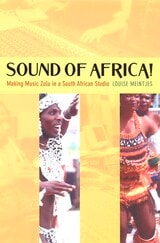
Sound of Africa!
Making Music Zulu in a South African StudioLouise Meintjes
Duke University Press, 2003
Focusing on the ways artists, producers, and sound engineers collaborate in the studio control room, Meintjes reveals not only how particular mbaqanga sounds are shaped technically, but also how egos and artistic sensibilities and race and ethnicity influence the mix. She analyzes how the turbulent identity politics surrounding Zulu ethnic nationalism impacted mbaqanga artists' decisions in and out of the studio. Conversely, she explores how the global consumption of Afropop and African images fed back into mbaqanga during the recording process. Meintjes is especially attentive to the ways the emotive qualities of timbre (sound quality or tone color) forge complex connections between aesthetic practices and political ideology. Vivid photos by the internationally renowned photographer TJ Lemon further dramatize Meintjes’ ethnography.

Sounds English
TRANSNATIONAL POPULAR MUSICNabeel Zuberi
University of Illinois Press, 2001
Zuberi looks at how the sounds, images, and lyrics of English popular music generate and critique ideas of national belonging, recasting the social and even the physical landscapes of cities like Manchester and London. The Smiths and Morrissey play on romanticized notions of the (white) English working class, while the Pet Shop Boys map a "queer urban Britain" in the AIDS era. The techno-culture of raves and dance clubs incorporates both an anti-institutional do-it-yourself politics and emergent leisure practices, while the potent mix of technology and creativity in British black music includes local conditions as well as a sense of global diaspora. British Asian musicians, drawing on Afrodiasporic and South Asian traditions, seek a sense of place in Britain as commercial interests try to pin down an image of them to market.
Sounds English shows how popular music complicates cherished notions of Englishness as it activates cultural outsiders and taps into a sense of not belonging. Alert and readable, Zuberi's wide-ranging discussion includes the performers Oasis, Blur, Tricky, Massive Attack, Goldie, A Guy Called Gerald, Roni Size, Bally Sagoo, Funˆdaˆmental, Echobelly, Cornershop, Talvin Singh, and others.
Sounds of the South
Daniel W. Patterson, ed.
Duke University Press, 1991
"Sounds of the South"—a 1989 conference that gathered record collectors, folklorists, musicians, record producers, librarians, archivists, and traditional music lovers—celebrated the official opening of the Southern Folklife Collection with the John Edwards Memorial Collection at the library of the University of North Carolina, Chapel Hill. Based on that conference, Sounds of the South includes Bill Malone's account of his own career as fan and scholar of country music, Paul Oliver on European blues scholarship, and Ray Funk on researching Black Gospel Quartets.
The contributors look at a number of topics related to the role of the archivist/folklorist in recording and documenting the music of the South—evaluating past fieldwork and current needs in documentation, archival issues, prospects for the publication of recordings, and changes in music and technology. Written in an accessible style, this volume will be of interest to all those concerned with preserving the music of the American South.
Soundtrack Available
Essays on Film and Popular MusicPamela Robertson Wojcik and Arthur Knight, eds.
Duke University Press, 2001
With a cross-cultural emphasis, the contributors focus on movies that use popular songs from a variety of genres, including country, bubble-gum pop, disco, classical, jazz, swing, French cabaret, and showtunes. The films discussed range from silents to musicals, from dramatic and avant-garde films to documentaries in India, France, England, Australia, and the United States. The essays examine both “nondiegetic” music in film—the score playing outside the story space, unheard by the characters, but no less a part of the scene from the perspective of the audience—and “diegetic” music—music incorporated into the shared reality of the story and the audience. They include analyses of music written and performed for films, as well as the now common practice of scoring a film with pre-existing songs. By exploring in detail how musical patterns and structures relate to filmic patterns of narration, character, editing, framing, and mise-en-scene, this volume demonstrates that pop music is a crucial element in the film experience. It also analyzes the life of the soundtrack apart from the film, tracing how popular music circulates and acquires new meanings when it becomes an official soundtrack.
Contributors. Rick Altman, Priscilla Barlow, Barbara Ching, Kelley Conway, Corey Creekmur, Krin Gabbard, Jonathan Gill, Andrew Killick, Arthur Knight, Adam Knee, Jill Leeper, Neepa Majumdar, Allison McCracken, Murray Pomerance, Paul Ramaeker, Jeff Smith, Pamela Robertson Wojcik, Nabeel Zuberi
Soundtracks of Asian America
Navigating Race through Musical PerformanceGrace Wang
Duke University Press, 2015