70 books match the query 'Postmodernism (Literature)' and 7 start with s
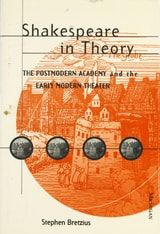
cover of Shakespeare in Theory: The Postmodern Academy and the Early Modern Theater

Shakespeare in Theory

The Postmodern Academy and the Early Modern Theater

Stephen Bretzius

University of Michigan Press, 1997

Shakespeare in Theory: The Postmodern Academy and the Early Modern Theater offers a provocative, highly original premise: that present-day literary criticism and theory have been shaped by the same institutional forces that shaped the theater of Shakespeare's day. Stephen Bretzius argues that Shakespeare's poetry and drama have been central to the development of postwar literary and cultural criticism, not just because his works validate these various critical approaches, but because the approaches variously replay his works, from the theater of the Renaissance to the contemporary American university. Where early modern theater once usurped the university, the postmodern university now refashions the theater, recasting in a theoretical register the same disappearing subjects, ideological contradictions, and imperialist illusions that it uncovers in Shakespeare.Individual chapters provide provocative interpretations of various postwar critical schools and Shakespearean dramas, including the New Historicism and Hamlet, feminism and The Taming of the Shrew, pragmatism and Henry V. Other approaches, including psychoanalysis, multiculturalism, feminism, deconstruction, and nuclear criticism are brought to bear on Love's Labor Lost, Julius Caesar, and Othello. A final chapter on Shakespeare and the Beatles provides a lively conclusion to an imaginative and thought-provoking volume.  "A wonderful book, both witty and incisive in its analysis of cold war literary theory. Bretzius proves the astounding thesis that Shakespearean plot provides the archetypes of theoretical desire for the postwar academy. Paul de Man, Jacques Derrida, Stephen Greenblatt, René Girard, Joel Fineman, pragmatists and feminists alike, appear among the cast of characters in the postmodern play-within-a-play called the 'University.' Bretzius's strong readings of Shakespeare and literary theory will instruct Renaissance and theory scholars alike and amuse a wide audience of readers." -- Tobin Siebers, University of Michigan
[more]
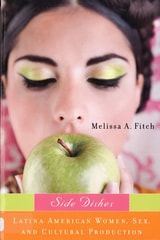
cover of Side Dishes: Latina American Women, Sex, and Cultural Production

Side Dishes

Latina American Women, Sex, and Cultural Production

Fitch, Melissa A

Rutgers University Press, 2009

Moving beyond the "main dishes" of traditional literary works, Side Dishes offers a provocative and delicious new understanding of Latin American women's authorship and activism. The book illuminates a wealth of creative and intellectual work by Latin American women—editors, directors, cartoonists, academics, performance artists, and comedians—and explores them in light of their treatment of women's sexuality.

Side Dishes considers feminist pornography and literary representations of masturbation, bisexuality, lesbianism, and sexual fantasies; the treatment of lust in stand-up comedy and science fiction; critical issues in leading feminist journals; and portrayals of sexuality in four contemporary Latin American films. Melissa A. Fitch concludes with a look at the rise of women's and gender studies programs in Latin America.
[more]
cover of Side Dishes: Latina American Women, Sex, and Cultural Production

Side Dishes

Latina American Women, Sex, and Cultural Production

Fitch, Melissa A

Rutgers University Press, 2009

Moving beyond the "main dishes" of traditional literary works, Side Dishes offers a provocative and delicious new understanding of Latin American women's authorship and activism. The book illuminates a wealth of creative and intellectual work by Latin American women—editors, directors, cartoonists, academics, performance artists, and comedians—and explores them in light of their treatment of women's sexuality.

Side Dishes considers feminist pornography and literary representations of masturbation, bisexuality, lesbianism, and sexual fantasies; the treatment of lust in stand-up comedy and science fiction; critical issues in leading feminist journals; and portrayals of sexuality in four contemporary Latin American films. Melissa A. Fitch concludes with a look at the rise of women's and gender studies programs in Latin America.
[more]
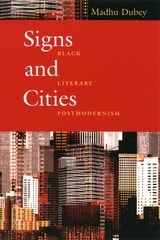
cover of Signs and Cities: Black Literary Postmodernism

Signs and Cities

Black Literary Postmodernism

Madhu Dubey

University of Chicago Press, 2003

Signs and Cities is the first book to consider what it means to speak of a postmodern moment in African-American literature. Dubey argues that for African-American studies, postmodernity best names a period, beginning in the early 1970s, marked by acute disenchantment with the promises of urban modernity and of print literacy.

Dubey shows how black novelists from the last three decades have reconsidered the modern urban legacy and thus articulated a distinctly African-American strain of postmodernism. She argues that novelists such as Octavia Butler, Samuel Delany, Toni Morrison, Gloria Naylor, Ishmael Reed, Sapphire, and John Edgar Wideman probe the disillusionment of urban modernity through repeated recourse to tropes of the book and scenes of reading and writing. Ultimately, she demonstrates that these writers view the book with profound ambivalence, construing it as an urban medium that cannot recapture the face-to-face communities assumed by oral and folk forms of expression.
[more]
cover of Stories Of Raymond Carver: A Critical Study

Stories Of Raymond Carver

A Critical Study

Kirk Nesset

Ohio University Press, 1994

Raymond Carver, known in some circles as the “godfather of minimalism,” has been credited by many as the rejuvenator of the once-dying American short story. (See the link on this page to a 2008 Kenyon Review story that discusses the recent controversy over the editing of Carver’s stories.) Drawing on representative tales from each of Carver’s major volumes of fiction, Nesset’s critical exploration leads us deep into the heart of Carver country, an eerie post-industrial world of low-rent survivors. In the earliest fiction, the politics of sex are tied to politics of fortune and chance; marriage as an institution is capricious and unsettling. In later stories, the gesture of telling stories provides an escape for certain of these characters, metaphorically and otherwise; and in Carver’s last stories, subtle strategies of language offer a similar, if more tentative release. From beginning to end, Carver’s distinctive, highly imitative style is intrinsic to his subject and is crucial in presenting what Carver called the “dark side of Reagan’s America.”

In this comprehensive study of Carver, Nesset discusses the relationship of minimalism and postmodern trends and the rise of new realism. By locating Carver in the gallery of American letters, Nesset shows him to be at once more simple and more complex than we might have believed, skillfully laying the groundwork for Carver studies to come.
[more]
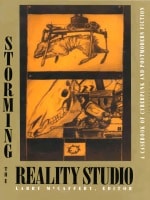
cover of Storming the Reality Studio: A Casebook of Cyberpunk & Postmodern Science Fiction

Storming the Reality Studio

A Casebook of Cyberpunk & Postmodern Science Fiction

Larry McCaffery, ed.

Duke University Press, 1992

The term “cyberpunk” entered the literary landscape in 1984 to describe William Gibson’s pathbreaking novel Neuromancer. Cyberpunks are now among the shock troops of postmodernism, Larry McCaffery argues in Storming the Reality Studio, marshalling the resources of a fragmentary culture to create a startling new form. Artificial intelligence, genetic engineering, multinational machinations, frenetic bursts of prose, collisions of style, celebrations of texture: although emerging largely from science fiction, these features of cyberpunk writing are, as this volume makes clear, integrally related to the aims and innovations of the literary avant-garde.

By bringing together original fiction by well-known contemporary writers (William Burroughs, Thomas Pynchon, Don DeLillo, Kathy Acker, J. G. Ballard, Samuel R. Delany), critical commentary by some of the major theorists of postmodern art and culture (Jacques Derrida, Fredric Jameson, Timothy Leary, Jean-François Lyotard), and work by major practitioners of cyberpunk (William Gibson, Rudy Rucker, John Shirley, Pat Cadigan, Bruce Sterling), Storming the Reality Studio reveals a fascinating ongoing dialog in contemporary culture.

What emerges most strikingly from the colloquy is a shared preoccupation with the force of technology in shaping modern life. It is precisely this concern, according to McCaffery, that has put science fiction, typically the province of technological art, at the forefront of creative explorations of our unique age.
A rich opporunity for reading across genres, this anthology offers a new perspective on the evolution of postmodern culture and ultimately shows how deeply technological developments have influenced our vision and our art.

Selected Fiction contributors: Kathy Acker, J. G. Ballard, William S. Burroughs, Pat Cadigan, Samuel R. Delany, Don DeLillo, William Gibson, Harold Jaffe, Richard Kadrey, Marc Laidlaw, Mark Leyner, Joseph McElroy, Misha, Ted Mooney, Thomas Pynchon, Rudy Rucker, Lucius Shepard, Lewis Shiner, John Shirley, Bruce Sterling, William Vollman

Selected Non-Fiction contributors: Jean Baudrillard, Jacques Derrida, Joan Gordon, Veronica Hollinger, Fredric Jameson, Arthur Kroker and David Cook, Timothy Leary, Jean-François Lyotard, Larry McCaffery, Brian McHale, Dave Porush, Bruce Sterling, Darko Suvin, Takayuki Tatsumi

[more]
cover of Structuring the Void: The Struggle for Subject in Contemporary American Fiction

Structuring the Void

The Struggle for Subject in Contemporary American Fiction

Jerome Klinkowitz

Duke University Press, 1992

If, as the literary theorists of postmodernism contend, “content” does not exist, then how can fiction continue to be written? Jerome Klinkowitz, himself a veteran practitioner and theorist of fiction, addresses this question in Structuring the Void, an account of what today’s novelists and short story writers do when they produce a fictive work. Klinkowitz’s focus is on the way in which writers have turned this lack of content itself into subject matter, and, by thus “structuring the void,” have created a new form of fiction.
Among the writers Klinkowitz discusses are Richard Brautigan, Kurt Vonnegut, Max Apple, Saul Bellow, Erica Jong, Susan Quist, Gerald Rosen, Rob Swigart, and Grace Paley. He shows how, in the absence of subject matter, these writers persist in the act of structuring—by organizing autobiography as a narrative device, ritualizing national history and popular culture, or formalizing a comic response to a new imaginative state, the state of California. Klinkowitz also considers subjects such as gender and war, which, though they cannot be represented, nevertheless exercise contraints on a writer’s intention to structure.
What emerges from Klinkowitz’s analysis is a clear sense of what today’s fiction—and fiction writing—is about. As such, Structuring the Void will prove invaluable to anyone with an interest in contemporary literature.
[more]