Results by title
160 books match the query 'Poverty & Homelessness' and 8 start with s
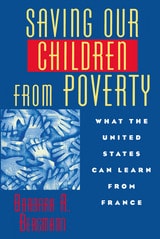
Saving Our Children From Poverty
What the United States Can Learn From FranceBarbara R. Bergmann
Russell Sage Foundation, 1996
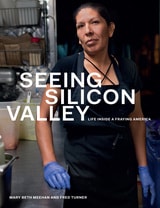
Seeing Silicon Valley
Life inside a Fraying AmericaMary Beth Meehan and Fred Turner
University of Chicago Press, 2021
It’s hard to imagine a place more central to American mythology today than Silicon Valley. To outsiders, the region glitters with the promise of extraordinary wealth and innovation. But behind this image lies another Silicon Valley, one segregated by race, class, and nationality in complex and contradictory ways. Its beautiful landscape lies atop underground streams of pollutants left behind by decades of technological innovation, and while its billionaires live in compounds, surrounded by redwood trees and security fences, its service workers live in their cars.
With arresting photography and intimate stories, Seeing Silicon Valley makes this hidden world visible. Instead of young entrepreneurs striving for efficiency in minimalist corporate campuses, we see portraits of struggle—families displaced by an impossible real estate market, workers striving for a living wage, and communities harmed by environmental degradation. If the fate of Silicon Valley is the fate of America—as so many of its boosters claim—then this book gives us an unvarnished look into the future.
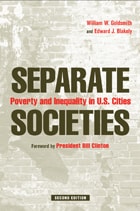
Separate Societies
Poverty and Inequality in U.S. CitiesAuthored by William W. Goldsmith and Edward J. Blakely with a foreword by President Bill Clinton
Temple University Press, 2010
“Economic and political forces no longer combat poverty—they generate poverty!" exclaim William Goldsmith and Edward Blakely in their report on the plight of American's urban poor. In this revised and updated edition of their 1992 book Separate Societies,the authors present a compelling examination of the damaging divisions that isolate poor city minority residents from the middle-class suburban majority. They pay special attention to how the needs of the permanently poor have been unmet through the alternating years of promises and neglect, and propose a progressive turn away from 30 years of conservative policies.
Separate Societies vividly documents how the urban working class has been pushed out of industrial jobs through global economic restructuring, and how the Wall Street meltdown has aggravated underemployment, depleted public services, and sharpened racial and class inequalities.
The authors insist that the current U.S. approach puts Americans out of work and lowers the standard of living for all. As such, Goldsmith and Blakely urge the Obama administration to create better urban policy and foster better metropolitan management to effectively and efficiently promote equality.

Shareveillance
The Dangers of Openly Sharing and Covertly Collecting DataClare Birchall
University of Minnesota Press, 2017
Cracking open the politics of transparency and secrecy
In an era of open data and ubiquitous dataveillance, what does it mean to “share”? This book argues that we are all “shareveillant” subjects, called upon to be transparent and render data open at the same time as the security state invests in practices to keep data closed. Drawing on Jacques Rancière’s “distribution of the sensible,” Clare Birchall reimagines sharing in terms of a collective political relationality beyond the veillant expectations of the state.
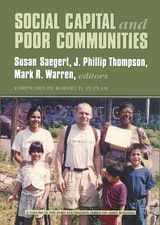
Social Capital and Poor Communities
Susan Saegert
Russell Sage Foundation, 2001
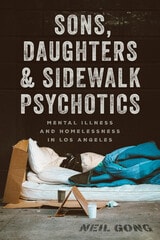
Sons, Daughters, and Sidewalk Psychotics
Mental Illness and Homelessness in Los AngelesNeil Gong
University of Chicago Press, 2024
Drawing on the nuanced experiences of patients and care providers, Sons, Daughters, and Sidewalk Psychotics introduces readers to two drastically different forms of community psychiatric services: public safety net clinics focused on keeping people housed and out of jail and elite private care trying to push clients toward respectable futures.
In downtown Los Angeles, many people in psychiatric crisis only receive help after experiencing homelessness or arrest. Public providers engage in guerrilla social work to secure housing and safety, but these programs are rarely able to deliver true rehabilitation for psychological distress and addiction. Patients are free to refuse treatment or use illegal drugs—so long as they do so away from public view. Across town in West LA or Malibu, wealthy people diagnosed with serious mental illness attend luxurious treatment centers. Programs may offer yoga and organic meals alongside personalized therapeutic treatments, but patients can feel trapped, as their families pay exorbitantly to surveil and “fix” them. Meanwhile, middle-class families—stymied by private insurers, unable to afford elite providers, and yet not poor enough to qualify for social services—struggle to find care at all.
Examining this divergent treatment of people facing similar mental struggles, Gong raises provocative questions about urban policy, individual freedom, and what it would take to create a fundamentally different psychiatric system—one that will meet the needs of patients, their loved ones, and society at large.
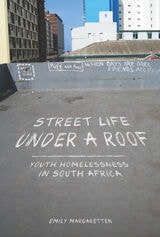
Street Life under a Roof
Youth Homelessness in South AfricaEmily Margaretten
University of Illinois Press, 2015
In Street Life under a Roof, Emily Margaretten draws on ten years of up-close fieldwork to explore the distinct cultural universe of the Point Place community. Margaretten's sensitive investigations reveal how young men and women draw on customary notions of respect and support to forge an ethos of connection and care that allows them to live far richer lives than ordinarily assumed. Her discussion of gender dynamics highlights terms like nakana--to care about or take notice of another--that young women and men use to construct "outside" and "inside" boyfriends and girlfriends and to communicate notions of trust. Margaretten exposes the structures of inequality at a local, regional, and global level that contribute to socioeconomic and political dislocation. But she also challenges the idea that Point Place's marginalized residents need "rehabilitation." As she argues, these young men and women want love, secure homes, and the means to provide for their dependents--in short, the same hopes and aspirations mirrored across South African society.
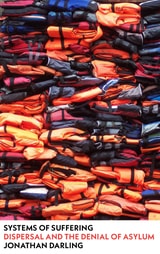
Systems of Suffering
Dispersal and the Denial of AsylumJonathan Darling
Pluto Press, 2021
Of the many state-enacted cruelties to which refugees and asylum seekers are subjected, detention and deportation loom largest in popular consciousness. But there is a third practice, perpetrating a slower violence, that remains hidden: dispersal.
Jonathan Darling provides the first detailed account of how dispersal - the system of accommodation and support for asylum seekers and refugees in Britain - both sustains and produces patterns of violence, suffering and social abjection. He explores the evolution of dispersal as a privatized process, from the first outsourced asylum accommodation contracts in 2012 to the renewed wave of outsourcing pursued by the Home Office today.
Drawing on six years of research into Britain's dispersal system, and foregrounding the voices and experiences of refugees and asylum seekers, Darling argues that dispersal has played a central role in the erasure of asylum from public concern. Systems of Suffering is a vital tool in the arsenal of those fighting to hold the government to account for the violence of its asylum policy and practice.