Results by title
471 books match the query 'Power' and 35 start with s

Sadomasochism in Everyday Life
The Dynamics of Power and PowerlessnessChancer, Lynn S.
Rutgers University Press, 1992
Lynn Chancer advances the provocative thesis that sadomasochism is far more prevalent in contemporary societies like the United States than we realize. According to Chancer, sexual sadomasochism is only the best-known manifestation of what is actually a much more broadly based social phenomenon. Moving from personal relationships to school, the workplace, and other interactions, Chancer uses a variety of examples that are linked by a recurrent pattern of behavior. She goes beyond the predominantly individualistic and psychological explanations generally associated with sadomasochism (including those popularized in the "how to" literature of the recent Women Who Love Too Much genre) toward a more sociological interpretation. Chancer suggests that the structure of societies organized along male-dominated and capitalistic lines reflects and perpetuates a sadomasochistic social psychology, creating a culture steeped in everyday experiences of dominance and subordination.
In the first part of the book, Chancer discusses the prevalence of sadomasochistic cultural imagery in contemporary America and examines sadomasochism through several perspectives. She develops a set of definitional traits both through existential analysis of an instance of S/M sex and by incorporating a number of Hegelian and psychoanalytic concepts. In the second part of the book, she places sadomasochism in a broader context by exploring whether and how it appears in the workplace and how it relates to gender and race.

Savage Anomaly
The Power of Spinoza’s Metaphysics and PoliticsAntonio Negri
University of Minnesota Press, 1999
A fresh take on this critical philosopher.
In this essential rereading of Spinoza’s (1632-1677) philosophical and political writings, Negri positions this thinker within the historical context of the development of the modern state and its attendant political economy. Through a close examination of Spinoza, Negri reveals him as unique among his contemporaries for his nondialectical approach to social organization in a bourgeois age.

Science as Power
Discourse and Ideology in Modern SocietyStanley Aronowitz
University of Minnesota Press, 1988
Science as Power was first published in 1988. Minnesota Archive Editions uses digital technology to make long-unavailable books once again accessible, and are published unaltered from the original University of Minnesota Press editions.
Science has established itself as not merely the dominant but the only legitimate form of human knowledge. By tying its truth claims to methodology, science has claimed independence from the influence of social and historical conditions. Here, Aronowitz asserts that the norms of science are by no means self-evident and that science is best seen as a socially constructed discourse that legitimates its power by presenting itself as truth.
Stanley Aronowitz is professor of sociology in the graduate school of City University of New York. His books include Working Class Hero: A New Strategy for Labor and, with Henry Giroux, Education Under Siege.
Science by the People
Participation, Power, and the Politics of Environmental KnowledgeAya H. Kimura
Rutgers University Press, 2019
Citizen science—research involving nonprofessionals in the research process—has attracted both strong enthusiasts and detractors. Many environmental professionals, activists, and scholars consider citizen science part of their toolkit for addressing environmental challenges. Critics, however, contend that it represents a corporate takeover of scientific priorities. In this timely book, two sociologists move beyond this binary debate by analyzing the tensions and dilemmas that citizen science projects commonly face. Key lessons are drawn from case studies where citizen scientists have investigated the impact of shale oil and gas, nuclear power, and genetically engineered crops. These studies show that diverse citizen science projects face shared dilemmas relating to austerity pressures, presumed boundaries between science and activism, and difficulties moving between scales of environmental problems. By unpacking the politics of citizen science, this book aims to help people negotiate a complex political landscape and choose paths moving toward social change and environmental sustainability.

Screen Couple Chemistry
The Power of 2By Martha P. Nochimson
University of Texas Press, 2002
Astaire and Rogers, Tracy and Hepburn. Just the mention of their names evokes the powerful chemistry between these screen couples, which utterly transcended the often formulaic films in which they appeared together. Indeed, watching the synergistic flow of energy between charismatic screen partners is one of the great pleasures of cinema and television, as well as an important vehicle for thinking through issues of intimacy and gender relations.
In this book, Martha P. Nochimson engages in a groundbreaking study of screen couple chemistry. She begins by classifying various types of couples to define what sets the synergistic couple apart from other onscreen pairings. Then she moves into extended discussions of four enduring screen couples—Maureen O'Sullivan/Johnny Weissmuller, Myrna Loy/William Powell, Fred Astaire/Ginger Rogers, and Katharine Hepburn/Spencer Tracy. Using theories of neuroscience, she demonstrates that their onscreen chemistry is a very real phenomenon, powerful enough to subvert conventional formulations of male/female relations. Material she has uncovered in the infamous Production Code Administration files illuminates the historical context of her contentions. Finally, Nochimson traces the screen couple to its present-day incarnation in such pairs as Woody Allen/Diane Keaton, Scully/Mulder of The X-Files, and Cliff/Claire Huxtable of The Cosby Show.
Searching for Africa in Brazil
Power and Tradition in CandombléStefania Capone
Duke University Press, 2010
Challenging the usual interpretations of Afro-Brazilian religions as fixed entities, completely independent of one another, Capone reveals these practices as parts of a unique religious continuum. She does so through an analysis of ritual variations as well as discursive practices. To illuminate the continuum of Afro-Brazilian religious practice and the tensions between exegetic discourses and ritual practices, Capone focuses on the figure of Exu, the sacred African trickster who allows communication between gods and men. Following Exu and his avatars, she discloses the centrality of notions of prestige and power—mystical and religious—in Afro-Brazilian religions. To explain how religious identity is constantly negotiated among social actors, Capone emphasizes the agency of practitioners and their political agendas in the “return to roots,” or re-Africanization, movement, an attempt to recover the original purity of a mythical and legitimizing Africa.

Secrecy
Silence, Power, and ReligionHugh B. Urban
University of Chicago Press, 2021
With Secrecy, Urban investigates several revealing instances of the power of secrecy in religion, including nineteenth-century Scottish Rite Freemasonry, the sexual magic of a Russian-born Parisian mystic; the white supremacist BrüderSchweigen or “Silent Brotherhood” movement of the 1980s, the Five Percenters, and the Church of Scientology. An electrifying read, Secrecy is the culmination of decades of Urban’s reflections on a vexed, ever-present subject.

Seeds of Power
Environmental Injustice and Genetically Modified Soybeans in ArgentinaAmalia Leguizamón
Duke University Press, 2020

Seeking a Future for the Past
Space, Power, and Heritage in a Chinese CityPhilipp Demgenski
University of Michigan Press, 2024

Sex, Power, and Slavery
Gwyn Campbell
Ohio University Press, 2014
Sexual exploitation was and is a critical feature of enslavement. Across many different societies, slaves were considered to own neither their bodies nor their children, even if many struggled to resist. At the same time, paradoxes abound: for example, in some societies to bear the children of a master was a potential route to manumission for some women. Sex, Power, and Slavery is the first history of slavery and bondage to take sexuality seriously.
Twenty-six authors from diverse scholarly backgrounds look at the vexed, traumatic intersections of the histories of slavery and of sexuality. They argue that such intersections mattered profoundly and, indeed, that slavery cannot be understood without adequate attention to sexuality. Sex, Power, and Slavery brings into conversation historians of the slave trade, art historians, and scholars of childhood and contemporary sex trafficking. The book merges work on the Atlantic world and the Indian Ocean world and enables rich comparisons and parallels between these diverse areas.
Contributors: David Brion Davis, Martin Klein, Richard Hellie, Abdul Sheriff, Griet Vankeerberghen, E. Ann McDougall, Matthew S. Hopper, Marie Rodet, George La Rue, Ulrike Schmieder, Tara Iniss, Mariana Candido, James Francis Warren, Johanna Ransmeier, Roseline Uyanga with Marie-Luise Ermisch, Francesca Ann Louise Mitchell, Shigeru Sato, Gabeba Baderoon, Charmaine Nelson, Ana Lucia Araujo, Brian Lewis, Ronaldo Vainfas, Salah Trabelsi, Joost Coté, Sandra Evers, and Subho Basu

Shakespearean Educations
Power, Citizenship, and PerformanceCoppélia Kahn
University of Delaware Press, 2011
Published by University of Delaware Press. Distributed worldwide by Rutgers University Press.

Shamans of the Foye Tree
Gender, Power, and Healing among Chilean MapucheBy Ana Mariella Bacigalupo
University of Texas Press, 2007
Drawing on anthropologist Ana Mariella Bacigalupo's fifteen years of field research, Shamans of the Foye Tree: Gender, Power, and Healing among Chilean Mapuche is the first study to follow shamans' gender identities and performance in a variety of ritual, social, sexual, and political contexts.
To Mapuche shamans, or machi, the foye tree is of special importance, not only for its medicinal qualities but also because of its hermaphroditic flowers, which reflect the gender-shifting components of machi healing practices. Framed by the cultural constructions of gender and identity, Bacigalupo's fascinating findings span the ways in which the Chilean state stigmatizes the machi as witches and sexual deviants; how shamans use paradoxical discourses about gender to legitimatize themselves as healers and, at the same time, as modern men and women; the tree's political use as a symbol of resistance to national ideologies; and other components of these rich traditions.
The first comprehensive study on Mapuche shamans' gendered practices, Shamans of the Foye Tree offers new perspectives on this crucial intersection of spiritual, social, and political power.

Shaping the Future of Power
Knowledge Production and Network-Building in China-Africa RelationsLina Benabdallah
University of Michigan Press, 2020

Sharing the Balance of Power
An Examination of Shared Power in the Michigan House of Representatives, 1993-1994Daniel Loepp
University of Michigan Press, 1999
Like national politicians, state legislators all too often focus on partisanship instead of policy making, engaging themselves in rancorous debate that achieves little beyond gridlock. However, during one short period in Michigan's history, legislators stopped bickering and focused on forging compromise. Daniel Loepp's Sharing the Balance of Power chronicles the 87th Michigan Legislature (1993-1994), in which Republicans and Democrats successfully shared power.
In 1992, Michigan voters elected exactly fifty-five Republicans and fifty-five Democrats to the state house. As a result, the two parties each elected a co-speaker, and a shared power agreement was forged. Given the history of intense partisanship in the state house, political pundits predicted that any plan for shared power would disintegrate within months. What resulted instead was one of the most productive legislatures in Michigan history.
Author Daniel Loepp, chief of staff to Democratic Co-Speaker Curtis Hertel at the time, skillfully takes the reader "inside" the State Capitol, examining the key policy debates (including school finance reform), important personalities, and difficult negotiations. Loepp's balanced presentation is testimony to the two years of bi-partisan cooperation in which he took part.
In an age of public cynicism about the legislative process, Daniel Loepp offers the reader a refreshing story about two co-speakers and their 108 colleagues who came together in the spirit of bi-partisan representation to successfully serve their constituents, the people of Michigan.
Daniel Loepp is a partner in the firm of Karoub Associates, Michigan's oldest multi-client lobbying firm.

Shows of Force
Power, Politics, and Ideology in Art ExhibitionsTimothy W. Luke
Duke University Press, 1992
The first section, “Envisioning a Past, Imagining the West,” looks at art exhibitions devoted to artworks about or from the American West. Luke shows how these exhibitions—displaying nineteenth- and early-twentieth century works by artists such as George Caleb Bingham, Frederic Remington, Frederic Edwin Church, and Georgia O’Keefe—express contemporary political agendas in the way the portray “the past” and shape new visions of “the West.”
In “Developing the Present, Defining a World,” Luke considers artists from the post-1945 era, including Ilya Kabokov, Hans Haacke, Sue Coe, Roger Brown, and Robert Longo. Recent art exhibits, his analysis reveals, attempt to develop politically charged conceptions of the present, which in turn struggle to define the changing contemporary world and art’s various roles within it.
Luke brings to light the contradictions encoded in the exhibition of art and, in doing so, illuminates the political realities and cultural ideologies of the present. Shows of Force offers a timely and surely controversial contribution to current discussions of the politics of exhibiting art.

Signs of Power
The Rise of Cultural Complexity in the SoutheastEdited by Jon L. Gibson and Philip J. Carr
University of Alabama Press, 2004
Traces the sources of power and large-scale organization of prehistoric peoples among Archaic societies.
By focusing on the first instances of mound building, pottery making, fancy polished stone and bone, as well as specialized chipped stone, artifacts, and their widespread exchange, this book explores the sources of power and organization among Archaic societies. It investigates the origins of these technologies and their effects on long-term (evolutionary) and short-term (historical) change.
The characteristics of first origins in social complexity belong to 5,000- to 6,000-year-old Archaic groups who inhabited the southeastern United States. In Signs of Power, regional specialists identify the conditions, causes, and consequences that define organization and social complexity in societies. Often termed "big mound power," these considerations include the role of demography, kinship, and ecology in sociocultural change; the meaning of geometry and design in sacred groupings; the degree of advancement in stone tool technologies; and differentials in shell ring sizes that reflect social inequality.
Silence and Power
A Reevaluation of Djuna BarnesEdited by Mary Lynn Broe. Afterword by Catharine Stimpson
Southern Illinois University Press, 1991
Roughly chronological, these essays explore Barnes’ early work in the New York newspaper world of the ‘teens, proceed through the 1954 publication of The Antiphon, and include several approaches to such works as Ryder, Ladies Almanack, and Nightwood. This judicious mix of essays—many of them illustrated by photographs and drawings—presents a comprehensive picture of the creative imagination of Djuna Barnes.
Essayists include Mary Lynn Broe, Nancy J. Levine, Ann Larabee, Joan Retallack, Carolyn Allen, Carolyn Burke, Sheryl Stevenson, Marie Ponsot, Frances M. Doughty, Susan Sniader Lanser, Frann Michel, Karla Jay, Jane Marcus, Judith Lee, Julie L. Abraham, Meryl Altman, Lynda Curry, Louise A. DeSalvo, and Catharine Stimpson. Individuals sharing personal recollections of Barnes are Ruth Ford, James B. Scott, Alex Gildzen, Hank O’Neal, Chester Page, Andrew Field, and Frances McCullough. Janice Thom and Kevin Engel provide an updated bibliography.
From The Book of Repulsive Women to The Antiphon, Barnes challenged old gender dichotomies as she shaped radical sociopolitical views. Her textual methods celebrated a multiplicity of voices, heterodox forms, and genres, transgressing those tenets of modernism that privilege the “high art” of a single, unified textual identity or a discrete discourse. These essays offer various critical approaches and sinuous readings of the full range of Barnes’ achievement. Interwoven through the essays and reminiscences is a lively commentary from Barnes’ friends and contemporaries as well as Barnes herself.

Skin Color, Power, and Politics in America
Mara Cecilia Ostfeld
Russell Sage Foundation, 2022
Ostfeld and Yadon surveyed over 1,300 people about their political views, including party affiliation, their opinions on welfare, and the importance of speaking English in the U.S. The authors created a matrix grounded in their “Roots of Race” framework, which predicts the relationship between skin color and political attitudes for each ethnoracial group based on the blurriness of the group’s boundaries and historical levels of privilege. They draw upon three distinct measures of skin color to conceptualize the relationship between skin color and political views: “Machine-Rated Skin Color,” measured with a light-reflectance meter; “Self-Assessed Skin Color,” using the Yadon-Ostfeld Skin Color Scale; and “Skin Color Discrepancy,” the difference between one’s Machine-Rated and Self-Assessed Skin Color.
Ostfeld and Yadon examine patterns that emerge among these measures, and their relationships with life experiences and political stances. Among Latinos, a group with relatively blurry group boundaries and low levels of historical privilege, the authors find a robust relationship between political views and Self-Assessed Skin Color. Latinos who overestimate the lightness of their skin color are more likely to hold conservative views on current racialized political issues, such as policing. Latinos who overestimate the darkness of their skin color, on the other hand, are more likely to hold liberal political views. As America’s major political parties remain divided on issues of race, this suggests that for Latinos, self-reported skin color is used as a means of aligning oneself with valued political coalitions.
African Americans, another group with low levels of historical privilege but with more clearly defined group boundaries, demonstrated no significant relationship between skin color and political attitudes. Thus, the lived experiences associated with being African American appeared to supersede the differences in life experiences due to skin color.
Whites, a group with more historical privilege and increasingly blurry group boundaries, showed a clear relationship between machine-assessed skin color and attitudes on political issues. Those with darker Machine-Rated Skin Color are more likely to hold conservative views, suggesting that they are responding to the threat of losing their privilege in a multicultural society.
At a time when the U.S. is both more diverse and politically divided, Skin Color, Power, and Politics in Americais a timely account of the ways in which skin color and politics are intertwined.
Slavery Unseen
Sex, Power, and Violence in Brazilian HistoryLamonte Aidoo
Duke University Press, 2018

Small Town in Mass Society
Class, Power, and Religion in a Rural Community (rev. ed.)Arthur J. Vidich and Joseph BensmanForeword by Michael W. Hughey
University of Illinois Press, 2000
Through a close study of "Springdale, New York," Arthur J. Vidich and Joseph Bensman depict the small town as continuously and increasingly drawn into the central institutions and processes of the total society. Vidich and Bensman based their conclusions on extensive interviews with and close observation of the inhabitants of one community. The original publication of the book caused a sharp response among the town's citizens who felt their trust had been violated and their town misrepresented.
The present volume includes the editorials and correspondence evoked by that controversy, the authors' articles describing their methodology, a new foreword by Michael W. Hughey, and a new afterword in which Arthur J. Vidich recounts the creation and history of the book.

Society, Power, and Land in Northeastern Zimbabwe, ca. 1560–1960
Admire Mseba
Ohio University Press, 2024
This book refocuses attention on how regimes of power rooted in kinship, gender, generation, and status have, individually and in combination, informed access to land in precolonial northeastern Zimbabwe. It then examines how these regimes of power interacted with colonial policies to inform the African experience in colonial Zimbabwe. Further, the book places land and the ability to ensure its fecundity at the center of the making and moderation of precolonial political power and how this power was impacted by the imposition of colonial rule.
Tracing the dynamics of land and power from precolonial times, together with their entanglement with colonial policies, is important, for this relationship is almost always neglected by both scholars and policymakers drawn to the high drama of colonial and postcolonial politics of land. This oversight has real consequences on our understandings of landed inequalities and how they are addressed. When Zimbabwe’s postcolonial state focused on colonially induced racialized land inequalities, its land reform efforts left older forms of landed inequalities based on gender, generation, and ideas of belonging intact. The book, which details these inequalities, reminds Zimbabweans and others that if the quest for equity espoused in postcolonial land reforms is to be meaningful, it must be attentive to both colonially induced inequalities and those enduring disparities that predated, were deepened by, and outlived colonial rule. At the same time, Zimbabweans who now live with a postcolonial state that is increasingly centralizing power over land may well learn from past societies’ creative efforts to limit the authority of their leaders.
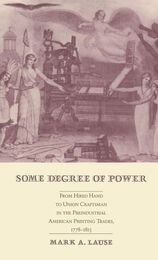
Some Degree of Power
From Hired Hand to Union Craftsman in the Preindustrial American Printing Trades 1778-1815Mark Lause
University of Arkansas Press, 1991

Songs of Power and Prayer in the Columbia Plateau
The Jesuit, the Medicine Man, and the Indian Hymn SingerChad S. Hamill
Oregon State University Press, 2012
In Chad Hamill’s narrative, a Jesuit and his two Indian “grandfathers”—one a medicine man, the other a hymn singer—engage in a collective search for the sacred. The priest becomes a student of the medicine man. The medicine man becomes a Catholic. The Indian hymn singer brings indigenous songs to the Catholic mass. Using song as a thread, these men weave together two worlds previously at odds, realizing a promise born two centuries earlier within the prophecies of Circling Raven and Shining Shirt.
Songs of Power and Prayer reveals how song can bridge worlds: between the individual and Spirit, the Jesuits and the Indians. Whether sung in an indigenous ceremony or adapted for Catholic Indian services, song abides as a force that strengthens Native identity and acts as a conduit for power and prayer.
A First Peoples: New Directions in Indigenous Studies book
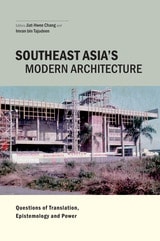
Southeast Asia's Modern Architecture
Questions of Translation, Epistemology and PowerEdited by Jiat-Hwee Chang and Imran bin Tajudeen
National University of Singapore Press, 2018

Sovereignty and Survival
Power, Conflict and Climate Change in BurmaAshley South
National University of Singapore Press, 2027
Evaluates Burma at a pivotal tipping point after the 2021 military coup.
The 2021 military coup in Burma/Myanmar triggered popular resistance and a spreading civil war, reigniting long-standing struggles for ethnic self-determination. The chaos has enabled a huge rise in transnational criminal activities, including drug trafficking and the emergence of scam centers. The country's geopolitical importance, not least as a source of rare earths, is also heightening the struggle for power. At the same time, accelerating climate change is destabilizing local ecologies and livelihoods, driving food production, socio-economic systems, and civil society towards collapse or massive change. Together, these forces have undermined the coherence of Burma as a centralized state. However, new forms of resistance and political organization have emerged in liberated areas across the country. At this critical juncture, rather than “state failure,” Burma demonstrates novel forms of complex, asymmetrical, and sometimes messy state-building, a “bottom-up” federalism based on the agency and resilience of Indigenous communities and anti-junta forces.
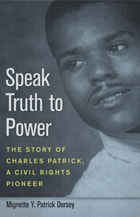
Speak Truth to Power
The Story of Charles Patrick, a Civil Rights PioneerMignette Y. Patrick Dorsey
University of Alabama Press, 2010
"Patrick did not intend to become a civil rights pioneer, but a minor dispute over a parking spot led to his arrest, beating while in custody, and eventual legal tribulations. His daughter's account of his ordeal is well researched, beautifully narrated, and extremely informative." —Journal of Southern History
On December 11, 1954, Charles Patrick drove to downtown Birmingham to buy a Boy Scout uniform for his son. Christmas traffic around the downtown department stores was heavy, and Patrick circled unsuccessfully until at last a streetside spot opened up and he began to pull in. As he did so, he was cut off by a woman who ordered him out of the way, as she was the wife of a city police officer. Patrick pulled away, remarking, "Ma’am, he doesn’t own the streets of Birmingham."
Normal low-level urban hassle? Not in 1954 Birmingham, when the woman was white and Patrick black. The woman reported to her husband that a black man had sassed her, and Patrick was summarily arrested, charged with disorderly conduct, and placed in a cell where he was beaten by the husband and another police officer.
Usually that would have been the end of it, but Patrick was not the sort of man to meekly endure an injustice. He found an attorney, went to court to fight the charges, and brought his assailants to justice--as whites, blacks, politicians and the press offered public support.
This book tells the story of Patrick’s quest for justice in segregated Alabama on the eve of the civil rights movement and represents a telling instance of the growing determination of African Americans to be treated fairly, part of the broadening and deepening stream of resolve that led to the widespread activism of the civil rights movement.

Speaker Jim Wright
Power, Scandal, and the Birth of Modern PoliticsBy J. Brooks Flippen
University of Texas Press, 2018
Honorable Mention, Ramirez Family Award for Most Significant Scholarly Book, Texas Institute of Letters, 2019
Jim Wright made his mark on virtually every major public policy issue in the later twentieth century—energy, education, taxes, transportation, environmental protection, civil rights, criminal justice, and foreign relations, among them. He played a significant role in peace initiatives in Central America and in the Camp David Accords, and he was the first American politician to speak live on Soviet television. A Democrat representing Texas’s twelfth district (Fort Worth), Wright served in the US House of Representatives from the Eisenhower administration to the presidency of George H. W. Bush, including twelve years (1977–1989) as majority leader and speaker. His long congressional ascension and sudden fall in a highly partisan ethics scandal spearheaded by Newt Gingrich mirrored the evolution of Congress as an institution.
Speaker Jim Wright traces the congressman’s long life and career in a highly readable narrative grounded in extensive interviews with Wright and access to his personal diaries. A skilled connector who bridged the conservative and liberal wings of the Democratic party while forging alliances with Republicans to pass legislation, Wright ultimately fell victim to a new era of political infighting, as well as to his own hubris and mistakes. J. Brooks Flippen shows how Wright’s career shaped the political culture of Congress, from its internal rules and power structure to its growing partisanship, even as those new dynamics eventually contributed to his political demise. To understand Jim Wright in all his complexity is to understand the story of modern American politics.

Speaking Chicana
Voice, Power, and IdentityD. Letticia Galindo
University of Arizona Press, 1999
Part 1. Reconstruction: Language Varieties, Language Use, and Language Attitudes
1. Crossing Social and Cultural Borders: The Road to Language Hybridity, María Dolores Gonzales
2. Fighting Words: Latina Girls, Gangs, and Language Attitudes, Norma Mendoza-Denton
Part 2. Reflection: Testimonios
3. Speaking as a Chicana: Tracing Cultural Heritage through Silence and Betrayal, Jacqueline M. Martínez
4. The Power of Language: From the Back of the Bus to the Ivory Tower, Christine Marín
5. Challenging Tradition: Opening the Headgate, Ida M. Luján
6. Mexican Blood Runs through My Veins, Aurora E. Orozco
Part 3. Innovation: Speaking Creatively/Creatively Speaking
7. Searching for a Voice: Ambiguities and Possibilities, Erlinda Gonzales-Berry
8. Sacred Cults, Subversive Icons: Chicanas and the Pictorial Language of Catholicism, Charlene Villaseñor Black
9. Caló and Taboo Language Use among Chicanas: A Description of Linguistic Appropriation and Innovation, D. Letticia Galindo
10. Máscaras, Trenzas, y Greñas: Un/Masking the Self While Un/Braiding Latina Stories and Legal Discourse, Margaret E. Montoya
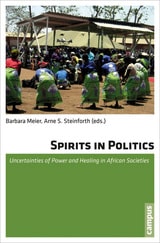
Spirits in Politics
Uncertainties of Power and Healing in African SocietiesEdited by Barbara Meier and Arne S. Steinforth
Campus Verlag, 2013

Sports, Power, and Resistance
An Introduction to Critical Sports StudiesEdited by Thomas P. Oates and Travis Vogan
University of Illinois Press, 2026
Topics range from Black coaches in the National Football League to disordered eating within distance running to transgender athletes’ fight to participate in sports. The editors have organized the contributions into three sections. Part one probes how sports build communities that foster belonging as well as exclusion. The essays in part two explore multiple forms of resistance in sports through various performances and representations. In the final section, essayists analyze more explicit efforts to use sports as a platform for activism from various political viewpoints. Throughout, the works nurture and demonstrate a sensibility that encourages humanistic, critical, and interdisciplinary inquiry.
Wide-reaching and accessible, Sports, Power, and Resistance explores timely issues while demonstrating the value of blending perspectives to better understand the games we play and watch.
Contributors: Ali Bouterse, Adrian Burgos, Jr., Michael L. Butterworth, Noah Cohan, Douglas Hartmann, Victoria E. Johnson, Abraham I. Khan, Jason Kido Lopez, Theresa Runstedtler, Jaime Schultz, Samantha N. Sheppard, and Travers

Story Tech
Power, Storytelling, and Social Change AdvocacyFilippo Trevisan, Michael Vaughan, and Ariadne Vromen
University of Michigan Press, 2025
Story Tech explores the increasingly influential impact of technologies—such as databases, algorithms, and digital story banks—that are usually invisible to the public. It shows that hidden “story tech” enables political organizations to treat stories as data that can be queried for storylines and used to intervene in news and information cycles in real time. In particular, the authors review successful story-centered campaigns that helped change dominant narratives on disability rights, marriage equality, and essential workers’ rights in the United States and Australia. They compare the use of storytelling advocacy across different types of organizations including volunteer grassroots groups, large national advocacy coalitions, and trade unions, and examine how trends differ for storytellers, organizers, and their technology partners. As political stories shift to being “on demand,” they reshape power relationships in key public debates in ways that produce moments of tension as well as positive narrative change. Story Tech examines these trends and illustrates how storytelling success can—and should—be achieved in conjunction with personal dignity, privacy, and empowerment for storytellers and their communities, particularly marginalized ones.

Story and Situation
Narrative Seduction and the Power of FictionRoss Chambers
University of Minnesota Press, 1984
Ross Chambers shifs the emphasis to precisely the play of authority and mastery by focusing on the narrative situation or the “point” of telling a story in given context. He studies the relation between teller and listener in a set of French, English, and American short stories from the nineteenth and early twentieth centuries and detects in that relationship the key to the power of fiction. In each of these stories, the author identifies the narrative situation by recourse to the metaphor of seduction, a phenomenon Chambers finds characteristic of literary production in the modern period.
“Story and Situation is a powerful work of criticism, the best work in short narrative I know, and will redirect critics’ attention to a form which has always engaged readers but has recently been neglected by literary theorists. . . . It is clear, assured, and intelligently paced.”-Jonathan Culler, Cornell University
Struggle on the North Santiam
Power and Community on the Margins of the American WestBob H Reinhardt
Oregon State University Press, 2020
In this deeply researched account, historian Bob H. Reinhardt connects the North Santiam Canyon’s history to that of the Pacific Northwest and the United States more broadly. Readers will learn about specific events that illuminate themes in the region’s history: railroad development as seen through the failed dreams of the Oregon Pacific Railroad, federal land scams in the Oregon land fraud trials of the early twentieth century, the causes and consequences of mid-century river development projects like Detroit Dam, the post-war booms and busts of the timber industry, the spotted owl/ancient forest debate in the 1980s and 1990s, and the promises and perils of Oregon’s recreational tourism economy.
From nineteenth-century interactions between Native and non-Native peoples to the changing fortunes of the timber industry and questions about economic and environmental sustainability in the twenty-first century, the book offers important insights into power dynamics in small communities and marginal places. Struggle on the North Santiam will be of interest to scholars of the American West and thoughtful readers interested in Oregon and Pacific Northwest history.
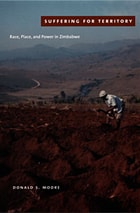
Suffering for Territory
Race, Place, and Power in ZimbabweDonald S. Moore
Duke University Press, 2005
Moore makes a significant contribution to postcolonial theory with his conceptualization of “entangled landscapes” by articulating racialized rule, situated sovereignties, and environmental resources. Fusing Gramscian cultural politics and Foucault’s analytic of governmentality, he enlists ethnography to foreground the spatiality of power. Suffering for Territory demonstrates how emplaced micro-practices matter, how the outcomes of cultural struggles are contingent on the diverse ways land comes to be inhabited, labored upon, and suffered for.

Symbols of Wealth and Power
Architectural Terracotta Decoration in Etruria and Central Italy, 640-510 B.C.Nancy A. Winter
University of Michigan Press, 2009
Although initially intended for the innovative, if prosaic, purpose of providing waterproof and fireproof cover for earlier thatch-roofed homes, fired clay tiles, in seventh- and sixth-century Etruria and Central Italy, combined with Etruscan love of adornment to create exceptional domestic and religious building decoration. Featuring statues and figured friezes of humans, animals, and mythological figures intended to convey the status of the owner or dedicator, the surviving terracotta roofs provide important insights into the architectural history of Etruria. With Symbols of Wealth and Power, Nancy A. Winter has provided a definitive overview of the evidence for these roofing elements that will enhance our knowledge of Etruscan---and more broadly, ancient---architecture.
Nancy A. Winter is an archaeologist and former librarian of the American School of Classical Studies, Athens. She is the author of Greek Architectural Terracottas: From the Prehistoric to the End of the Archaic Period (1993).
Role Models in the Roman World: Identity and Assimilation, edited by Sinclair Bell and Inge Lyse Hansen
The Maritime World of Ancient Rome, edited by Robert L. Hohlfelder
Cosa: The Black-Glaze Pottery 2, by Ann Reynolds Scott