76 books match the query 'Principles' and 2 start with s
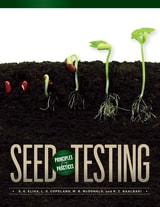
cover of Seed Testing: Principles and Practices

Seed Testing

Principles and Practices

Sabry G. Elias

Michigan State University Press, 2012

An essential reference for students, seed technologists, researchers, and seed industry personnel, this comprehensive guide outlines the most widely performed modern seed quality tests, explores the principles behind them, the history of seed testing, why seeds are tested and when, and sampling, sub-sampling, seed laboratory management, accreditation, and seed quality assurance programs. The authors describe statistical applications to seed testing and tolerances, and they provide a detailed morphological and structural description of seed formation and development. The book examines the testing of genetic traits and transgenic seeds, including DNA and protein genetic purity tests, and cultivar purity identification for conventional seeds. In addition to the most common seed purity and viability tests, tests for seed and seedling vigor, seed-borne diseases and seed moisture determination are also discussed.

[more]
cover of Swarm Intelligence: Principles, current algorithms and methods, Volume 1

Swarm Intelligence

Principles, current algorithms and methods, Volume 1

Ying Tan

The Institution of Engineering and Technology, 2018

Swarm Intelligence (SI) is one of the most important and challenging paradigms under the umbrella of computational intelligence. It focuses on the research of collective behaviours of a swarm in nature and/or social phenomenon to solve complicated and difficult problems which cannot be handled by traditional approaches. Thousands of papers are published each year presenting new algorithms, new improvements and numerous real world applications. This makes it hard for researchers and students to share their ideas with other colleagues; follow up the works from other researchers with common interests; and to follow new developments and innovative approaches. This complete and timely collection fills this gap by presenting the latest research systematically and thoroughly to provide readers with a full view of the field of swarm. Students will learn the principles and theories of typical swarm intelligence algorithms; scholars will be inspired with promising research directions; and practitioners will find suitable methods for their applications of interest along with useful instructions.
[more]