Results by title
56 books match the query 'Public schools' and 5 start with s
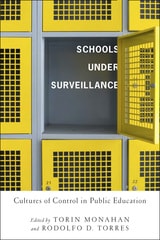
Schools Under Surveillance
Cultures of Control in Public EducationMonahan, Torin
Rutgers University Press, 2009
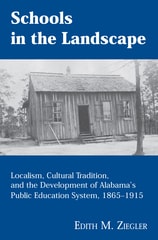
Schools in the Landscape
Localism, Cultural Tradition, and the Development of Alabama's Public Education System, 1865-1915Edith M. Ziegler
University of Alabama Press, 2010
Where culture met classroom—how Alabama’s past shaped its public schools.
Schools in the Landscape offers a richly detailed and deeply contextualized history of public education in Alabama during the transformative half-century following the Civil War. In this groundbreaking study, Edith M. Ziegler examines how localism, cultural tradition, and social conservatism shaped the development of Alabama’s public school system between 1865 and 1915—a period marked by Reconstruction, Redemption, and the entrenchment of racial segregation.
Ziegler explores how Alabama’s rural, economically challenged, and culturally conservative communities influenced the structure and function of public education. Drawing on a wide range of archival sources, she investigates the roles of teachers, schoolhouses, funding mechanisms, and community rituals in shaping educational experiences. The book also delves into the dual system of Black and white schools, highlighting the systemic inequalities and the resilience of African American communities in the face of institutionalized racism.
Through chapters on Progressive Era reforms, local festivals, and the symbolic role of schools in civic life, Ziegler reveals how education in Alabama was not merely a top-down initiative but a deeply local and contested process. Her analysis underscores the importance of understanding regional identity and cultural values in the broader narrative of American educational history.
Schools in the Landscape is essential reading for scholars of Southern history, education policy, and cultural studies, offering a nuanced portrait of how public schooling evolved in one of the nation’s most complex and tradition-bound regions.
Southern Stalemate
Five Years without Public Education in Prince Edward County, VirginiaChristopher Bonastia
University of Chicago Press, 2011
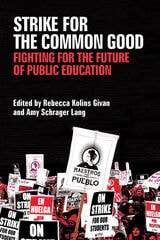
Strike for the Common Good
Fighting for the Future of Public EducationRebecca Kolins Givan and Amy Schrager Lang, Editors
University of Michigan Press, 2020
In February 2018, 35,000 public school educators and staff walked off the job in West Virginia. More than 100,000 teachers in other states—both right-to-work states, like West Virginia, and those with a unionized workforce—followed them over the next year. From Arizona, Kentucky, and Oklahoma to Colorado and California, teachers announced to state legislators that not only their abysmal wages but the deplorable conditions of their work and the increasingly straitened circumstances of public education were unacceptable. These recent teacher walkouts affirm public education as a crucial public benefit and understand the rampant disinvestment in public education not simply as a local issue affecting teacher paychecks but also as a danger to communities and to democracy.
Strike for the Common Good gathers together original essays, written by teachers involved in strikes nationwide, by students and parents who have supported them, by journalists who have covered these strikes in depth, and by outside analysts (academic and otherwise). Together, the essays consider the place of these strikes in the broader landscape of recent labor organizing and battles over public education, and attend to the largely female workforce and, often, largely non-white student population of America’s schools.

Struggle For Control Of Public Education
Michael Engel
Temple University Press, 2000
Seduced by the language of the market economy, those making decisions about education today argue that market strategies promote democratic educational reform, when really they promote market reform of education. Michael Engel argues against this tendency, siding with democratic values -- which encourage openness, creativity, social awareness, and idealism, whereas market values uphold individual achievement, competition, economic growth, and national security.
Behind the facade of progressive rhetoric, advocates of these corporate models have succeeded in imposing their definition of school reform through federal and state policy makers. As a result, communities lose control of their schools, teachers lose control of their work, and students lose control of their schools, teachers lose control of their work, and students lose control of their futures. Engel attacks the increasing dominance of market ideology in educational policy and extends his critique beyond such trends in school reform as vouchers, charter schools, and "contracting out" to include issues such as decentralization, computer technology, and standards.
The debate over privatization amounts to ideological warfare between democratic and market values. The question is not so much about "school choice" as it is about the values Americans want at the root of their society. Unprecedented in its value-based challenge to the threat of market ideology to educational policy, The Struggle for Control of Public Education is a sophisticated call for a return to community-controlled schools and democratic values. This argument offers theoretical and practical models crafted in the contemporary feminist and social reconstructionist tradition. Readers interested in the study of educational policies, philosophy, and policy will find this book engaging.