Results by title
74 books match the query 'Public welfare' and 4 start with s
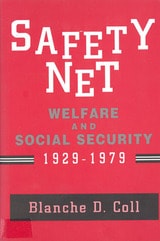
Safety Net
Welfare and Social Security, 1929-1979Coll, Blanche D
Rutgers University Press, 1995
Beginning with the stock market crash of 1929, Blanche Coll documents the evolution of the federal and state government policymaking for welfare and Social Security, our "safety net." As Coll points out, the policies that determine who is "entitled" to aid, how standard dollar amounts are set, child support responsibilities, the equitable fiscal division between state, federal, and local governments, and the resulting impact on the poorÐÐparticularly women and children of all racesÐÐhave fluctuated throughout the history of welfare.
Coll shows how demographic patterns, the definition of a family, the relative health of the economy, and Presidents' political agendas all deeply affect the system of entitlements to Social Security and welfare, the kernal of the American welfare state.
Safety Net is the only comprehensive history of modern welfare in the United States. Clearly written and unpolemical, it is based on a wealth of primary sources, interviews with key policymakers, and the authoritative analysis of a trained historian who served as a research administrator in the federal government through Democractic and Republican administrations. Saftey Net will be indispensable reading for everyone concerned with contemporary debates about welfare and Social Security.

Shaping the Discourse on Space
Charity and Its Wards in Nineteenth-Century San Juan, Puerto RicoBy Teresita Martínez-Vergne
University of Texas Press, 1999
As an inchoate middle class emerged in Puerto Rico in the early nineteenth century, its members sought to control not only public space, but also the people, activities, and even attitudes that filled it. Their instruments were the San Juan town council and the Casa de Beneficencia, a state-run charitable establishment charged with responsibility for the poor.
In this book, Teresita Martínez-Vergne explores how municipal officials and the Casa de Beneficencia shaped the discourse on public and private space and thereby marginalized the worthy poor and vagrants, "liberated" Africans, indigent and unruly women, and destitute children. Drawing on extensive and innovative archival research, she shows that the men who comprised the San Juan ayuntamiento and the board of charity regulated the public discourse on topics such as education, religious orthodoxy, hygiene, and family life, thereby establishing norms for "correct" social behavior and chastising the "deviant" lifestyles of the working poor.
This research clarifies the ways in which San Juan's middle class defined itself in the midst of rapid social and economic change. It also offers new insights into notions of citizenship and the process of nation-building in the Caribbean.
Shelter Poverty
New Ideas on Housing AffordabilityMichael E. Stone
Temple University Press, 1993
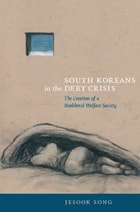
South Koreans in the Debt Crisis
The Creation of a Neoliberal Welfare SocietyJesook Song
Duke University Press, 2009
Drawing on her experience during the crisis as an employee in a public works program in Seoul, Song provides an ethnographic assessment of the efforts of the state and civilians to regulate social insecurity, instability, and inequality through assistance programs. She focuses specifically on efforts to help two populations deemed worthy of state subsidies: the “IMF homeless,” people temporarily homeless but considered employable, and the “new intellectuals,” young adults who had become professionally redundant during the crisis but had the high-tech skills necessary to lead a transformed post-crisis South Korea.