Results by title
54 books match the query 'Punishment' and 5 start with s
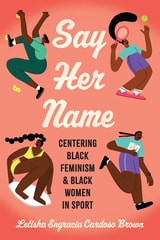
Say Her Name
Centering Black Feminism and Black Women in SportLetisha Engracia Cardoso Brown
Rutgers University Press, 2025
Say Her Name delves deeply into issues of gender, the politics of punishment, athlete activism, the politics of Black hair, fingernails and fashion, and the representation and commodification of Blackgirlwomen in sport and society. An entry point into the growing research in sport studies and beyond from a Black feminist lens, Say Her Name offers a clear window into the power and potential of nuanced examinations of sport. As a reflection of the larger social world, sport provides a framework for understanding larger social issues, including racism, sexism, and misogynoir. Blackgirlwomen have varied experiences in sport, and Say Her Name provides a window into those experiences. The book discusses Black women in sports including the South African runner Caster Semenya and the American runners Florence Griffith Joyner and Sha’Carri Richardson, as well as Venus and Serena Williams, Gabby Douglas, and Simone Biles. The women in this book have lived experiences that speak to the larger experiences of Black women and girls in sport and society, while also leaning into a larger discussion of the importance of the social movement #SayHerName.
Sentencing without Guidelines
Rhys Hester
Temple University Press, 2024
Sentencing without Guidelines is Rhys Hester’s deep dive into how South Carolina, which never passed sentencing guideline legislation, nonetheless created meaningful punishment reform. It achieved uniformity in sentencing with a traveling circuit of judges, informal norms among judges, and the unique phenomenon of the “Plea Judge” to manage cases.
Hester examines how prior convictions, race, and geographical differences impact sentences to explain why individuals get the criminal sentences they do. He also explores how legal reform mechanisms can influence punishment goals and policy. Sentencing without Guidelines shows the benefits and drawbacks South Carolina experienced as it met sentencing reform goals. These lessons can be translated into policy for other jurisdictions.
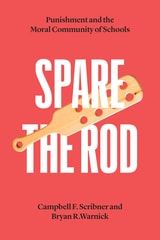
Spare the Rod
Punishment and the Moral Community of SchoolsCampbell F. Scribner and Bryan R. Warnick
University of Chicago Press, 2021
Spare the Rod traces the history of discipline in schools and its ever increasing integration with prison and policing, ultimately arguing for an approach to discipline that aligns with the moral community that schools could and should be.
In Spare the Rod, historian Campbell F. Scribner and philosopher Bryan R. Warnick investigate the history and philosophy of America’s punishment and discipline practices in schools. To delve into this controversial subject, they first ask questions of meaning. How have concepts of discipline and punishment in schools changed over time? What purposes are they supposed to serve? And what can they tell us about our assumptions about education? They then explore the justifications. Are public school educators ever justified in punishing or disciplining students? Are discipline and punishment necessary for students’ moral education, or do they fundamentally have no place in education at all? If some form of punishment is justified in schools, what ethical guidelines should be followed?
The authors argue that as schools have grown increasingly bureaucratic over the last century, formalizing disciplinary systems and shifting from physical punishments to forms of spatial or structural punishment such as in-school suspension, school discipline has not only come to resemble the operation of prisons or policing, but has grown increasingly integrated with those institutions. These changes and structures are responsible for the school-to-prison pipeline. They show that these shifts disregard the unique status of schools as spaces of moral growth and community oversight, and are incompatible with the developmental environment of education. What we need, they argue, is an approach to discipline and punishment that fits with the sort of moral community that schools could and should be.
Spare the Rod
Punishment and the Moral Community of SchoolsCampbell F. Scribner and Bryan R. Warnick
University of Chicago Press, 2021
This is an auto-narrated audiobook edition of this book.
Spare the Rodtraces the history of discipline in schools and its ever increasing integration with prison and policing, ultimately arguing for an approach to discipline that aligns with the moral community that schools could and should be.
In Spare the Rod, historian Campbell F. Scribner and philosopher Bryan R. Warnick investigate the history and philosophy of America’s punishment and discipline practices in schools. To delve into this controversial subject, they first ask questions of meaning. How have concepts of discipline and punishment in schools changed over time? What purposes are they supposed to serve? And what can they tell us about our assumptions about education? They then explore the justifications. Are public school educators ever justified in punishing or disciplining students? Are discipline and punishment necessary for students’ moral education, or do they fundamentally have no place in education at all? If some form of punishment is justified in schools, what ethical guidelines should be followed?
The authors argue that as schools have grown increasingly bureaucratic over the last century, formalizing disciplinary systems and shifting from physical punishments to forms of spatial or structural punishment such as in-school suspension, school discipline has not only come to resemble the operation of prisons or policing, but has grown increasingly integrated with those institutions. These changes and structures are responsible for the school-to-prison pipeline. They show that these shifts disregard the unique status of schools as spaces of moral growth and community oversight, and are incompatible with the developmental environment of education. What we need, they argue, is an approach to discipline and punishment that fits with the sort of moral community that schools could and should be.
Sunbelt Capitalism and the Making of the Carceral State
Kirstine Taylor
University of Chicago Press, 2025
The story of how the American South became the most incarcerated region in the world’s most incarcerated nation.
Sunbelt Capitalism and the Making of the Carceral State examines the evolution of southern criminal punishment from Jim Crow to the dawn of mass incarceration, charting this definitive era of carceral transformation and expansion in the southern United States. The demise of the county chain gang, the professionalization of police, and the construction of large-scale prisons were among the sweeping changes that forever altered the southern landscape and bolstered the region’s capacity to punish. What prompted this southern revolution in criminal punishment?
Kirstine Taylor argues that the crisis in the cotton fields and the arrival of Sunbelt capitalism in the south’s rising metropolises prompted lawmakers to build expansive, modern criminal punishment systems in response to Brown v. Board of Education and the Black freedom movements of the 1960s and ‘70s. Taking us inside industry-hunting expeditions, school desegregation battles, the sit-in movement, prisoners’ labor unions, and policy commissions, Taylor tells the story of how a modernizing south became the most incarcerated region in the globe’s most incarcerated nation.