Results by title
325 books match the query 'Race identity' and 16 start with s

Say Her Name
Centering Black Feminism and Black Women in SportLetisha Engracia Cardoso Brown
Rutgers University Press, 2025
Say Her Name delves deeply into issues of gender, the politics of punishment, athlete activism, the politics of Black hair, fingernails and fashion, and the representation and commodification of Blackgirlwomen in sport and society. An entry point into the growing research in sport studies and beyond from a Black feminist lens, Say Her Name offers a clear window into the power and potential of nuanced examinations of sport. As a reflection of the larger social world, sport provides a framework for understanding larger social issues, including racism, sexism, and misogynoir. Blackgirlwomen have varied experiences in sport, and Say Her Name provides a window into those experiences. The book discusses Black women in sports including the South African runner Caster Semenya and the American runners Florence Griffith Joyner and Sha’Carri Richardson, as well as Venus and Serena Williams, Gabby Douglas, and Simone Biles. The women in this book have lived experiences that speak to the larger experiences of Black women and girls in sport and society, while also leaning into a larger discussion of the importance of the social movement #SayHerName.

Scandinavians in Chicago
The Origins of White Privilege in Modern AmericaErika K. Jackson
University of Illinois Press, 2019
Selling the Race
Culture, Community, and Black Chicago, 1940-1955Adam Green
University of Chicago Press, 2006
In Selling the Race, Adam Green tells the story of how black Chicagoans were at the center of a national movement in the 1940s and ’50s, a time when African Americans across the country first started to see themselves as part of a single culture. Along the way, he offers fascinating reinterpretations of such events as the 1940 American Negro Exposition, the rise of black music and the culture industry that emerged around it, the development of the Associated Negro Press and the founding of Johnson Publishing, and the outcry over the 1955 lynching of Emmett Till.
By presenting African Americans as agents, rather than casualties, of modernity, Green ultimately reenvisions urban existence in a way that will resonate with anyone interested in race, culture, or the life of cities.
Sentient Flesh
Thinking in Disorder, Poiesis in BlackR. A. Judy
Duke University Press, 2020
Shades of White
White Kids and Racial Identities in High SchoolPamela Perry
Duke University Press, 2002
Through ethnographic research and in-depth interviews of students in two demographically distinct U.S. high schools—one suburban and predominantly white; the other urban, multiracial, and minority white—Perry shares students’ candor about race and self-identification. By examining the meanings students attached (or didn’t attach) to their social lives and everyday cultural practices, including their taste in music and clothes, she shows that the ways white students defined white identity were not only markedly different between the two schools but were considerably diverse and ambiguous within them as well. Challenging reductionist notions of whiteness and white racism, this study suggests how we might go “beyond whiteness” to new directions in antiracist activism and school reform.
Shades of White is emblematic of an emerging second wave of whiteness studies that focuses on the racial identity of whites. It will appeal to scholars and students of anthropology, sociology, and cultural studies, as well as to those involved with high school education and antiracist activities.
Shaming into Brown
Somatic Transactions of Race in Latina/o LiteratureStephanie Fetta
The Ohio State University Press, 2018
In Shaming into Brown: Somatic Transactions of Race in Latina/o Literature, Stephanie Fetta asserts that our bodies are fundamental to how we live and how we make meaning. Anchored by two psychoanalytic theories, bioenergetic analysis developed by Alexander Lowen and affect theory put forth by Silvan Tomkins, Fetta examines Latinx fiction to draw attention to the cultural role of the intelligent, emotional, and communicative body—the soma—in relation to shame. She argues that we bring the soma—the physical, emotive, and social register of our subjectivity—to the text as we do to our lives,proposing that the power of racialization operates at the level of somatic expression and reception through habituated, socially cued behaviors that are not readily subject to intentional control.
Fetta examines shame beyond individual experiences, looking at literary renderings of the cultural practice of racial shaming that are deeply embedded into our laws, hiring practices, marketing strategies, and more. Grounding her analysis in the works of Gloria Anzaldúa and Cherríe Moraga, Shaming into Brown focuses on exposing the underpinnings of racialized shame and does so through analyzing “scenes of racialization” in prominent works by authors such as Junot Díaz, Sandra Cisneros, and Oscar Zeta Acosta.
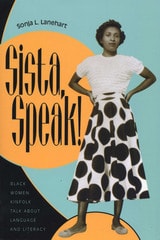
Sista, Speak!
Black Women Kinfolk Talk about Language and LiteracyBy Sonja L. Lanehart
University of Texas Press, 2002
2003 — Honorable Mention, Myers Outstanding Book Award – The Gustavus Myers Center for the Study of Bigotry and Human Rights in North America
The demand of white, affluent society that all Americans should speak, read, and write "proper" English causes many people who are not white and/or middle class to attempt to "talk in a way that feel peculiar to [their] mind," as a character in Alice Walker's The Color Purple puts it. In this book, Sonja Lanehart explores how this valorization of "proper" English has affected the language, literacy, educational achievements, and self-image of five African American women—her grandmother, mother, aunt, sister, and herself.
Through interviews and written statements by each woman, Lanehart draws out the life stories of these women and their attitudes toward and use of language. Making comparisons and contrasts among them, she shows how, even within a single family, differences in age, educational opportunities, and social circumstances can lead to widely different abilities and comfort in using language to navigate daily life. Her research also adds a new dimension to our understanding of African American English, which has been little studied in relation to women.
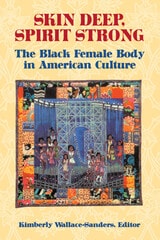
Skin Deep, Spirit Strong
The Black Female Body in American CultureKimberly Wallace-Sanders, Editor
University of Michigan Press, 2002
The collection blends original and classic essays to reveal the interconnections among art, literature, public policy, the history of medicine, and theories about sexuality with regard to bodies that are both black and female. Contributors include Rachel Adams, Elizabeth Alexander, Lisa Collins, Bridgette Davis, Lisa E.Farrington, Anne Fausto-Sterling, Beverly Guy-Sheftall, Evelynn Hammonds, Terri Kapsalis, Jennifer L. Morgan, Siobhan B. Somerville, Kimberly Wallace-Sanders, Carla Williams, and Doris Witt.
Skin Deep, Spirit Strong: The Black Female Body in American Culture will appeal to both the academic reader attempting to integrate race into discussion about the female body and to the general reader curious about the history of black female representation.
Kimberly Wallace-Sanders is Assistant Professor, Graduate Institute of Liberal Arts and Institute of Women's Studies, Emory University.
Slavery's Descendants
Shared Legacies of Race and ReconciliationJill Strauss
Rutgers University Press, 2019
Slavery’s Descendants brings together contributors from a variety of racial backgrounds, all members or associates of a national racial reconciliation organization called Coming to the Table, to tell their stories of dealing with America’s racial past through their experiences and their family histories. Some are descendants of slaveholders, some are descendants of the enslaved, and many are descendants of both slaveholders and slaves. What they all have in common is a commitment toward collective introspection, and a willingness to think critically about how the nation’s histories of oppression continue to ripple into the present, affecting us all.
The stories in Slavery’s Descendants deal with harrowing topics—rape, lynching, cruelty, shame—but they also describe acts of generosity, gratitude, and love. Together, they help us confront the legacy of slavery to reclaim a more complete picture of U.S. history, one cousin at a time.
Funding for the production of this book was provided by Furthermore, a program of the J. M. Kaplan Fund (https://www.furthermore.org).
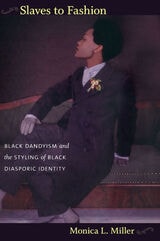
Slaves to Fashion
Black Dandyism and the Styling of Black Diasporic IdentityMonica L. Miller
Duke University Press, 2009
Dandyism was initially imposed on black men in eighteenth-century England, as the Atlantic slave trade and an emerging culture of conspicuous consumption generated a vogue in dandified black servants. “Luxury slaves” tweaked and reworked their uniforms, and were soon known for their sartorial novelty and sometimes flamboyant personalities. Tracing the history of the black dandy forward to contemporary celebrity incarnations such as Andre 3000, Miller explains how black people became arbiters of style and how they have historically used the dandy’s signature tools—clothing, gesture, and wit—to break down limiting identity markers and propose new ways of fashioning political and social possibility in the black Atlantic world. With an aplomb worthy of her iconographic subject, she considers the black dandy in relation to nineteenth-century American literature and drama, W. E. B. Du Bois’s reflections on black masculinity and cultural nationalism, the modernist aesthetics of the Harlem Renaissance, and representations of black cosmopolitanism in contemporary visual art.

So Unimaginable a Price
Baldwin and the Black AtlanticJohn E. Drabinski
Northwestern University Press, 2026
James Baldwin’s nonfiction offers some of the most important and challenging thinking on the experience of race, history, and memory in the Black Atlantic world. Yet much of the scholarly literature on Baldwin’s writing reads his work from inside the sociocultural context of the United States, alongside key interlocutors like Richard Wright, Ralph Ellison, and Lorraine Hansberry. So Unimaginable a Price: Baldwin and the Black Atlantic shifts the critical frame, examining Baldwin’s work as part of a midcentury moment across the wider Atlantic world and tying his reflections to those of thinkers in the Caribbean and Africa to underscore the widening sense, as well as the particularity, of his critical claims. Who is Baldwin to the Atlantic world? And who, then, is Baldwin to the United States? John E. Drabinski recasts Baldwin as a Black Atlantic writer whose unique qualities as a thinker are enhanced by their similarities and differences with fellow writers of liberation in the global Black world.
Staging Black Fugitivity
Stacie Selmon McCormick
The Ohio State University Press, 2019
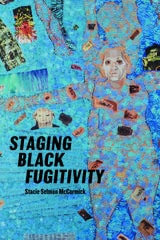
McCormick traces the innovative ways that artists render slavery for present-day audiences. The dramas assembled in this book approach slavery from myriad perspectives—afrofuturist, feminist, and queer—in order to produce new imaginaries that offer more complex depictions of black experience. Through subverting notions of time, race, gender, and familiar histories of slavery themselves, the dramas under discussion produce performances of fugitivity—subversive, radical, and experimental performances of black artistic and political freedom at the site of slavery.

Stay Black and Die
On Melancholy and GeniusI. Augustus Durham
Duke University Press, 2023
Stigma and Culture
Last-Place Anxiety in Black AmericaJ. Lorand Matory
University of Chicago Press, 2015
Matory describes the competitive process that hierarchically structures their self-definition as ethnic groups and the similar process by which middle-class African Americans seek distinction from their impoverished compatriots. Drawing on research at universities such as Howard, Harvard, and Duke and among their alumni networks, he details how university life—while facilitating individual upward mobility, touting human equality, and regaling cultural diversity—also perpetuates the cultural standards that historically justified the dominance of some groups over others. Combining his ethnographic findings with classic theoretical insights from Frantz Fanon, Fredrik Barth, Erving Goffman, Pierre Bourdieu and others—alongside stories from his own life in academia—Matory sketches the university as an institution that, particularly through the anthropological vocabulary of culture, encourages the stigmatized to stratify their own.

Stolen Life
Fred Moten
Duke University Press, 2018
In Stolen Life—the second volume in his landmark trilogy consent not to be a single being—Fred Moten undertakes an expansive exploration of blackness as it relates to black life and the collective refusal of social death. The essays resist categorization, moving from Moten's opening meditation on Kant, Olaudah Equiano, and the conditions of black thought through discussions of academic freedom, writing and pedagogy, non-neurotypicality, and uncritical notions of freedom. Moten also models black study as a form of social life through an engagement with Fanon, Hartman, and Spillers and plumbs the distinction between blackness and black people in readings of Du Bois and Nahum Chandler. The force and creativity of Moten's criticism resonate throughout, reminding us not only of his importance as a thinker, but of the continued necessity of interrogating blackness as a form of sociality.
Sunbelt Diaspora
Race, Class, and Latino Politics in Puerto Rican OrlandoBy Patricia Silver
University of Texas Press, 2020
2021 — Silver Medal, Raul Yzaguirre Best Political/Current Affairs Book – International Latino Book Awards, Latino Literacy Now
An in-depth look at an emerging Latino presence in Orlando, Florida, where Puerto Ricans and others navigate differences of race, class, and place of origin in their struggle for social, economic, and political belonging.
Puerto Ricans make up half of Orlando-area Latinos, arriving from Puerto Rico as well as from other long-established diaspora communities to a place where Latino politics has long been about Cubans in Miami. Together with other Latinos from multiple places, Puerto Ricans bring diverse experiences of race and class to this Sunbelt city. Tracing the emergence of the Puerto Rican and Latino presence in Orlando from the 1940s through an ethnographic moment of twenty-first-century electoral redistricting, Sunbelt Diaspora provides a timely prism for viewing how differences of race, class, and place play out in struggles to claim political, social, and economic ground for Latinos.
Drawing on over a decade of ethnographic, oral history, and archival research, Patricia Silver situates her findings in Orlando’s historically black-white racial landscape, post-1960s claims to “color-blindness,” and neoliberal celebrations of individualism. Through the voices of diverse participants, Silver brings anthropological attention to the question of how social difference affects collective identification and political practice. Sunbelt Diaspora asks what constitutes community and how criteria for membership and legitimate representation are negotiated.