Results by title
53 books match the query 'Rap & Hip Hop' and 4 start with s
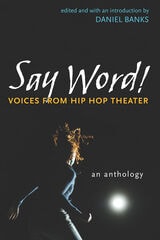
Say Word!
Voices from Hip Hop TheaterAn Anthology Edited and with an Introduction by Daniel Banks
University of Michigan Press, 2011
The phenomenon known as Hip Hop encompasses a global, multiethnic, grassroots culture committed to social justice and self-expression through performance. Hip Hop Theater emerged from that culture, mixing spoken-word performance with music and dance and marked by Hip Hop's strong sense of activism and resistance. Hip Hop Theater is engaged with questions of identity – culture, heritage, ethnicity, class, gender, sexuality, and difference—narrating the experiences of historically marginalized peoples and putting them in dialogue with other oppressed communities.
Say Word! Voices from Hip Hop Theater collects eight works by contemporary artists who confront today's compelling issues, ranging from racial profiling and police brutality to women's empowerment and from the commercial exploitation of Hip Hop to identity politics. Editor Daniel Banks has assembled work by Abiola Abrams, Zakiyyah Alexander, Chadwick Boseman, Kristoffer Diaz, Rha Goddess, Antoy Grant, Joe Hernandez-Kolski, Rickerby Hinds, and Ben Snyder, augmented with an extensive introduction and other informative commentary. The book also includes a roundtable moderated by Holly Bass and featuring Hip Hop pioneers Eisa Davis, Danny Hoch, Sarah Jones, and Will Power, a conversation that traces the roots of Hip Hop Theater and imagines its future directions.
Shaping Words to Fit the Soul
The Southern Ritual Grounds of Afro-ModernismJürgen E. Grandt
The Ohio State University Press, 2009
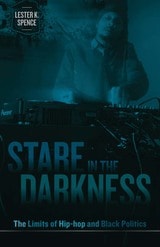
Stare in the Darkness
The Limits of Hip-hop and Black PoliticsLester K. Spence
University of Minnesota Press, 2010
A growing number of black activists and artists claim that rap and hip-hop are the basis of an influential new urban social movement. Simultaneously, black citizens evince concern with the effect that rap and hip-hop culture exerts on African American communities. According to a recent Pew survey conducted on the opinions of Black Americans, 71 percent of blacks think that rap is a bad influence. To what extent are African American hopes and fears about hip-hop’s potential political power justified? In Stare in the Darkness, Lester K. Spence answers this question using a blend of neoliberal analysis, survey data, experiments, and case studies.
Spence finds that rap does in fact influence black political attitudes. However, rap also reproduces rather than critiques neoliberal ideology. Furthermore, black activists seeking to create an innovative model of hip-hop politics are hamstrung by their reliance on outmoded forms of organizing. By considering the possibilities inherent in the most prolific and prominent activities of hip-hop politics, Stare in the Darkness reveals, in a clear and practical manner, the political consequences of rap culture for black publics.
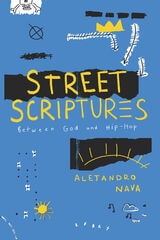
Street Scriptures
Between God and Hip-HopAlejandro Nava
University of Chicago Press, 2022
The world of hip-hop is saturated with religion, but rarely is that element given serious consideration. In Street Scriptures, Alejandro Nava focuses our attention on this aspect of the music and culture in a fresh way, combining his profound love of hip-hop, his passion for racial and social justice, and his deep theological knowledge. Street Scriptures offers a refreshingly earnest and beautifully written journey through hip-hop’s deep entanglement with the sacred.
Nava reveals a largely unheard religious heartbeat in hip-hop, exploring crosscurrents of the sacred and profane in rap, reggaeton, and Latinx hip-hop today. Ranging from Kendrick Lamar, Chance the Rapper, Lauryn Hill, Cardi B, and Bad Bunny to St. Augustine and William James, Nava examines the ethical-political, mystical-prophetic, and theological qualities in hip-hop, probing the pure sonic and aesthetic signatures of music, while also diving deep into the voices that invoke the spirit of protest. The result is nothing short of a new liberation theology for our time, what Nava calls a “street theology.”