Results by title
57 books match the query 'Realism in literature' and 3 start with s
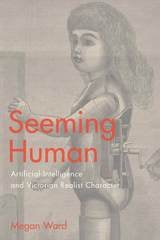
Seeming Human
Artificial Intelligence and Victorian Realist CharacterMegan Ward
The Ohio State University Press, 2018
Offers a new theory of realist character through character’s unexpected afterlife: the intelligent machine.
In Seeming Human, Megan Ward contends that mid-twentieth-century versions of artificial intelligence (AI) offer a theory of verisimilitude omitted by traditional histories of character, which often focus on the development of interiority and the shift from “flat” to “round” characters in the Victorian era. Instead, by reading character through AI, Megan Ward’s Seeming Human argues that routinization, predictability, automation, and even flatness are all features of realist characters.
Early artificial intelligence movements such as cybernetics, information theory, and the Turing test define ways of seeming—rather than being—human. Using these theories of verisimilitude to read Victorian novelists such as Elizabeth Gaskell, Margaret Oliphant, Anthony Trollope, Thomas Hardy, and Henry James, Seeming Human argues that mechanicity has been perceived as anti-realist because it is the element that we least want to identify as human. Because AI produces human-like intelligence, it makes clear that we must actually turn to machines in order to understand what makes realist characters seem so human.
[more]
Sovereign Fictions
Poetics and Politics in the Age of Russian RealismIlya Kliger
University of Chicago Press, 2024
An exploration of Russian realist fiction reveals a preoccupation with the absolutist state.
The nineteenth-century novel is generally assumed to owe its basic social imaginaries to the ideologies, institutions, and practices of modern civil society. In Sovereign Fictions, Ilya Kliger asks what happens to the novel when its fundamental sociohistorical orientation is, as in the case of Russian realism, toward the state. Kliger explores Russian realism’s distinctive construals of sociality through a broad range of texts from the 1830s to the 1870s, including major works by Tolstoy, Dostoevsky, Gogol, Pushkin, Lermontov, Goncharov, and Turgenev, and several lesser-known but influential books of the period, including Alexander Druzhinin’s Polinka Saks (1847), Aleksei Pisemsky’s One Thousand Souls (1858), and Vasily Sleptsov’s Hard Times (1865). Challenging much current scholarly consensus about the social dynamics of nineteenth-century realist fiction, Sovereign Fictions offers an important intervention in socially inflected theories of the novel and in current thinking on representations of power and historical poetics.
The nineteenth-century novel is generally assumed to owe its basic social imaginaries to the ideologies, institutions, and practices of modern civil society. In Sovereign Fictions, Ilya Kliger asks what happens to the novel when its fundamental sociohistorical orientation is, as in the case of Russian realism, toward the state. Kliger explores Russian realism’s distinctive construals of sociality through a broad range of texts from the 1830s to the 1870s, including major works by Tolstoy, Dostoevsky, Gogol, Pushkin, Lermontov, Goncharov, and Turgenev, and several lesser-known but influential books of the period, including Alexander Druzhinin’s Polinka Saks (1847), Aleksei Pisemsky’s One Thousand Souls (1858), and Vasily Sleptsov’s Hard Times (1865). Challenging much current scholarly consensus about the social dynamics of nineteenth-century realist fiction, Sovereign Fictions offers an important intervention in socially inflected theories of the novel and in current thinking on representations of power and historical poetics.
[more]

Stories Of Raymond Carver
A Critical StudyKirk Nesset
Ohio University Press, 1994
Raymond Carver, known in some circles as the “godfather of minimalism,” has been credited by many as the rejuvenator of the once-dying American short story. (See the link on this page to a 2008 Kenyon Review story that discusses the recent controversy over the editing of Carver’s stories.) Drawing on representative tales from each of Carver’s major volumes of fiction, Nesset’s critical exploration leads us deep into the heart of Carver country, an eerie post-industrial world of low-rent survivors. In the earliest fiction, the politics of sex are tied to politics of fortune and chance; marriage as an institution is capricious and unsettling. In later stories, the gesture of telling stories provides an escape for certain of these characters, metaphorically and otherwise; and in Carver’s last stories, subtle strategies of language offer a similar, if more tentative release. From beginning to end, Carver’s distinctive, highly imitative style is intrinsic to his subject and is crucial in presenting what Carver called the “dark side of Reagan’s America.”
In this comprehensive study of Carver, Nesset discusses the relationship of minimalism and postmodern trends and the rise of new realism. By locating Carver in the gallery of American letters, Nesset shows him to be at once more simple and more complex than we might have believed, skillfully laying the groundwork for Carver studies to come.
In this comprehensive study of Carver, Nesset discusses the relationship of minimalism and postmodern trends and the rise of new realism. By locating Carver in the gallery of American letters, Nesset shows him to be at once more simple and more complex than we might have believed, skillfully laying the groundwork for Carver studies to come.
[more]