Results by title
70 books match the query 'Reason' and 6 start with s
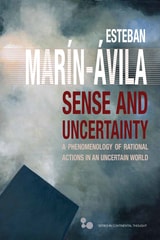
Sense and Uncertainty
A Phenomenology of Rational Actions in an Uncertain WorldEsteban Marín-Ávila
Ohio University Press, 2025
- We are often forced through violence to do things that do not make sense for us except to avoid retaliations, punishments, or the various evils that others might inflict on us.
- We inhabit a world that escapes our control. This involves living in uncertainty concerning the things that we might suffer and do, that is, the things that might happen to us and the results of our actions.
- We are dependent on others and collaborate with them in ways that make it impossible to fully understand the sense of our own actions and practical intentions.

Society as Text
Essays on Rhetoric, Reason, and RealityRichard Harvey Brown
University of Chicago Press, 1987
Spacings--of Reason and Imagination
In Texts of Kant, Fichte, HegelJohn Sallis
University of Chicago Press, 1987
Sallis focuses on certain operations of "spacing" in metaphysics—textual lapses and leaps in which reason is displaced or suspended or abridged. In the project of establishing priority of reason, such operations can appear only in disguise, and Sallis reveals the play of imagination and metaphor that masks them. Concentrating on what has been called the closure of metaphysics, he examines texts in which the suppression of spacing would be carried out most rigorously, texts in which even metaphysics itself is seen as only an errant roaming, a spacing that must still be secured, to be replaced by a pure space of truth. And yet, in these very texts Sallis identifies outbreaks of spacing that would disrupt the tranquil space of reason. Rather than closure, he finds an opening of reason to imagination.
Sallis's reading of a metaphorical system in the Critique of Pure Reason reveals a fissuring and historicizing of what would otherwise be called pure reason. Next he traces in Fichte's major work as well as in several lesser-known texts a decentering from reason to imagination, which he characterizes as a power of hovering between opposites and beyond being. Sallis then returns to the Critique of Pure Reason to expose, in relation to the famous question of the common root of reason and sensibility, a certain eccentricity of reason. Proceeding to the Critique of Judgment, he traces a divergence of sublime nature away from that supersensible space of reason to which Kant would otherwise assimilate it—a withdrawal toward an abyss. Finally, Sallis turns to Hegel's Encyclopedia, supplementing his reading with previously unknown notes from Hegel's lectures on those sections dealing with imagination; his reading of those sections serves to expose, within the most rigorous reduction of spacing in the history of metaphysics, an irrepressible and disseminative play of imagination.
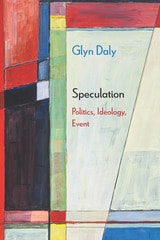
Speculation
Politics, Ideology, EventGlyn Daly
Northwestern University Press, 2019
Speculation: Politics, Ideology, Event develops Hegel’s radical perspective of speculative thought as a way of reclaiming and revitalizing the sense of the future and its possibilities. Engaging with such figures as Alain Badiou, Quentin Meillassoux, Ernesto Laclau, Slavoj Žižek, and Fredric Jameson, Glyn Daly articulates the distinctness of speculative philosophy and draws its implications for new debates in areas of science, politics, capitalism, ideology, ethics, and the event.
In a confrontation with today’s fatalistic milieu, principal emphasis is given to Hegel’s idea of infinity as the intrinsic dimension of negativity within all finitude. Against the modern era’s paradigmatic tendency to externalize social problems in the form of antagonism and Otherness, Daly argues for a renewal of utopian thought based on Hegelian reconciliation and the affirmation of excess as the essence of all being. On these grounds, he advances a new kind of political imagination that in speculative terms centers on uncompromising notions of truth and reason.
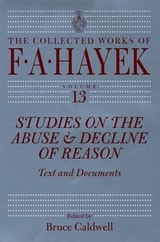
Studies on the Abuse and Decline of Reason
Text and DocumentsF. A. Hayek
University of Chicago Press, 2010
Hayek argues that the vast number of elements whose interactions create social structures and institutions make it unlikely that social science can predict precise outcomes. Instead, he contends, we should strive to simply understand the principles by which phenomena are produced. For Hayek this modesty of aspirations went hand in hand with his concern over widespread enthusiasm for economic planning. As a result, these essays are relevant to ongoing debates within the social sciences and to discussion about the role government can and should play in the economy.
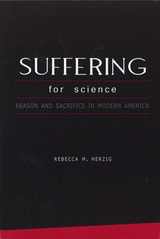
Suffering For Science
Reason and Sacrifice in Modern AmericaHerzig, Rebecca
Rutgers University Press, 2006
Suffering for Science reveals more than the passion evident in many scientific vocations; it also illuminates a nation's changing understandings of the purposes of suffering, the limits of reason, and the nature of freedom in the aftermath of slavery.