160 books match the query 'Reflections' and 8 start with s
cover of Sabbath Born: Reflections of a Reluctant Prophet

Sabbath Born

Reflections of a Reluctant Prophet

Britt Allen Skarda

Parkhurst Brothers, Inc., 2022
A devotional essays by a prominent Methodist minister.
[more]
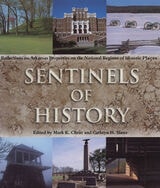
cover of Sentinels of History: Reflections on Arkansas Properties on the National Register of Historic Places

Sentinels of History

Reflections on Arkansas Properties on the National Register of Historic Places

Mark Christ

University of Arkansas Press, 2000
Sentinels of History was conceived of as a way to mark the turn of the millennium by the Arkansas Historic Preservation Program. This generously illustrated book contains thirty-nine essays, each of which showcases an important Arkansas site and is written by a noted authority. Also included is a location map for these sites and a full appendix providing location information, county by county, for the more than two thousand surviving properties in Arkansas (as of June 1999) that appear on the National Register. The essays are as wide-ranging as Roger Kennedy's placement of the Toltec Mounds at the time of Charlemagne, Donald Harington's sensitive look at the "bigeminal" architecture of the Wolf dogtrot cabin, and Neil Compton's egalitarian tribute to the Boxley Valley Historic District on the Buffalo National River. At least one current color photo of the site and one historic image are included with each essay. In addition, illustrations of the locations or structures listed in the appendix are scattered throughout sections. In all, Sentinels of History serves as a lavish inventory of historic properties in Arkansas at the end of the twentieth century.
[more]
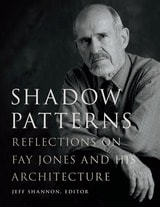
cover of Shadow Patterns: Reflections on Fay Jones and His Architecture

Shadow Patterns

Reflections on Fay Jones and His Architecture

Jeff Shannon

University of Arkansas Press, 2017

Winner, 2017 Ned Shank Award for Outstanding Preservation Publication from Preserve Arkansas

Shadow Patterns: Reflections on Fay Jones and His Architecture is a collection of critical essays and personal accounts of the man the American Institute of Architects honored with its highest award, the Gold Medal, in 1990.

The essays range from the academic, with appreciations and observations by Juhanni Palaasma and Robert McCarter and Ethel Goodstein-Murphree, to personal reflections by clients and friends. Two of Arkansas’s most accomplished writers, Roy Reed and Ellen Gilchrist, who each live in Fay Jones houses, have provided intimate portrayals of what it’s like to live in, and manage the quirks of, a “house built by a genius,” where “light is everywhere. . . . Everything is quiet, and everything is a surprise,” as Gilchrist says.

Through this compendium of perspectives, readers will learn about Jones’s personal qualities, including his strong will, his ability to convince other people of the rightness of his ideas, and yet his willingness, at times, to change his mind. We also enter into the work: powerful architecture like Stoneflower and Thorncrown Chapel and Pinecote Pavilion, along with private residences ranging from the modest to the monumental. And we learn about his relationship with his mentor, Frank Lloyd Wright.

Shadow Patterns broadens and enriches our understanding of this major figure in American architecture of the twentieth century.
[more]
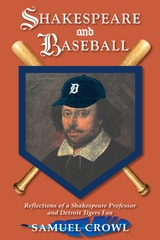
cover of Shakespeare and Baseball: Reflections of a Shakespeare Professor and Detroit Tigers Fan

Shakespeare and Baseball

Reflections of a Shakespeare Professor and Detroit Tigers Fan

Samuel Crowl

Ohio University Press, 2024
Shakespeare and baseball are monuments of high and popular culture: Shakespeare is the most widely read and staged playwright in the world, and baseball is America’s game. Professor Samuel Crowl, a prize-winning teacher and international scholar of Shakespeare on film, explores his life as a champion of the Bard and a fan of the Detroit Tigers. He saw his first Tigers game in the summer of 1950 (Hal Newhouser beat the Chicago White Sox) and his first Shakespeare play in 1953 (Alec Guinness as Richard III at Ontario’s Stratford Festival) and has spent almost seventy-five years enjoying and writing about the pleasures of play that each provides. Shakespeare and Baseball is an unusual hybrid combining Crowl’s education as a Shakespeare and baseball fan, the resonances he perceives between the playwright and the game, the unexpected pleasures both forms of play have afforded his extended family of children and grandchildren, and a selection from the seventy letters he has written to them about Tigers games he has seen, from old Tiger Stadium, Fenway Park, Yankee Stadium, and ballparks in Cleveland. Crowl finds unexpected connections between his twin subjects, including beer, which funded and fueled both the establishment of Major League baseball clubs, like the Yankees and Cardinals, and the creation of the Shakespeare Memorial Theatre in Stratford-upon-Avon, the home of the Royal Shakespeare Company, visited by Shakespeare enthusiasts from around the world. A deeper linkage is that Shakespeare’s festive comedies kept the ideas, rituals, and customs of rural England alive in the dense urban world of Elizabethan London, just as baseball kept the image of the garden—the rural American past in which the game took shape­—alive in the twentieth-century American city. The book is written in a style that captures what one reader has called Crowl’s “warm, rich midwestern voice” and will be of interest to fans of the game and of the Bard, from high schoolers on up.
[more]
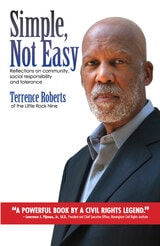
cover of Simple Not Easy: Reflections on community social responsibility and tolerance

Simple Not Easy

Reflections on community social responsibility and tolerance

Terrence Roberts

Parkhurst Brothers, Inc., 2010

HE MADE  HISTORY. HE TELLS THE TRUTHS HE  KNOWS.
 LEAD TITLE/Our  National Conversation Series

"Terrence Roberts is in the truest sense an upstander - an individual whose voice and actions compel us to explore difficult topics and challenge us to face our shared history, honestly. His words and reflections celebrate the notion of difference, model socially responsible behavior and promote tolerance in our daily lives. Reading this book, you will be inspired, in Dr. Roberts's words, to 'think  beyond the ordinary."
----Margot  Stern Strom, Executive  Director, Facing History and Ourselves, Inc.

"Terrence  Roberts  challenges  all of  us to make the world  more inclusive  by adjusting  our 'mental maps.'  He reminds  us that we will not achieve that long-sought  beloved  community  until we  recognize   the  value  of  each  individual-until  we  affirm  each  other.  Simple,  NotEasy is one trailblazer's  mingling  of  history  and  contemporary  mattersto engage a new conversations on community, social responsibility and tolerance. A powerful  book  by  a civil rights  legend."
--
- Lawrence J. Pijeaux, Jr., Ed.D.,
[more]
cover of Soldiers and Statesmen: Reflections on Leadership

Soldiers and Statesmen

Reflections on Leadership

John S. D. Eisenhower

University of Missouri Press, 2012
Which generals were most influential in World War II? Did Winston Churchill really see himself as culturally "half American"? What really caused the break between Harry S. Truman and Dwight Eisenhower? In Soldiers and Statesmen, John S. D. Eisenhower answers these questions and more, offering his personal reflections on great leaders of our time.
The son of President Dwight D. Eisenhower, John S. D. Eisenhower possesses an expert perspective on prominent political and military leaders, giving readers a matchless view on relationships between powerful figures and the president. Eisenhower also had a long military career, coincidentally beginning with his graduation from West Point on D-Day. His unique position as a young Army staff officer and close relationship with his father gave him insider's access to leaders such as Winston Churchill, Harry Truman, George Patton, Douglas MacArthur, Omar Bradley, John Foster Dulles, Mark Clark, Terry Allen, and Matthew Ridgway. He combines personal insight with the specialized knowledge of a veteran soldier and accomplished historian to communicate exclusive perspectives on U. S. foreign relations and leadership.
Eisenhower's observations of various wartime leaders began in June 1944, just after the Allied landings in Normandy. On orders from General George C. Marshall, Army chief of staff, Eisenhower sailed from New York aboard the British-liner-turned-American-troopship Queen Maryto join his father, Supreme Commander of the Allied Expeditionary Force, in London, where he stayed for over two weeks. A year later, at the end of the war, Eisenhower accompanied his father as a temporary aide on trips where Ike's former associates were present. In the mid-1950s, Eisenhower's perspective was broadened by his service in a room next to the White House Oval Office during his father's tenure as president.
On the light side, Eisenhower has added a special appendix called "Home Movies," in which he reveals amusing and often irreverent vignettes from his life in military service. Eisenhower gives readers both a taste of history from the inside and a rich and relatable memoir filled with compelling remembrances.
 
[more]
cover of Songwriting in Contemporary West Virginia: Profiles and Reflections

Songwriting in Contemporary West Virginia

Profiles and Reflections

Travis D. Stimeling

West Virginia University Press, 2018

Songwriting in Contemporary West Virginia: Profiles and Reflections is the first book dedicated to telling the stories of West Virginia’s extensive community of songwriters.  Based on oral histories conducted by Stimeling and told largely in the songwriters’ own words, these profiles offer a lively overview of the personalities, venues, and networks that nurture and sustain popular music in West Virginia.
Stimeling is attentive to breadth and diversity, presenting sketches of established personalities like Larry Groce, who oversees Mountain Stage, and emerging musicians like Maria Allison, who dreams of one day performing there. Each profile includes a brief selected discography to guide readers to recordings of these musicians’ work.
[more]
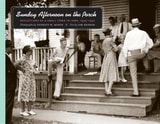
cover of Sunday Afternoon on the Porch: Reflections of a Small Town in Iowa, 1939-1942

Sunday Afternoon on the Porch

Reflections of a Small Town in Iowa, 1939-1942

Everett W. Kuntz

University of Iowa Press, 2008

In 1939, just before graduating from high school in the small town of Ridgeway in northeast Iowa, Everett Kuntz spent his entire savings of $12.50 on a 35mm Argus AF camera. He made a camera case from a worn-out boot, scraps from a tin can, and a clasp from his mother’s purse. For the next several years, especially during the summers when he worked on his parents’ dairy farm, he clicked the shutter of his trusty Argus all around the quiet town.

Everett bought movie reel film in bulk from a mail-order house, rolled his own film, and developed it in a closet at home, but he never had the money to print his photographs. More than two thousand negatives stayed in a box while he married, raised a family, and worked as an electrical engineer in the Twin Cities. When he became ill with cancer in the fall of 2002—sixty years after he had developed the last of his bulk film—Everett opened his time capsule and printed the images from his youth. He died in 2003, having brought his childhood town back to life just as he was leaving it.

A sense of peace radiates from these images. Whether skinny-dipping in the Turkey River, wheelbarrow-racing, threshing oats, milking cows, visiting with relatives after church, or hanging out at the drugstore or the movies, Ridgeway’s hardworking citizens are modest and trusting and luminous in their graceful harmony and their unguarded affection for each other. Visiting the town in 2006 as he was writing the text to accompany these photographs, Jim Heynen crafted vignettes that perfectly complement these rediscovered images by blending fact and fiction to give context and voice to Ridgeway’s citizens.
[more]