Results by title
167 books match the query 'Reform' and 12 start with s

Savonarola's Women
Visions and Reform in Renaissance ItalyTamar Herzig
University of Chicago Press, 2007
In their quest to stay true to their leader’s teachings, Savonarola’s female followers faced hostile superiors within their orders, local political pressures, and the deep-rooted misogynistic assumptions of the Church establishment. This unprecedented volume demonstrates how reform circles throughout the Italian peninsula each tailored Savonarola’s life and works to their particular communities’ regionally specific needs. Savonarola’s Women is an important reconstruction of women’s influence on one of the most important and controversial religious movements in premodern Europe.
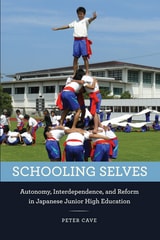
Schooling Selves
Autonomy, Interdependence, and Reform in Japanese Junior High EducationPeter Cave
University of Chicago Press, 2016
Cave examines the implementation of “relaxed education” reforms that attempted to promote individual autonomy and free thinking in Japanese classrooms. As he shows, however, these policies were eventually transformed by educators and school administrators into curricula and approaches that actually promoted social integration over individuality, an effect opposite to the reforms’ intended purpose. With vivid detail, he offers the voices of teachers, students, and parents to show what happens when national education policies run up against long-held beliefs and practices, and what their complex and conflicted interactions say about the production of self and community in education. The result is a fascinating analysis of a turbulent era in Japanese education that offers lessons for educational practitioners in any country.

Seder Tu Bishevat
The Festival of TreesRabbi Adam Fisher
Central Conference of American Rabbis, 1989
The Festival of Trees, Tu Bishevat, celebrates nature's rebirth after winter. Seder Tu Bishevat not only marks the observance but celebrates Judaism's appreciation of the larger cycle of nature as the work of God. This volume contains two Seders: Seder I addresses both adults and children of various ages; Seder II is specifically designed for the understanding and participation of younger children. The book includes prayers and selections from traditional sources, original poetry by Rabbi Fisher, and 20 songs with complete chording for guitar. Ideal for congregational or home use.

Seedtime of Reform
American Social Service and Social Action, 1918-1933Clarke A. Chambers
University of Minnesota Press, 1963
Seedtime of Reform was first published in 1963. Minnesota Archive Editions uses digital technology to make long-unavailable books once again accessible, and are published unaltered from the original University of Minnesota Press editions.
This is a detailed history of the social welfare movement in the United States during the period from the end of World War I to the inauguration of President Franklin D. Roosevelt, an era which most historians characterize as one of normalcy and reaction. In his book Professor Chambers demonstrates that this was actually a seedtime of reform, a period when the groundwork was laid for many of the sweeping social changes which were to take place under the New Deal.
While it is true, as the author points out, that the years from 1918 to 1933 were not hospitable to the cause of reform, it was during these years that reform leaders and welfare workers (and the associations and agencies they directed) elaborated new theories and programs of action to alleviate, prevent, and overcome certain persisting social ills. Although little was constructively achieved until new political leadership, operating in the context of acute and prolonged economic crisis, acted in the 1930s, much of what we identify as the New Deal was rooted not only in prewar progressivism but in the research, agitation, and welfare services of the 1920s as well. Reformers and welfare workers made especially significant contributions in the areas of housing, social security, public works, federal responsibility for dependent groups in society, and working conditions.

Shock Cities
The Environmental Transformation and Reform of Manchester and ChicagoHarold L. Platt
University of Chicago Press, 2005
Shock Cities also recasts the age of industry within a larger frame of nature. Frightening epidemics and unnatural "natural disasters" forced the city dwellers onto the path of environmental reform. Crusaders for social justice such as Chicago's Jane Addams and Manchester's Charles Rowley led class-bridging campaigns to clean up the slums. Women activists and other "municipal housekeepers" promoted regulations to reduce air pollution. Public health experts directed efforts to improve sanitation.
Out of these reform movements, the Progressives formulated new concepts of environmental conservation and regional planning. Comparing the two cities, Platt highlights the ways in which political culture and institutions act to turn social geography into physical shapes on the ground. This focus on the political formation of urban space helps illuminate questions of social and environmental justice. Shock Cities will be of enormous value to students of ecology, technology, urban planning, and public health in the Western world.
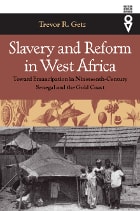
Slavery and Reform in West Africa
Toward Emancipation in Nineteenth-Century Senegal and the Gold CoastTrevor R. Getz
Ohio University Press, 2004
A series of transformations, reforms, and attempted abolitions of slavery form a core narrative of nineteenth-century coastal West Africa. As the region’s role in Atlantic commercial networks underwent a gradual transition from principally that of slave exporter to producer of “legitimate goods” and dependent markets, institutions of slavery became battlegrounds in which European abolitionism, pragmatic colonialism, and indigenous agency clashed.
In Slavery and Reform in West Africa, Trevor Getz demonstrates that it was largely on the anvil of this issue that French and British policy in West Africa was forged. With distant metropoles unable to intervene in daily affairs, local European administrators, striving to balance abolitionist pressures against the resistance of politically and economically powerful local slave owners, sought ways to satisfy the latter while placating or duping the former.
The result was an alliance between colonial officials, company agents, and slave-owning elites that effectively slowed, sidetracked, or undermined serious attempts to reform slave holding. Although slavery was outlawed in both regions, in only a few isolated instances did large-scale emancipations occur. Under the surface, however, slaves used the threat of self-liberation to reach accommodations that transformed the master-slave relationship.
By comparing the strategies of colonial administrators, slave-owners, and slaves across these two regions and throughout the nineteenth century, Slavery and Reform in West Africa reveals not only the causes of the astounding success of slave owners, but also the factors that could, and in some cases did, lead to slave liberations. These findings have serious implications for the wider study of slavery and emancipation and for the history of Africa generally.
Social Security Programs and Retirement around the World
Fiscal Implications of ReformEdited by Jonathan Gruber and David A. Wise
University of Chicago Press, 2007
Drawing on the work of an international group of noted economists, the editors argue that social security programs provide strong incentives for workers to leave the labor force by retiring and taking the benefits to which they are entitled. By penalizing work, social security systems magnify the increased financial burden caused by aging populations, thus contributing to the insolvency of the system. This book is a model of comparative analysis that evaluates the effects of illustrative policies for countries facing the impending rapid growth of social security benefits. Its insights will help inform one of the most pressing debates.

Songs Ascending
The Book of Psalms in a New Translation with Textual and Spiritual CommentaryRabbi Richard N. Levy
Central Conference of American Rabbis, 2017
A beautiful, poetic translation of the Book of Psalms, Songs Ascending includes textual commentary and insights into the translation process, illuminating the choices of the original composers and the choices facing us in the 21st century as we try to make each psalm our own. The spiritual commentary asks: To what events, struggles, and triumphs in our lives might this psalm speak? How might this psalm articulate an aspect of our own sacred existence, or how might it help us celebrate a special day in our lives? How might it provide comfort when we are bereft and most in need of consolation, or how might it help us provide comfort for someone else? Songs Ascending explores all this and more, engaging the reader in dialogue that will inform and inspire.

Spectacles of Reform
Theater and Activism in Nineteenth-Century AmericaAmy E. Hughes
University of Michigan Press, 2014
In the nineteenth century, long before film and television arrived to electrify audiences with explosions, car chases, and narrow escapes, it was America's theaters that offered audiences such thrills, with "sensation scenes" of speeding trains, burning buildings, and endangered bodies, often in melodramas extolling the virtues of temperance, abolition, and women's suffrage. In Spectacles of Reform , Amy E. Hughes scrutinizes these peculiar intersections of spectacle and reform, revealing that spectacle plays a crucial role in American activism. By examining how theater producers and political groups harnessed its power and appeal, Hughes suggests that spectacle was—and remains—central to the dramaturgy of reform.
Engaging evidence from lithographs to children's books to typography catalogs, Hughes traces the cultural history of three famous sensation scenes—the drunkard suffering from the delirium tremens, the fugitive slave escaping over a river, and the victim tied to the railroad tracks—assessing how they conveyed, allayed, and denied concerns about the rights and responsibilities of citizenship. These images also appeared in printed propaganda, suggesting that the coup de théâtre was an essential part of American reform culture. Additionally, Hughes argues that today's producers and advertisers continue to exploit the affective dynamism of spectacle, reaching an even broader audience through film, television, and the Internet.
To be attuned to the dynamics of spectacle, Hughes argues, is to understand how we see. Consequently, Spectacles of Reform will interest not only theater historians, but also scholars and students of political, literary, and visual culture who are curious about how U.S. citizens saw themselves and their world during a pivotal period in American history.
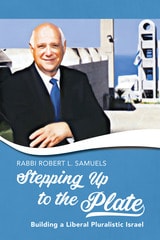
Stepping Up to the Plate
Building a Liberal Pluralistic IsraelRabbi Robert L. Samuels
Central Conference of American Rabbis, 2017
U'vamakom she'ein anashim, hishtadel l'hiyot ish…"In the place where no one stands up to do what is right, be the one who steps up to the plate."
Stepping Up to the Plate is the autobiography of Rabbi Robert L. Samuels, a visionary who fused Zionism and Progressive Judaism and who had a tremendous impact on Israel.
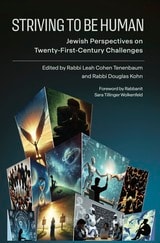
Striving to Be Human
Jewish Perspectives on Twenty-First-Century ChallengesRabbi Leah Cohen Tenenbaum and Rabbi Douglas Kohn
Central Conference of American Rabbis, 2025
In his clarion call for ethical behavior, Rabbi Hillel tells us, “In a place where there is no humanity, strive to be human.” But what exactly does it mean to be human, especially in an age of rapid transformation? Striving to Be Human: Jewish Perspectives on Twenty-First-Century Challenges confronts this question with boldness, hope, and a foundation of Jewish wisdom. The volume begins with “Challenges from Within Us,” addressing such topics as moral justice, belonging, queer theology, and good and evil. In part two, “Challenges from Beyond Us,” the authors delve into artificial intelligence, robotics, reproductive technologies, and the animal-human relationship. The result is a profound conversation about Jewish values and human dignity in our evolving landscape.
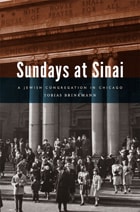
Sundays at Sinai
A Jewish Congregation in ChicagoTobias Brinkmann
University of Chicago Press, 2012