Results by title
70 books match the query 'Rehabilitation' and 8 start with s

Sex Offenders, Stigma, and Social Control
Rickard, Diana
Rutgers University Press, 2016
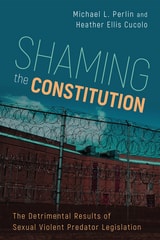
Shaming the Constitution
The Detrimental Results of Sexual Violent Predator LegislationMichael L. Perlin
Temple University Press, 2017
Convicted sexually violent predators are more vilified, more subject to media misrepresentation, and more likely to be denied basic human rights than any other population. Shaming the Constitution authors Michael Perlin and Heather Cucolo question the intentions of sex offender laws, offering new approaches to this most complex (and controversial) area of law and social policy.
The authors assert that sex offender laws and policies are unconstitutional and counter-productive. The legislation largely fails to add to public safety—even ruining lives for what are, in some cases, trivial infractions. Shaming the Constitution draws on law, behavioral sciences, and other disciplines to show that many of the “solutions” to penalizing sexually violent predators are “wrong,” as they create the most repressive and useless laws.
In addition to tracing the history of sex offender laws, the authors address the case of Jesse Timmendequas, whose crime begat “Megan’s Law;” the media’s role in creating a “moral panic;” recidivism statistics and treatments, as well as international human rights laws. Ultimately, they call attention to the flaws in the system so we can find solutions that contribute to public safety in ways that do not mock Constitutional principles.

Signing With Your Clients
Florence Vold
Gallaudet University Press, 2001
Especially for use with deaf and hard-of-hearing clients, Signing with Your Clients shows how to sign the questions and statements most frequently used by clinicians.
More than 500 line drawings illustrate the signs for 237 sentences with translations printed below. Each sentence begins and ends on the same page, and the spiral binding allows pages to be flipped easily, to leave hands free for signing. A special glossary with technical terms allows the creation of original sentences.

Sounding for Cool
Donald Morrill
Michigan State University Press, 2002
Sounding for Cool is about self-transformation, about growing up on one’s own as a product of contemporary America, and about how to become not just a man, but a contributing adult in society. Donald Morrill presents the day-to-day lives of seven young men (white, black, Hispanic, immigrant, middle-class, thick-headed, poor, and smart), who for various reasons have become homeless. Placed in a Transitional Living Program facility (TLP) by the courts, these men must learn to navigate in the world of “normal” values and reasonable rules. Streetwise and callow, trained to seek shortcuts or to make excuses, they struggle with the structures and assumptions inherent in living a law-abiding, bill-paying life. While sorting out their souls, they learn how to connect with others.
In turn, Sounding for Cool scrutinizes the staff of the TLP, one woman and three men, who variously come to terms with their lives by settling accounts from the past. As a TLP volunteer, Donald Morrill often finds himself bridging the gap between staff and client. In the process of telling their stories, he chronicles his own journey to understand the past. Ultimately, Sounding for Cool asks the enduring questions, “Who am I in the world and what can I become?”

Stations of the Lost
The Treatment of Skid Row AlcoholicsJacqueline P. Wiseman
University of Chicago Press, 1979

Staying Sober in Mexico City
By Stanley Brandes
University of Texas Press, 2002
Staying sober is a daily struggle for many men living in Mexico City, one of the world's largest, grittiest urban centers. In this engaging study, Stanley Brandes focuses on a common therapeutic response to alcoholism, Alcoholics Anonymous (A.A.), which boasts an enormous following throughout Mexico and much of Latin America.
Over several years, Brandes observed and participated in an all-men's chapter of A.A. located in a working class district of Mexico City. Employing richly textured ethnography, he analyzes the group's social dynamics, therapeutic effectiveness, and ritual and spiritual life. Brandes demonstrates how recovering alcoholics in Mexico redefine gender roles in order to preserve masculine identity. He also explains how an organization rooted historically in evangelical Protestantism has been able to flourish in Roman Catholic Latin America.

Storytelling in Alcoholics Anonymous
A Rhetorical AnalysisGeorge H. Jensen
Southern Illinois University Press, 2000
Based on an ethnographic study spanning four years, George H. Jensen’s Storytelling in Alcoholics Anonymous: A Rhetorical Analysis calls upon Bakhtinian theory to analyze storytelling in AA.
Jensen introduces his study with an analysis of “Bill W.’s Story” as it appears in the first chapter of AA’s central text, Alcoholics Anonymous. Drawing on Walter Ong’s work on orality and literacy, he argues that “Bill W.’s Story” as it appears in print cannot fully capture the oral tradition of storytelling as it occurs in AA meetings.
In his first section, Jensen discusses storytelling as practiced by the Washingtonians, a temperance organization much like AA. He also discusses the influence of the Oxford Group’s (an international and interdenominational religious movement seeking to recapture the enthusiasm and dedication of first-century Christianity) spiritual program to the development of AA’s Twelve Steps. The remainder of the first section serves as an introduction of the culture of AA to outsiders.
In the second section, Jensen covers Bakhtin’s theory of the relationship between the author and the hero of a text, using Lillian Roth’s autobiographies as counterexamples of AA talks. He devotes an entire chapter in this section to explaining how AA meetings provide an example of what Bakhtin meant by carnival, a process through which humor, irony, and parody supply a mechanism for questioning commonly held beliefs. He shows how newcomers to AA move away from their egocentric personae as practicing alcoholics to adopt a new identity within AA. Drawing further on Bakhtin, he examines the autobiographical moments of AA talks, stressing that these moments never become fully autobiographical. AA talks, Jensen argues, are fragmented, yet achieve coherence through the interweaving of two important chronotopes. Finally, using Bakhtin’s discussion of heroes in autobiography, Jensen discusses the kinds of heroes one typically finds in AA talks.

Surgical Consent
Bioethics and Cochlear ImplantationLinda Komesaroff
Gallaudet University Press, 2007
Drawing on current research, this volume presents the varying reactions around the globe to the high rate of implantation. These views contrast sharply with the medical perspective of deafness overwhelmingly promoted through the media and by the cochlear implantation industry. At the same time, the contributors aim to disrupt the binaries that have long dominated the field of deafness — speech versus sign, instruction through speech and sign systems versus bilingual education, and medical intervention versus cultural membership in the Deaf community.
Surgical Consent begins and ends with the voices of Deaf people. Their articulate and, at times, raw insights clearly delineate the issues of power, positioning, and minority-majority group relations that are inherent in the dominant hearing culture’s understanding of diversity and globalization.