Results by title
436 books match the query 'Renaissance' and 30 start with s
SPS vol 33 num 1
The University of Chicago Press
University of Chicago Press Journals, 2019
SPS vol 34 num 1
The University of Chicago Press
University of Chicago Press Journals, 2020
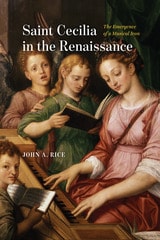
Saint Cecilia in the Renaissance
The Emergence of a Musical IconJohn A. Rice
University of Chicago Press, 2022
Until the fifteenth century, Saint Cecilia was not connected with music. She was perceived as one of many virgin martyrs, with no obvious musical skills or interests. During the next two centuries, however, she inspired many musical works written in her honor and a vast number of paintings that depicted her singing or playing an instrument.
In this book, John A. Rice argues that Cecilia’s association with music came about in several stages, involving Christian liturgy, visual arts, and music. It was fostered by interactions between artists, musicians, and their patrons and the transfer of visual and musical traditions from northern Europe to Italy. Saint Cecilia in the Renaissance explores the cult of the saint in Medieval times and through the sixteenth century when musicians’ guilds in the Low Countries and France first chose Cecilia as their patron. The book then turns to music and the explosion of polyphonic vocal works written in Cecilia’s honor by some of the most celebrated composers in Europe. Finally, the book examines the wealth of visual representations of Cecilia especially during the Italian Renaissance, among which Raphael’s 1515 painting, The Ecstasy of Saint Cecilia, is but the most famous example. Thoroughly researched and beautifully illustrated in color, Saint Cecilia in the Renaissance is the definitive portrait of Saint Cecilia as a figure of musical and artistic inspiration.
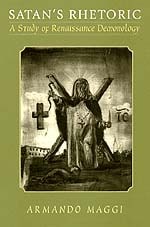
Satan's Rhetoric
A Study of Renaissance DemonologyArmando Maggi
University of Chicago Press, 2001
With this probing new contribution to the study of Christianity, Armando Maggi examines this dialogue, exploring how evil spirits interacted with mankind during the early modern period. Reading innumerable treatises on demonology written during the Renaissance, including Thesaurus exorcismorum, the most important record of early modern exorcisms, Maggi finds repeated attempts to define the language exchanged between the fallen progeny of Adam, and the most notorious fallen angel of them all, Satan. Using points of departure taken from de Certeau and Lacan, Maggi shows that Satan articulates his language first and foremost in the mind. More than speaking, the devil tries to make human beings understand his language and speak it themselves. Through sodomites, infidels, and witches, then, the devil is able to infect humanity as it appropriates his seductive rhetoric.
Savonarola's Women
Visions and Reform in Renaissance ItalyTamar Herzig
University of Chicago Press, 2007
In their quest to stay true to their leader’s teachings, Savonarola’s female followers faced hostile superiors within their orders, local political pressures, and the deep-rooted misogynistic assumptions of the Church establishment. This unprecedented volume demonstrates how reform circles throughout the Italian peninsula each tailored Savonarola’s life and works to their particular communities’ regionally specific needs. Savonarola’s Women is an important reconstruction of women’s influence on one of the most important and controversial religious movements in premodern Europe.
Scenes of Instruction in Renaissance Romance
Jeff Dolven
University of Chicago Press, 2007
We take it for granted today that the study of poetry belongs in school—but in sixteenth-century England, making Ovid or Virgil into pillars of the curriculum was a revolution. Scenes of Instruction in Renaissance Romance explores how poets reacted to the new authority of humanist pedagogy, and how they transformed a genre to express their most radical doubts.
Jeff Dolven investigates what it meant for a book to teach as he traces the rivalry between poet and schoolmaster in the works of John Lyly, Philip Sydney, Edmund Spenser, and John Milton. Drawing deeply on the era’s pedagogical literature, Dolven explores the links between humanist strategies of instruction and romance narrative, rethinking such concepts as experience, sententiousness, example, method, punishment, lessons, and endings. In scrutinizing this pivotal moment in the ancient, intimate contest between art and education, Scenes of Instruction in Renaissance Romance offers a new view of one of the most unconsidered—yet fundamental—problems in literary criticism: poetry’s power to please and instruct.

Scribes, Script, and Books
The Book Arts from Antiquity to the RenaissanceLeila Avrin
American Library Association, 2009
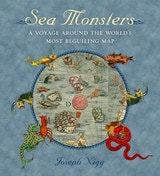
Sea Monsters
A Voyage around the World's Most Beguiling MapJoseph Nigg
University of Chicago Press, 2013
Nearly two meters wide in total, the map’s nine wood-block panels comprise the largest and first realistic portrayal of Northern Europe. But in addition to these important geographic elements, Magnus’s map goes beyond cartography to scenes both domestic and mystic. Close to shore, Magnus shows humans interacting with common sea life—boats struggling to stay afloat, merchants trading, children swimming, and fisherman pulling lines. But from the offshore deeps rise some of the most magical and terrifying sea creatures imaginable at the time or thereafter—like sea swine, whales as large as islands, and the Kraken. In this book, Nigg provides a thorough tour of the map’s cartographic details, as well as a colorful look at its unusual pictorial and imaginative elements. He draws on Magnus’s own text to further describe and illuminate the inventive scenes and to flesh out the stories of the monsters.
Sea Monsters is a stunning tour of a world that still holds many secrets for us land dwellers, who will forever be fascinated by reports of giant squid and the real-life creatures of the deep that have proven to be as bizarre and otherworldly as we have imagined for centuries. It is a gorgeous guide for enthusiasts of maps, monsters, and the mythic.
Sea of Lentils
Hilda Otano Benitez
University of Massachusetts Press, 1990
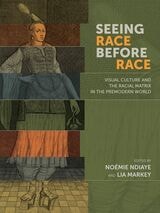
Seeing Race Before Race
Visual Culture and the Racial Matrix in the Premodern WorldEdited by Noémie Ndiaye and Lia Markey
Arizona Center for Medieval and Renaissance Studies, 2023
The capacious visual archive studied in this volume includes a trove of materials such as annotated or illuminated manuscripts, Renaissance costume books and travel books, maps and cartographic volumes produced by Europeans as well as Indigenous peoples, mass-printed pamphlets, jewelry, decorative arts, religious iconography, paintings from around the world, ceremonial objects, festival books, and play texts intended for live performance.
Contributors explore the deployment of what coeditor Noémie Ndiaye calls “the racial matrix” and its interconnected paradigms across the medieval and early modern chronological divide and across vast transnational and multilingual geographies. This volume uses items from the Fall 2023 exhibition “Seeing Race Before Race”—a collaboration between RaceB4Race and the Newberry Library—as a starting point for an ambitious theoretical conversation between premodern race studies, art history, performance studies, book history, and critical race theory.
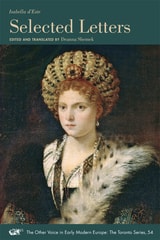
Selected Letters
Isabella d’Este
Iter Press, 2017
Isabella d’Este (1474–1539), daughter of the Este dukes of Ferrara and wife of Marchese Francesco II Gonzaga of Mantua, co-regent of the Gonzaga state, art collector, musician, diplomat, dynastic mother, traveler, reader, gardener, fashion innovator, and consummate politician, was also, as this volume attests, a prolific letter writer with a highly developed epistolary network. Presented here for the first time in any language is a representative selection from over 16,000 letters sent by Isabella to addressees across a wide social spectrum. Together, they paint a nuanced and colorful portrait of a brilliant and influential female protagonist of early modern European society.
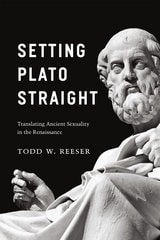
Setting Plato Straight
Translating Ancient Sexuality in the RenaissanceTodd W. Reeser
University of Chicago Press, 2015
In Setting Plato Straight, Todd W. Reeser undertakes the first sustained and comprehensive study of Renaissance textual responses to Platonic same-sex sexuality. Reeser mines an expansive collection of translations, commentaries, and literary sources to study how Renaissance translators transformed ancient eros into non-erotic, non-homosexual relations. He analyzes the interpretive lenses translators employed and the ways in which they read and reread Plato’s texts. In spite of this cleansing, Reeser finds surviving traces of Platonic same-sex sexuality that imply a complicated, recurring process of course-correction—of setting Plato straight.
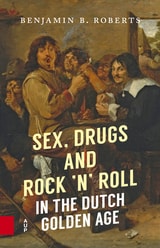
Sex, Drugs and Rock 'n' Roll in the Dutch Golden Age
Benjamin B. Roberts
Amsterdam University Press, 2018
With his engaging storytelling style and humorous anecdotes, Roberts convincingly reveals that deviant male youth behavior is common to all times, especially periods when youngsters have too much money and too much free time on their hands.
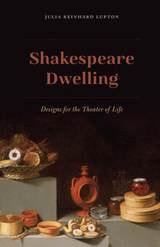
Shakespeare Dwelling
Designs for the Theater of LifeJulia Reinhard Lupton
University of Chicago Press, 2018
Focusing on five works (Romeo and Juliet, Macbeth, Pericles, Cymbeline, and The Winter’s Tale), Lupton remakes the concept of dwelling by drawing on a variety of sources, including modern design theory, Renaissance treatises on husbandry and housekeeping, and the philosophies of Hannah Arendt and Martin Heidegger. The resulting synthesis not only offers a new entry point into the contemporary study of environments; it also shows how Shakespeare’s works help us continue to make sense of our primal creaturely need for shelter.
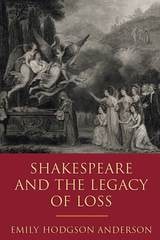
Shakespeare and the Legacy of Loss
Emily Hodgson Anderson
University of Michigan Press, 2018
How do we recapture, or hold on to, the live performances we most love, and the talented artists and performers we most revere? Shakespeare and the Legacy of Loss tells the story of how 18th-century actors, novelists, and artists, key among them David Garrick, struggled with these questions through their reenactments of Shakespearean plays. For these artists, the resurgence of Shakespeare, a playwright whose works just decades earlier had nearly been erased, represented their own chance for eternal life. Despite the ephemeral nature of performance, Garrick and company would find a way to make Shakespeare, and through him the actor, rise again.
In chapters featuring Othello, Richard III, Hamlet, The Winter’s Tale, and The Merchant of Venice, Emily Hodgson Anderson illuminates how Garrick’s performances of Shakespeare came to offer his contemporaries an alternative and even an antidote to the commemoration associated with the monument, the portrait, and the printed text. The first account to read 18th-century visual and textual references to Shakespeare alongside the performance history of his plays, this innovative study sheds new light on how we experience performance, and why we gravitate toward an art, and artists, we know will disappear.
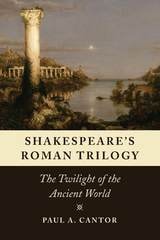
Shakespeare's Roman Trilogy
The Twilight of the Ancient WorldPaul A. Cantor
University of Chicago Press, 2017
Cantor analyzes the way Shakespeare chronicles the rise and fall of the Roman Republic and the emergence of the Roman Empire. The transformation of the ancient city into a cosmopolitan empire marks the end of the era of civic virtue in antiquity, but it also opens up new spiritual possibilities that Shakespeare correlates with the rise of Christianity and thus the first stirrings of the medieval and the modern worlds.
More broadly, Cantor places Shakespeare’s plays in a long tradition of philosophical speculation about Rome, with special emphasis on Machiavelli and Nietzsche, two thinkers who provide important clues on how to read Shakespeare’s works. In a pathbreaking chapter, he undertakes the first systematic comparison of Shakespeare and Nietzsche on Rome, exploring their central point of contention: Did Christianity corrupt the Roman Empire or was the corruption of the Empire the precondition of the rise of Christianity? Bringing Shakespeare into dialogue with other major thinkers about Rome, Shakespeare’s Roman Trilogy reveals the true profundity of the Roman Plays.

Shakespeare’s Legal Ecologies
Law and Distributed SelfhoodKevin Curran
Northwestern University Press, 2017
At the center of the book is Shakespeare’s fascination with questions that are fundamental to both law and philosophy: What are the sources of agency? What counts as a person? For whom am I responsible, and how far does that responsibility extend? What is truly mine? Curran guides readers through Shakespeare’s responses to these questions, paying careful attention to both historical and intellectual contexts.
The result is a book that advances a new theory of Shakespeare’s imaginative relationship to law and an original account of law’s role in the ethical work of his plays and sonnets. Readers interested in Shakespeare, theater and philosophy, law, and the history of ideas will find Shakespeare’s Legal Ecologies to be an essential resource.
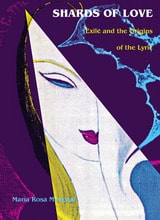
Shards of Love
Exile and the Origins of the LyricMaría Rosa Menocal
Duke University Press, 1994
It is in exile that Menocal locates the founding conditions for philology--as a discipline that loves origins--and for the genre of love songs that philology reveres. She crosses the boundaries, both temporal and geographical, of 1492 to recover the "original" medieval culture, with its Mediterranean mix of European, Arabic, and Hebrew poetics. The result is a form of literary history more lyrical than narrative and, Menocal persuasively demonstrates, more appropriate to the Middle Ages than to the revisionary legacy of the Renaissance. In discussions ranging from Eric Clapton's adaption of Nizami's Layla and Majnun, to the uncanny ties between Jim Morrison and Petrarch, Shards of Love deepens our sense of how the Middle Ages is tied to our own age as it expands the history and meaning of what we call Romance philology.
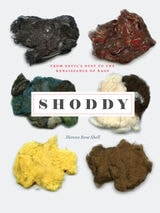
Shoddy
From Devil’s Dust to the Renaissance of RagsHanna Rose Shell
University of Chicago Press, 2020
In Shoddy: From Devil’s Dust to the Renaissance of Rags, Hanna Rose Shell takes readers on a journey to discover shoddy, from Haiti to the “shoddy towns” of West Yorkshire in England, to the United States, back in time to the British cholera epidemics and the American Civil War, and into agricultural fields, textile labs, and rag-shredding factories. Shell’s narrative is both literary and historical, drawing on an extraordinary range of sources, from court cases to military uniforms, mattress labels to medical textbooks, political cartoons to high art. Shoddy moves between genres, bringing richly drawn characters and unexpected objects to life. Along the way, shoddy becomes equally an evocative object and a portal into another world.
Almost since the time it first appeared, shoddy was both ubiquitous and controversial. In part because it was often so hard to detect, it was inherently suspicious. Public health experts worried about sanitation and disease—how could old clothes be disinfected? As well, the idea of wearing someone else’s old clothes so close to your own skin was discomforting in and of itself. Could you sleep peacefully knowing that your mattress was very likely to be stuffed with dead soldiers’ overcoats? The use of the term “virgin” wool, the idea of virginity in relation to clothes, in fact emerged as an effort by the wool industry to counter shoddy’s appeal: to make shoddy seem shoddy. Over time, shoddy would capture a host of personal, ethical, commercial, and societal failings. And yet, there was always, within shoddy, the alluring concept of regeneration, of what we today think of as conscious clothing, eco-fashion, sustainable textiles.
Shell exposes an interwoven tale of industrial espionage, political infighting, scientific inquiry, ethnic prejudices, and war profiteering. Discarded clothes may make many journeys over the course of several lifetimes. Not only in your garments, but under your rug, in your mattress pads, piano blankets, in the peculiar confetti-like stuffing in your mailing envelopes, even in the insulation in your walls. Though it began with wool, over the past century the shredding “devil” has turned to synthetics from nylon stockings to Kevlar. Shoddy is likely connected to something you are wearing right now. After reading, you will never use the word shoddy or think about your clothes, the environment, sustainability, or the intermingled world around you the same way again.
Sir Philip Sidney
Selected Prose and PoetryEdited by Robert Kimbrough
University of Wisconsin Press, 1983
Site Unscene
The Offstage in English Renaissance DramaJonathan Walker
Northwestern University Press, 2017
Jonathan Walker demonstrates that by removing scenes from visible performance, playwrights take up the nondramatic mode of storytelling in order to transcend the limits of the stage. Through this technique, they present dramatic action from the subjective, self-interested, and idiosyncratic perspectives of individual characters. By recovering these offstage elements, Walker reveals the pervasive and formative dynamic between the onstage and offstage and between the seen and unseen in Renaissance drama.
Examining premodern dramatic theory, Renaissance plays, period amphitheaters, and material texts, this interdisciplinary work considers woodcuts, engravings, archaeology, architecture, rhetoric, the history of the book, as well as plays by Shakespeare, Marlowe, Kyd, Ford, Middleton, and Webster, among others. It addresses readers engaged in literary criticism, dramatic theory, theater history, and textual studies.
Spenser Studies, volume 37 number 1 (2023)
The University of Chicago Press
University of Chicago Press Journals, 2023
Spenser Studies, volume 38 number 1 (2024)
The University of Chicago Press
University of Chicago Press Journals, 2024
Spenser Studies, volume 39 number 1 (2025)
The University of Chicago Press
University of Chicago Press Journals, 2025
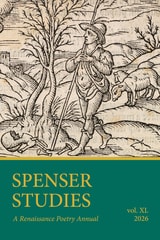
Spenser Studies, volume 40 number 1 (January 2026)
The University of Chicago Press
University of Chicago Press Journals, 2026
Spenser Studies
A Renaissance Poetry Annual, volume 35 number 1 (2021)The University of Chicago Press
University of Chicago Press Journals, 2021
Spenser Studies
A Renaissance Poetry Annual, volume 36 number 1 (2022)The University of Chicago Press
University of Chicago Press Journals, 2022
Storytelling in Sixteenth-Century France
Negotiating Shifting FormsEmily E. Thompson
University of Delaware Press, 2022
Published by the University of Delaware Press. Distributed worldwide by Rutgers University Press.
Studies in Medieval and Renaissance History
Volume 14Edited by Joel T. Rosenthal and Paul E. Szarmach
Arizona Center for Medieval and Renaissance Studies, 2019
Syriac Christian Culture
Beginnings to RenaissanceAaron Michael Butts
Catholic University of America Press, 2021