Results by title
51 books match the query 'Reptiles & Amphibians' and 7 start with s
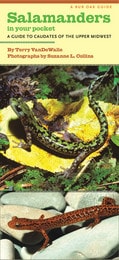
Salamanders in Your Pocket
A Guide to Caudates of the Upper MidwestTerry L. VanDeWalle and Suzanne L. Collins
University of Iowa Press, 2013
Common mudpuppies and lesser sirens spend their entire lives in water, never losing the gills that they developed as larvae; the lungless four-toed salamander distracts predators by detaching its tail; the eastern newt discourages predators by secreting poisonous chemicals from its skin; the flat-bodied hellbender, which can reach twenty-nine inches in length, breathes by absorbing oxygen through the folds of its skin. These, plus the well-named slimy, zigzag, tiger, and other salamanders in this guide, are now threatened by loss of habitat, pollution, and a deadly fungus.
Terry VanDeWalle provides a complete description of each species as well as distinguishing characteristics for twenty-one subspecies, from the striking orange and yellow spots of the spotted salamander to the lichenlike patches of the green salamander to the prominent rounded head of the mole salamander. He also includes information about the salamanders’ range and habitat preferences, from twilight zones of limestone caves and crevices to seepages and spring-fed bogs. His comparisons of similar species and his comprehensive key are most helpful for identifying individuals in the field. Superb photographs by Suzanne Collins make this new guide the perfect companion for outdoor expeditions in all kinds of moist environments.
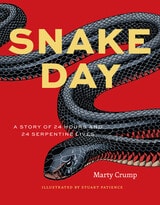
Snake Day
A Story of 24 Hours and 24 Serpentine LivesMarty Crump
University of Chicago Press, 2026
Does a snake crossing your path trigger delight or dread? The answer is clear for celebrated biologist Marty Crump, who shows us that snakes deserve our respect, admiration, and protection. In her short book Snake Day, each chapter introduces a single snake during a single hour, highlighting twenty-four different species from around the globe.
In the dark morning of a Brazilian forest, we avoid stepping on a jararaca, a nocturnal viper. If she bites, her venom will make our blood pressure—and us—drop. A synthetic version of this venom is now a lifesaving drug, used to treat hypertension and heart failure. Later in the morning, in the Zagros Mountains that trace Iran’s northwest border, what appears to be a tiny arachnid wiggles on the ground. When a hungry warbler approaches for a meal, realizes too late that the spider is actually a snake’s tail, and an Iranian spider-tailed viper makes a meal of the bird. In the early afternoon, in a pine forest outside Atlanta, Georgia, an eastern hognose snake strikes at us—a bluff—and then rolls over and plays dead. By the end of our snake day, we’ll have glimpsed the diversity of this unique group of reptiles, met serpentine friends who frighten and fascinate, and learned how humans can protect these amazing species.
For each hour, celebrated artist Stuart Patience has depicted serpentine scenes in stunning pen-and-ink drawings. Working together to narrate and illustrate these unique moments in time, Crump and Patience have created an engaging read that is a perfect way to spend an hour or two—and a true gift for amateur scientists or anyone who recoils at or relishes the sight of a snake.
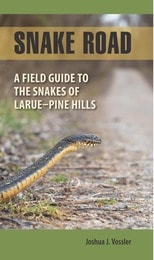
Snake Road
A Field Guide to the Snakes of LaRue-Pine HillsJoshua J. Vossler
Southern Illinois University Press, 2021
Twice a year, spring and fall, numerous species of reptiles and amphibians migrate between the LaRue–Pine Hills’ towering limestone bluffs and the Big Muddy River’s swampy floodplain in southern Illinois. Snakes, especially great numbers of Cottonmouths, give the road that separates these distinct environments its name. Although it is one of the best places in the world to observe snakes throughout the year, spring and fall are the optimal times to see a greater number and variety. Among the many activities that snakes can be observed doing are sunning themselves on rocks, lying in grasses, sheltering under or near fallen tree limbs, or crossing the road. In this engaging guide, author Joshua J. Vossler details what to expect and how to make the most of a visit to what is known around the world as Snake Road.
Vossler catalogs twenty-three native snake species by both common and scientific names, lists identifying features, and estimates the probability of spotting them. Throughout this book, stunning color photographs of each species’ distinctive physical characteristics enable identification by sight only, an important feature, since Illinois law prohibits the handling, harming, or removal of reptiles and other wildlife on and around the road. Since snakes are visually variable—individual snakes of the same species can differ tremendously in size, color, and pattern—photographs of as many variations as possible are included. To aid in identification, eleven sets of photographs contrast the features of similar species and point out how and why these snakes may be easily confused. Visitors can keep track of the snakes they have identified by using the checklist in the back of the book. A list of recommended reading provides sources of additional information about snakes in southern Illinois and beyond.
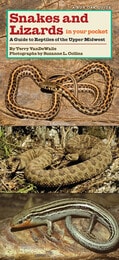
Snakes and Lizards in Your Pocket
A Guide to Reptiles of the Upper MidwestTerry VanDeWalle
University of Iowa Press, 2010
From the rare and docile massasauga, which relies on camouflage to remain unnoticed, to the more familiar bullsnake, which defends itself by hissing loudly and vibrating its tail from an S-shaped striking position, to the eastern racer, often seen crawling at more than three miles an hour during daytime, snakes are beautiful animals with habits both fascinating and beneficial to humans. Their relatives the lizards, most of which are more easily seen and identified, exhibit similarly fascinating behavior. This colorful addition to our series of laminated guides informs both amateur and professional herpetologists about twenty-seven species of snakes and six species of lizards in the Upper Midwest states of Minnesota, Wisconsin, Illinois, Indiana, Michigan, Ohio, South Dakota, North Dakota, Kansas, Nebraska, Iowa, and Missouri.
Terry VanDeWalle provides a complete description of each species, both adult and young, as well as distinguishing characteristics for thirty-two subspecies of snakes and two subspecies of lizards: length, color, head and neck patterns, scales, and so on. Also included is information about habitat preferences: forests, wet meadows, and sand prairies, for example. Most helpful for identifying snakes and lizards in the field are his comparisons of similar species and his comprehensive key.
Superb photographs by Suzanne Collins of adult and, when needed for identification, young snakes and lizards make this guide the perfect companion for hikers in all kinds of environments whenever a snake ripples across your path or a lizard darts into the underbrush.
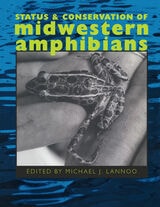
Status and Conservation of Midwestern Amphibians
Michael J. Lannoo
University of Iowa Press, 1998
In 1990 an international group of biologists, meeting to discuss rumors of declines in the number of amphibians, discovered that amphibian disappearances once thought to be a local problem were not—the problem was global. And, even more disturbing, amphibians were disappearing not just from areas settled by humans but from regions of the world once believed to be pristine. Under the mantle of the Declining Amphibian Populations Task Force, this timely book addresses three fundamental questions for the midwestern United States: are amphibians declining; if so, why; and, if so, what can be done to halt these losses?
In the Midwest—defined here as Missouri, Iowa, Illinois, Indiana, Ohio, Minnesota, Wisconsin, and Michigan—there can be no doubt that the number of salamanders and frogs has declined with Euro-American settlement and the conversion to an agriculturally dominated landscape. Habitat loss and landscape fragmentation have been major factors in this decline, as have aquacultural uses of natural wetlands. Bullfrog introductions have eliminated populations of native amphibians, and collecting for the biological supply trade has reduced the number of individuals within many populations. The goal of the forty-two essays in this well-documented, well-illustrated book is to put between two covers all we know now about the status of midwestern amphibians. By doing this, the editor has created a readily accessible historical record for future studies.
Organized into sections covering landscape patterns and biogeography, species status, regional and state status, diseases and toxins, conservation, and monitoring and applications, this landmark volume will serve as the foundation for amphibian conservation in the Midwest.
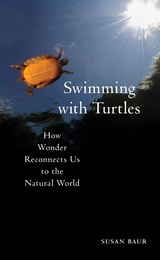
Swimming with Turtles
How Wonder Reconnects Us to the Natural WorldSusan Baur
University of Massachusetts Press, 2026
A memoir of discovery, loss, and wonder that shows us how to slow down
When psychologist and author Susan Baur first slipped into a Cape Cod pond with a snorkel, she wasn’t looking for transformation, just a swim. But beneath the surface, she discovered something extraordinary: minnows hiding among water lilies; fresh-water jellies like jewels and—most striking of all—painted, musk, and snapping turtles. Whether the turtles were buried in mud, teetering on a submerged branch, or drifting like ancient astronauts, they pulled her into a mysterious happiness she could not explain.
Learning to move slowly enough to see them became both her new discipline and her greatest joy. Each dive required patience, curiosity, and humility, and she learned to read the water, follow a subtle shadow, and anticipate the turtles’ rhythms without disturbing their world. As she mastered the art of swimming with turtles, Baur also fell in love with an older man whose companionship deepened her connection to the natural world. When he passed away, grief drove her deeper into the water. There, among the turtles, she found solace and purpose: a reason to keep diving, looking, and learning.
Over nearly two decades, Baur became a self-taught naturalist, children’s author (of The Turtle Sisters series), and unlikely environmental advocate, founding Old Ladies Against Underwater Garbage to protect the ponds she had grown to love. With humor, heart, and vivid observation, Baur shows that wonder isn’t reserved for the young or the lucky—it waits beneath the surface for anyone willing to slow down, look closely, and stay a while.
Swimming with Turtles
How Wonder Reconnects Us to the Natural WorldWritten by Susan Baur. Narrated by Moe Egan
University of Massachusetts Press, 2026
A memoir of discovery, loss, and wonder that shows us how to slow down
When psychologist and author Susan Baur first slipped into a Cape Cod pond with a snorkel, she wasn’t looking for transformation, just a swim. But beneath the surface, she discovered something extraordinary: minnows hiding among water lilies; fresh-water jellies like jewels and—most striking of all—painted, musk, and snapping turtles. Whether the turtles were buried in mud, teetering on a submerged branch, or drifting like ancient astronauts, they pulled her into a mysterious happiness she could not explain.
Learning to move slowly enough to see them became both her new discipline and her greatest joy. Each dive required patience, curiosity, and humility, and she learned to read the water, follow a subtle shadow, and anticipate the turtles’ rhythms without disturbing their world. As she mastered the art of swimming with turtles, Baur also fell in love with an older man whose companionship deepened her connection to the natural world. When he passed away, grief drove her deeper into the water. There, among the turtles, she found solace and purpose: a reason to keep diving, looking, and learning.
Over nearly two decades, Baur became a self-taught naturalist, children’s author (of The Turtle Sisters series), and unlikely environmental advocate, founding Old Ladies Against Underwater Garbage to protect the ponds she had grown to love. With humor, heart, and vivid observation, Baur shows that wonder isn’t reserved for the young or the lucky—it waits beneath the surface for anyone willing to slow down, look closely, and stay a while.