Results by title
53 books match the query 'Research & Methodology' and 4 start with s
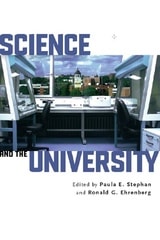
Science and the University
Edited by Paula E. Stephan and Ronald G. Ehrenberg
University of Wisconsin Press, 2007
Science and the University investigates the tremendous changes that have taken place in university research over the past several decades, gauging the current state of research in higher education and examining issues and challenges crucial to its future. Scientific research increasingly dominates the aims and agendas of many American universities, and this proliferation—and changes in the way research is conducted—has given rise to important questions about the interrelations of higher education, funding for scientific research, and government policy. The cost of doing science, the commercialization of university research, the changing composition and number of Ph.D. students, the effect of scientific research on other university programs—these are just a few of the many issues explored in this volume from the vantage points of scholars in such diverse fields as economics, biochemistry, genetics, and labor studies.
[more]

Selected Writings of Selma Fraiberg
Edited by Louis Fraiberg with a Foreword by Robert N. Emde, M.D.
The Ohio State University Press, 1987
Social worker, psychoanalyst, and child-development expert Selma Fraiberg’s iconic book, The Magic Years, has influenced generations of caregivers, therapists, and clinicians since its publication in 1959. No less rich are the essays that make up this new, accessibly priced reissue of her Selected Writings. Like The Magic Years, these essays (including her hugely influential “Ghosts in the Nursery”) glean their insights from years of clinical study and contain Fraiberg’s synthesis of and groundbreaking contributions to attachment theory, child psychology, social work, and, through her work with blind children, the experience of disability in infancy and childhood. Clinical rigor paired with attunement to the emotional lives of her subjects was Fraiberg’s hallmark: as her husband Louis writes in his preface to this volume, “Once, when asked how she knew what babies were thinking, she replied, ‘They tell me.’” Lucid and elegantly written, her Selected Writings will remain a valuable resource for new generations of social workers, mental-health professionals, educators, and others who work with young children.
[more]
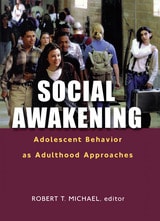
Social Awakening
Adolescent Behavior as Adulthood ApproachesRobert T. Michael
Russell Sage Foundation, 2001
While headlines about violent crimes committed by adolescents often capture the public's attention, many more young people excel in the classroom, on the athletic field, and in the community. Why do some youngsters strive to achieve while others court disaster? Using new data from the National Longitudinal Survey of Youth (NLSY), a survey of more than nine thousand young people between the ages of twelve and sixteen, Social Awakening explores the choices adolescents make about their lives and their futures. The book focuses on the key role the family plays as teenagers navigate the difficult transition from childhood to adulthood. Social Awakening analyzes a wide range of adolescent behavior and issues that affect teenagers' lives—from their dating and sexual behavior, drug and alcohol use, and physical and mental well-being, to their career goals and expectations for the future. The findings strengthen our understanding of how an array of family characteristics—single parenthood, income, educational level, race, and geographical location—influences teens' lives. One contributor explores why children from single-parent families are more likely to perform poorly in school and to indulge in risky behavior, such as drug abuse or promiscuous sexual activity. Another chapter examines why children of parents with a college degree are less likely to engage in early sexual activity. And another looks at different levels of criminal behavior among urban and rural youths. One of the advantages of an in-depth interview such as the NLSY is the wide array of behavior and experiences by the same youths that can be mutually investigated. The analysis in Social Awakening helps confirm or refute what we think we know—to explore what we could not explore with older or less complex surveys. The NLSY, which forms the foundation of Social Awakening, will be updated annually over the coming decades to enable experts to learn how those who were adolescents at the dawn of the twenty-first century handled the move to adulthood. Social Awakening provides a compelling first look at these young peoples' lives.
[more]
Suffering Made Real
American Science and the Survivors at HiroshimaM. Susan Lindee
University of Chicago Press, 1994
The atomic bombs dropped on Hiroshima and Nagasaki in August of 1945 unleashed a force as mysterious as it was deadly—radioactivity. In 1946, the United States government created the Atomic Bomb Casualty Commission (ABCC) to serve as a permanent agency in Japan with the official mission of studying the medical effects of radiation on the survivors. The next ten years saw the ABCC's most intensive research on the genetic effects of radiation, and up until 1974 the ABCC scientists published papers on the effects of radiation on aging, life span, fertility, and disease.
Suffering Made Real is the first comprehensive history of the ABCC's research on how radiation affected the survivors of the atomic bomb. Arguing that Cold War politics and cultural values fundamentally shaped the work of the ABCC, M. Susan Lindee tells the compelling story of a project that raised disturbing questions about the ethical implications of using human subjects in scientific research.
How did the politics of the emerging Cold War affect the scientists' biomedical research and findings? How did the ABCC document and publicly present the effects of radiation? Why did the ABCC refuse to provide medical treatment to the survivors? Through a detailed examination of ABCC policies, archival materials, the minutes of committee meetings, newspaper accounts, and interviews with ABCC scientists, Lindee explores how political and cultural interests were reflected in the day-to-day operations of this controversial research program.
Set against a period of conflicting views of nuclear weapons and nuclear power, Suffering Made Real follows the course of a politically charged research program and reveals in detail how politics and cultural values can shape the conduct, results, and uses of science.
[more]