81 books match the query 'Revolutions, Uprisings & Rebellions' and 3 start with s
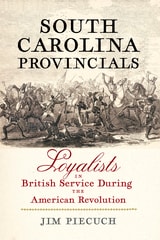
cover of South Carolina Provincials: Loyalists in British Service During the American Revolution

South Carolina Provincials

Loyalists in British Service During the American Revolution

Jim Piecuch

Westholme Publishing, 2026

The Loyalists who supported the British during the American Revolution have frequently been neglected in accounts of that conflict. Nevertheless, Loyalists made significant efforts to assist British forces in restoring royal control of the thirteen colonies. This was especially true in South Carolina, where backcountry Loyalists under almost-forgotten leaders such as Joseph Robinson and Euan McLaurin challenged the Revolutionary movement in 1775. Although their initial efforts were unsuccessful, Robinson, McLaurin, and hundreds of their followers eventually made their way to British East Florida, where they organized into a provincial regiment called the South Carolina Royalists. Operating in concert with British efforts, the Royalists were part of many notable actions from 1778 to 1781, including the defenses of East Florida and Savannah, Georgia, and the battles of Briar Creek, Stono Ferry, Musgrove’s Mill, and Hobkirk’s Hill. A second provincial regiment created in 1780, Major John Harrison’s South Carolina Rangers, saw considerably action in operations against partisans under Francis Marion. When the British were forced to evacuate their backcountry posts in 1781, the Royalists, Rangers, and three troops of Provincial Light Dragoons raised earlier in the year withdrew first to Charleston and then East Florida. From there, many went to Canada at the war’s end, with others dispersing to different British colonies to begin new lives after their strenuous but unsuccessful effort on behalf of king and country.
            In South Carolina Provincials: Loyalists in British Service During the American Revolution, historian Jim Piecuch provide the first comprehensive history of those South Carolinians who took up arms to assist the British during their attempt to quell the rebellion in the South. Based on primary source research including records rarely consulted, the result provides a much clearer picture of the American Revolution at the local level in Georgia, Florida, and the Carolinas.
 
[more]
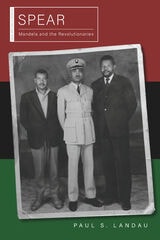
cover of Spear: Mandela and the Revolutionaries

Spear

Mandela and the Revolutionaries

Paul S. Landau

Ohio University Press, 2022
A revelatory and definitive account of how Nelson Mandela and his peers led South Africa to the brink of revolution against the postwar twentieth century’s most infamously racist regime. Spear: Mandela and the Revolutionaries brings to life the brief revolutionary period in which Nelson Mandela and his comrades fought apartheid not just with words but also with violence. After the 1960 Sharpeville police shootings of civilian protesters, Mandela and his comrades in the mass-resistance order of the African National Congress (ANC) and the Communist Party pioneered the use of force and formed Umkhonto we Sizwe (MK), or Spear of the Nation. A civilian-based militia, MK stockpiled weapons and waged a war of sabotage against the state with pipe bombs, Molotov cocktails, and dynamite. In response, the state passed draconian laws, militarized its police, and imprisoned its enemies without trial. Drawing from several hundred first-person accounts, most of which are unpublished, Paul Landau traces Mandela’s allies—and opponents—in communist, pan-Africanist, liberal, and other groups involved in escalating resistance alongside the ANC. After Mandela’s capture, the Pan Africanist Congress planned to initiate street violence, and MK organized Operation Mayibuye, an uprising to be led by trained commandos. The state short-circuited those plans and subsequently jailed, exiled, tortured, and murdered revolutionaries. The era of high apartheid then began. Spear reshapes our understanding of Mandela by focusing on this intense but relatively neglected period of escalation in the movement against apartheid. Landau’s book is not a biography, nor is it a history of a militia or an army; rather, it is a riveting story about ordinary civilians debating and acting together in extremis. Contextualizing Mandela and MK’s activities amid anticolonial change and Black Marxism in the early 1960s, Spear also speaks to today’s transnational antiracism protests and worldwide struggles against oppression.
[more]
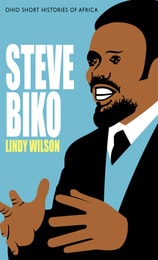
cover of Steve Biko

Steve Biko

Lindy Wilson

Ohio University Press, 2011

Steve Biko inspired a generation of black South Africans to claim their true identity and refuse to be a part of their own oppression. Through his example, he demonstrated fearlessness and self-esteem, and he led a black student movement countrywide that challenged and thwarted the culture of fear perpetuated by the apartheid regime. He paid the highest price with his life. The brutal circumstances of his death shocked the world and helped isolate his oppressors.

This short biography of Biko shows how fundamental he was to the reawakening and transformation of South Africa in the second half of the twentieth century—and just how relevant he remains. Biko’s understanding of black consciousness as a weapon of change could not be more relevant today to “restore people to their full humanity.”

As an important historical study, this book’s main sources were unique interviews done in 1989—before the end of apartheid—by the author with Biko’s acquaintances, many of whom have since died.

[more]