Results by title
137 books match the query 'Science & Technology' and 9 start with s
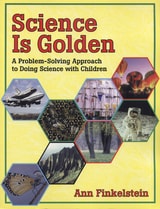
Science is Golden
A Problem-Solving Approach to Doing Science with ChildrenAnn Finkelstein
Michigan State University Press, 2002
The first book of its kind, Science is Golden discusses how to implement an inquiry-based, problem-solving approach to science education (grades K-5). Finkelstein shows parents and teachers how to help students investigate their own scientific questions. Rather than a set of guidelines for science fair projects, this book presents a method for helping students expand their creativity and develop logical thinking while learning science.
Starting with an introduction to the "brains-on method," Science is Golden explains brainstorming, experimental controls, collecting data, and how to streamline children's questions about science so that the questions define an experiment. Students will learn how to: ask good questions; clarify terminology; research, plan, and design experiments and controls; test assumptions; collect and analyze data; present results to others; and collaborate with adults.
Science is Golden is consistent with the National Science Education Standards proposed by the National Academy of Sciences, and the Michigan Essential Goals and Objectives for Science Education (K-12) from the Michigan State Board of Education.

Sex in an Age of Technological Reproduction
<i>ICSI<i/> and <i>Taboos<i/>Carl Djerassi
University of Wisconsin Press, 2008
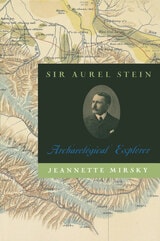
Sir Aurel Stein
Archaeological ExplorerJeannette Mirsky
University of Chicago Press, 1977
"[Mirsky] has digested the correspondence, and she quotes so skillfully that her book will save many people the trouble of reading Stein's own exhaustive and exhausting volumes. Definitive."—Larry McMurtry, Washington Post
"A first-rate and unique biography of one of the more significant explorers of Central Asia and the Indo-Iranian borderlands. . . . Mirsky has recreated not only the life of an intrepid explorer but the spirit of the times."—Choice
"Mirsky has performed a signal service in distilling the life, travels, and letters of Aurel Stein into a manageable, graceful, and meaningful synthesis."—Theodore A. Wertime, Technology and Culture
Something Incredibly Wonderful Happens
Frank Oppenheimer and His Astonishing ExploratoriumK. C. Cole
University of Chicago Press, 2012
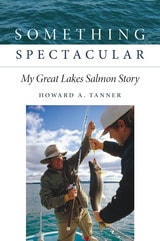
Something Spectacular
My Great Lakes Salmon StoryHoward A. Tanner
Michigan State University Press, 2018
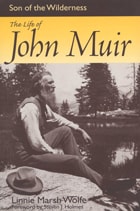
Son of the Wilderness
The Life of John MuirLinnie Marsh Wolfe
University of Wisconsin Press, 2003
Working closely with Muir’s family and with his papers, Wolfe was able to create a full portrait of her subject, not only as America’s firebrand conservationist and founder of the national park system, but also as husband, father, and friend. All readers who have admired Muir’s ruggedly individualistic lifestyle, and those who wish a greater appreciation for the history of environmental preservation in America, will be enthralled and enlightened by this splendid biography.
The story follows Muir from his ancestral home in Scotland, through his early years in the harsh Wisconsin wilderness, to his history-making pilgrimage to California.
This book, originally published in 1945 and based in large part on Wolfe’s personal interviews with people who knew and worked with Muir, is one that could never be written again. It is, and will remain, the standard Muir biography.

Stinging Trees and Wait-a-Whiles
Confessions of a Rainforest BiologistWilliam Laurance
University of Chicago Press, 2000
The book is his record of the time he spent in this remote area and his run-ins with plant, animal, and human species alike. Laurance lived in a tiny town of loggers and farmers, and he witnessed firsthand the impact of conservation issues on individual lives. He found himself at the center of a bitter battle over conservation strategies and became not only the subject of small-town gossip but also the object of many residents' hatred. Keeping ahead of his high-spirited young volunteers, hounded by the drug-sniffing local policeman, and all the while trying to further his own research amid natural and unnatural obstacles, Laurance offers us a personal and hilarious account of fieldwork and life in the Australian outpost of Millaa Millaa. Stinging Trees and Wait-a-Whiles is a biology lesson, a conservation primer, and an utterly energetic story about an impressionable young man who wound up at the epicenter of an issue that tore a small town apart.
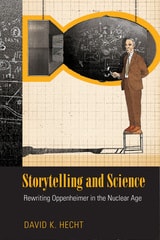
Storytelling and Science
Rewriting Oppenheimer in the Nuclear AgeDavid K. Hecht
University of Massachusetts Press, 2015
No single figure embodies Cold War science more than the renowned physicist J. Robert Oppenheimer. Although other scientists may have been more influential in establishing the institutions and policies of the nuclear age, none has loomed larger in the popular imagination than the “father of the atomic bomb.” Americans have been drawn to the story of the Manhattan Project Oppenheimer helped lead and riveted by the McCarthy-era politics that caught him in its crosshairs. Journalists and politicians, writers and artists have told Oppenheimer's story in many different ways since he first gained notoriety in 1945. In Storytelling and Science, David K. Hecht examines why they did so, and what they hoped to achieve through their stories.
From the outset, accounts of Oppenheimer's life and work were deployed for multiple ends: to trumpet or denigrate the value of science, to settle old scores or advocate new policies, to register dissent or express anxieties. In these different renditions, Oppenheimer was alternately portrayed as hero and villain, establishment figure and principled outsider, “destroyer of worlds” and humanist critic. Yet beneath the varying details of these stories, Hecht discerns important patterns in the way that audiences interpret, and often misinterpret, news about science. In the end, he argues, we find that science itself has surprisingly little to do with how its truths are assimilated by the public. Instead its meaning is shaped by narrative traditions and myths that frame how we think and write about it.
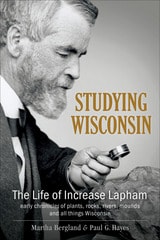
Studying Wisconsin
The Life of Increase Lapham, early chronicler of plants, rocks, rivers, mounds and all things WisconsinMartha Bergland
Wisconsin Historical Society Press, 2014
With masterful storytelling, Bergland and Hayes demonstrate how Lapham blended his ravenous curiosity with an equable temperament and a passion for detail to create a legacy that is still relevant today.
—John Gurda
In this long overdue tribute to Wisconsin’s first scientist, authors Martha Bergland and Paul G. Hayes explore the remarkable life and achievements of Increase Lapham (1811–1875). Lapham’s ability to observe, understand, and meticulously catalog the natural world marked all of his work, from his days as a teenage surveyor on the Erie Canal to his last great contribution as state geologist.
Self-taught, Lapham mastered botany, geology, archaeology, limnology, mineralogy, engineering, meteorology, and cartography. A prolific writer, his 1844 guide to the territory was the first book published in Wisconsin. Asked late in life which field of science was his specialty, he replied simply, “I am studying Wisconsin.”
Lapham identified and preserved thousands of botanical specimens. He surveyed and mapped Wisconsin’s effigy mounds. He was a force behind the creation of the National Weather Service, lobbying for a storm warning system to protect Great Lakes sailors. Told in compelling detail through Lapham’s letters, journals, books, and articles, Studying Wisconsin chronicles the life and times of Wisconsin’s pioneer citizen-scientist.