Results by title
67 books match the query 'Segregation' and 9 start with s
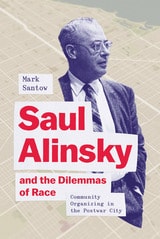
Saul Alinsky and the Dilemmas of Race
Community Organizing in the Postwar CityMark Santow
University of Chicago Press, 2023
Saul Alinsky is the most famous—even infamous—community organizer in American history. Almost single-handedly, he invented a new political form: community federations, which used the power of a neighborhood’s residents to define and fight for their own interests. Across a long and controversial career spanning more than three decades, Alinsky and his Industrial Areas Foundation organized Eastern European meatpackers in Chicago, Kansas City, Buffalo, and St. Paul; Mexican Americans in California and Arizona; white middle-class homeowners on the edge of Chicago’s South Side black ghetto; and African Americans in Rochester, Buffalo, Chicago, and other cities.
Mark Santow focuses on Alinsky’s attempts to grapple with the biggest moral dilemma of his age: race. As Santow shows, Alinsky was one of the few activists of the period to take on issues of race on paper and in the streets, on both sides of the color line, in the halls of power, and at the grassroots, in Chicago and in Washington, DC. Alinsky’s ideas, actions, and organizations thus provide us with a unique and comprehensive viewpoint on the politics of race, poverty, and social geography in the United States in the decades after World War II. Through Alinsky’s organizing and writing, we can see how the metropolitan color line was constructed, contested, and maintained—on the street, at the national level, and among white and black alike. In doing so, Santow offers new insight into an epochal figure and the society he worked to change.
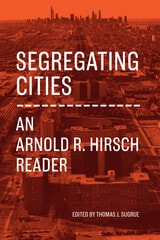
Segregating Cities
An Arnold R. Hirsch ReaderArnold R. Hirsch
University of Chicago Press, 2026
Arnold R. Hirsch (1949–2018) was one of the preeminent urban historians of his generation, a reputation cemented by his landmark book, Making the Second Ghetto. With compelling clarity, Hirsch demonstrated that segregation is not the inevitable result of individual choices, natural tendencies, or cultural traits—it is a structural phenomenon, reinforced on every level by state power.
Segregating Cities collects the author’s key essays, some previously unpublished, to reveal a more complete picture of a remarkable scholar and his exploration of race, place, politics, and policy in the twentieth-century American city. Together, these essays can help us see segregation for what it is, so that we can then begin to truly work to overcome it.
Segregating Sound
Inventing Folk and Pop Music in the Age of Jim CrowKarl Hagstrom Miller
Duke University Press, 2010
In a cultural history filled with musicians, listeners, scholars, and business people, Miller describes how folklore studies and the music industry helped to create a “musical color line,” a cultural parallel to the physical color line that came to define the Jim Crow South. Segregated sound emerged slowly through the interactions of southern and northern musicians, record companies that sought to penetrate new markets across the South and the globe, and academic folklorists who attempted to tap southern music for evidence about the history of human civilization. Contending that people’s musical worlds were defined less by who they were than by the music that they heard, Miller challenges assumptions about the relation of race, music, and the market.
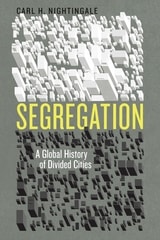
Segregation
A Global History of Divided CitiesCarl H. Nightingale
University of Chicago Press, 2012
When we think of segregation, what often comes to mind is apartheid South Africa, or the American South in the age of Jim Crow—two societies fundamentally premised on the concept of the separation of the races. But as Carl H. Nightingale shows us in this magisterial history, segregation is everywhere, deforming cities and societies worldwide.
Starting with segregation’s ancient roots, and what the archaeological evidence reveals about humanity’s long-standing use of urban divisions to reinforce political and economic inequality, Nightingale then moves to the world of European colonialism. It was there, he shows, segregation based on color—and eventually on race—took hold; the British East India Company, for example, split Calcutta into “White Town” and “Black Town.” As we follow Nightingale’s story around the globe, we see that division replicated from Hong Kong to Nairobi, Baltimore to San Francisco, and more. The turn of the twentieth century saw the most aggressive segregation movements yet, as white communities almost everywhere set to rearranging whole cities along racial lines. Nightingale focuses closely on two striking examples: Johannesburg, with its state-sponsored separation, and Chicago, in which the goal of segregation was advanced by the more subtle methods of real estate markets and housing policy.
For the first time ever, the majority of humans live in cities, and nearly all those cities bear the scars of segregation. This unprecedented, ambitious history lays bare our troubled past, and sets us on the path to imagining the better, more equal cities of the future.
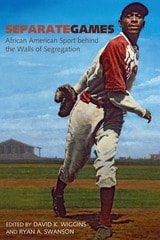
Separate Games
African American Sport behind the Walls of SegregationDavid K. Wiggins
University of Arkansas Press, 2017
Winner of the 2017 NASSH Book Award for best edited collection.
The hardening of racial lines during the first half of the twentieth century eliminated almost all African Americans from white organized sports, forcing black athletes to form their own teams, organizations, and events. This separate sporting culture, explored in the twelve essays included here, comprised much more than athletic competition; these “separate games” provided examples of black enterprise and black self-help and showed the importance of agency and the quest for racial uplift in a country fraught with racialist thinking and discrimination.
The significance of this sporting culture is vividly showcased in the stories of the Cuban Giants baseball team, basketball’s New York Renaissance Five, the Tennessee State Tigerbelles track-and-field team, black college football’s Turkey Bowl Classic, car racing’s Gold and Glory Sweepstakes, Negro League Baseball’s East-West All-Star game, and many more. These teams, organizations, and events made up a vibrant national sporting complex that remained in existence until the integration of sports beginning in the late 1940s. Separate Games explores the fascinating ways sports helped bind the black community and illuminate race pride, business acumen, and organizational abilities.
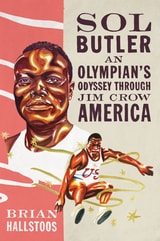
Sol Butler
An Olympian's Odyssey through Jim Crow AmericaBrian Hallstoos
University of Illinois Press, 2026
State of Segregation
America’s Freedom Rights Struggles as Told by AlabamaMark J. Tenhundfeld
University of Alabama Press, 2026
A revealing legal journey through Alabama’s civil rights battles, exposing systemic discrimination and the enduring fight for justice via landmark Supreme Court cases
State of Segregation: America’s Freedom Rights Struggles, as Told by Alabama by Mark J. Tenhundfeld offers a compelling exploration of Alabama’s civil rights and civil liberties history through the lens of thirty-two pivotal US Supreme Court cases. Each case, rooted in Alabama’s social and legal conflicts, reveals the persistent struggle to fulfill the Constitution’s promises of equal protection and due process. From early twentieth-century challenges to the Alabama Constitution of 1901 to contemporary battles over gerrymandering, Tenhundfeld traces how discrimination was embedded in the state’s institutions—and how it was contested.
State of Segregation uniquely blends legal analysis, historical narrative, and social commentary to expose the deep-rooted systems of racial, gender, and class-based discrimination in Alabama. Tenhundfeld argues that while discrimination is the most defining feature of Alabama’s past, it remains the most difficult to confront. By illuminating the legal strategies used to uphold and dismantle injustice, State of Segregation contributes to the broader understanding of how historical inequities continue to shape modern society.
Accessible to general readers and scholars alike, this work stands apart by combining Alabama history, civil rights struggles, and Supreme Court jurisprudence into a single, powerful narrative. It offers both cautionary tales about the fragility of freedom and enduring lessons for today’s social justice advocates.
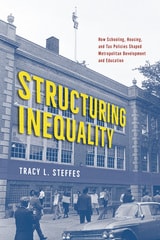
Structuring Inequality
How Schooling, Housing, and Tax Policies Shaped Metropolitan Development and EducationTracy L. Steffes
University of Chicago Press, 2024
As in many American metropolitan areas, inequality in Chicagoland is visible in its neighborhoods. These inequalities are not inevitable, however. They have been constructed and deepened by public policies around housing, schooling, taxation, and local governance, including hidden state government policies.
In Structuring Inequality, historian Tracy L. Steffes shows how metropolitan inequality in Chicagoland was structured, contested, and naturalized over time even as reformers tried to change it through school desegregation, affordable housing, and property tax reform. While these efforts had modest successes in the city and the suburbs, reformers faced significant resistance and counter-mobilization from affluent suburbanites, real estate developers, and other defenders of the status quo who defended inequality and reshaped the policy conversation about it. Grounded in comprehensive archival research and policy analysis, Structuring Inequality examines the history of Chicagoland’s established systems of inequality and provides perspective on the inequality we live with today.
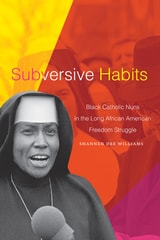
Subversive Habits
Black Catholic Nuns in the Long African American Freedom StruggleShannen Dee Williams
Duke University Press, 2022