Results by title
105 books match the query 'Self' and 15 start with s
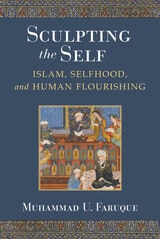
Sculpting the Self
Islam, Selfhood, and Human FlourishingMuhammad U. Faruque
University of Michigan Press, 2021
Sculpting the Self addresses “what it means to be human” in a secular, post-Enlightenment world by exploring notions of self and subjectivity in Islamic and non-Islamic philosophical and mystical thought. Alongside detailed analyses of three major Islamic thinkers (Mullā Ṣadrā, Shāh Walī Allāh, and Muhammad Iqbal), this study also situates their writings on selfhood within the wider constellation of related discussions in late modern and contemporary thought, engaging the seminal theoretical insights on the self by William James, Jean-Paul Sartre, and Michel Foucault. This allows the book to develop its inquiry within a spectrum theory of selfhood, incorporating bio-physiological, socio-cultural, and ethico-spiritual modes of discourse and meaning-construction. Weaving together insights from several disciplines such as religious studies, philosophy, anthropology, critical theory, and neuroscience, and arguing against views that narrowly restrict the self to a set of cognitive functions and abilities, this study proposes a multidimensional account of the self that offers new options for addressing central issues in the contemporary world, including spirituality, human flourishing, and meaning in life.
This is the first book-length treatment of selfhood in Islamic thought that draws on a wealth of primary source texts in Arabic, Persian, Urdu, Greek, and others. Muhammad U. Faruque’s interdisciplinary approach makes a significant contribution in the growing field of cross-cultural dialogue, as it opens up the way for engaging premodern and modern Islamic sources from a contemporary perspective by going beyond the exegesis of historical materials. He initiates a critical conversation between new insights into human nature as developed in neuroscience and modern philosophical literature and millennia-old Islamic perspectives on the self, consciousness, and human flourishing as developed in Islamic philosophical, mystical, and literary traditions.

Self and Society
Are Communal Solidarity and Individual Freedom Allies or Antagonists?Michael Amherst, David Crane, Nick Inman, Beninio McDonough-Tranza, and Tara McEvoy
Haus Publishing, 2021
Bringing together the winning and shortlisted essays from the 2020 Hubert Butler Essay Prize, Self and Society presents five fresh perspectives on the tension between individual freedom and communal solidarity, asking what we owe our communities and why it matters. With a foreword by Ireland’s President Michael D. Higgins, the book examines themes that are more pressing than ever in the age of Coronavirus and Brexit, invoking the spirit of the Irish essayist Hubert Butler to investigate whether collective and personal aims can be synergistic or are destined to remain ever in conflict.
Winner Michael Amherst takes on identity politics, questioning whether the stratification of society in the name of social justice is helpful or harmful in the pursuit of equality. Runners-up Tara McEvoy and David Crane tackle, respectively, the necessity of collective action as a response to the current pandemic and other social crises, and the role of conflicts of individual freedom in facilitating or stifling the economic liberation of refugees. Special mentions have been awarded to Nick Inman and Beninio McDonough-Tranza for their respective essays on personal responsibility and the legacy of the Polish union Solidarnosc.
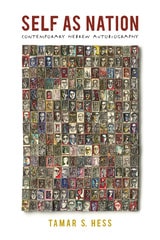
Self as Nation
Contemporary Hebrew AutobiographyTamar S. Hess
Brandeis University Press, 2016
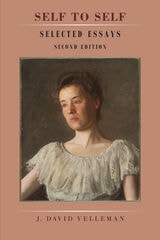
Self to Self
Selected Essays: Second EditionJ. David Velleman
Michigan Publishing Services, 2020
Self to Self brings together essays on personal identity, autonomy, and moral emotions by the philosopher J. David Velleman. Although the essays were written independently, they are unified by an overarching thesis – that there is no single entity denoted by “the self ” – as well as by themes from Kantian ethics, psychoanalytic theory, social psychology, and Velleman’s work in the philosophy of action. Two of the essays were selected by the editors of Philosophers’ Annual as being among the ten best papers in their year of publication.
Self to Self will be of interest to philosophers, psychologists, and others who theorize about the self.
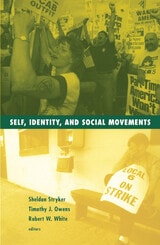
Self, Identity, and Social Movements
Sheldon Stryker
University of Minnesota Press, 2000
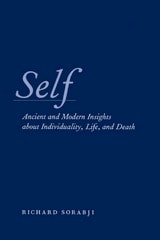
Self
Ancient and Modern Insights about Individuality, Life, and DeathRichard Sorabji
University of Chicago Press, 2006
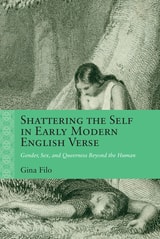
Shattering the Self in Early Modern English Verse
Gender, Sex, and Queerness Beyond the HumanGina Filo
Northwestern University Press, 2026
Rejecting the ideals of stability and sexual mastery demanded of masculine subjects, early modern English poets threw the limits of bodies and selves into question to embrace erotic experiences of genderqueer and transspecies embodiment and affiliation. Through close readings of still-canonical and lesser-read writers including William Shakespeare, John Donne, and Thomas Traherne, Gina Filo shows how these experimental encounters at the limits of the human were inextricable parts of the early modern literary and sexual imaginaries.
In its exploration of nonnormative forms of erotic attachment and embodiment, Shattering the Self in Early Modern English Verse: Gender, Sex, and Queerness Beyond the Human contributes to the burgeoning fields of early modern trans and ecocritical studies while also drawing on contemporary queer theory. Filo neither seeks to naively recuperate a fantasized past nor cedes relationality, sociality, or generativity to the normative. Instead, she shows how the embrace of erotic possibility, flexible, unstable subjectivities, and querying of the limits of “the human” were core features of early modern poetics, reconfiguring our understanding of English literary history and queer relationality today.
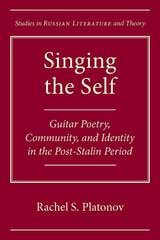
Singing the Self
Guitar Poetry, Community, and Identity in the Post-Stalin PeriodRachel S. Platonov
Northwestern University Press, 2012
This book is a study of a Soviet cultural phenomenon of the 1950s through the 1980s known as guitar poetry—songs accompanied by guitar and considered poetry in much the same way as those of, for example, Bob Dylan. Platonov’s is the most comprehensive book in English to date to analyze guitar poetry, which has rarely received scholarly attention outside of Russia. Going well beyond the conventional, text-centered view of guitar poetry as a form of political or artistic dissent, largely a function of the Cold War climate in which it began, Platonov argues for a more complex understanding of guitar poetry as a means of self-invention and community formation. Although grounded in literary studies, the book effectively brings historical, anthropological, and musicological perspectives to bear on an understudied phenomenon of the post-Stalin period.
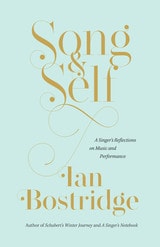
Song and Self
A Singer's Reflections on Music and PerformanceIan Bostridge
University of Chicago Press, 2023
Like so many performers, renowned tenor Ian Bostridge spent much of 2020 and 2021 unable to take part in live music. The enforced silence of the pandemic led him to question an identity that was previously defined by communicating directly with audiences in opera houses and concert halls. It also allowed him to delve deeper into many of the classical works he has encountered over the course of his career, such as Claudio Monteverdi’s seventeenth-century masterpiece Il Combattimento di Tancredi e Clorinda and Robert Schumann’s popular song cycle Frauenliebe und Leben. In lucid and compelling prose, Bostridge explores the ways Monteverdi, Schumann, and Britten employed and disrupted gender roles in their music; questions colonial power and hierarchy in Ravel’s Songs of Madagascar; and surveys Britten’s reckoning with death in works from the War Requiem to his final opera, Death in Venice.
As a performer reconciling his own identity and that of the musical text he delivers on stage, Bostridge unravels the complex history of each piece of music, showing how today’s performers can embody that complexity for their audiences. As readers become privy to Bostridge’s unique lines of inquiry, they are also primed for the searching intensity of his interpretations, in which the uncanny melding of song and self brings about moments of epiphany for both the singer and his audience.
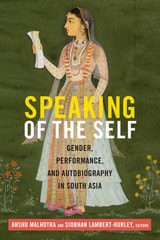
Speaking of the Self
Gender, Performance, and Autobiography in South AsiaAnshu Malhotra and Siobhan Lambert-Hurley, editors
Duke University Press, 2015
Contributors: Asiya Alam, Afshan Bokhari, Uma Chakravarti, Kathryn Hansen, Siobhan Lambert-Hurley, Anshu Malhotra, Ritu Menon, Shubhra Ray, Shweta Sachdeva Jha, Sylvia Vatuk
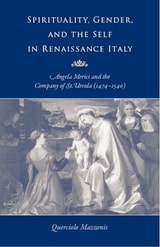
Spirituality, Gender, and the Self in Renaissance Italy
Angela Merici and the Company of St. Ursula (1474–1540)Querciolo Mazzonis
Catholic University of America Press, 2007

Storying the Self
Performance and CommunitiesJess Moriarty and Ross Adamson
Intellect Books, 2023
Through a wide array of texts and methodologies, Storying the Self spotlights autoethnographic research—and pushes the discipline in new directions. This edited volume aims to explore critical and creative approaches to understanding the self in relation to vital social, cultural, and political spheres. Chapters touch on memory and nostalgia, voluntourism in Malawi, the importance of intersectionality, documentary filmmaking, epilepsy, and other experiences to examine the role of the self, as both researcher and storyteller.
Storying the Self features contributions by Ross Adamson, Suzy Bamblett, Emily Bell, Jenni Cresswell, Hannah Davita Ludikhuijze, Sandra Lyndon, Vanessa Marr, Éva Mikuska, Jess Moriarty, Deirdre Russell, Louise Spiers, Holly Stewart, and Lucianna Whittle. It is the first book in Intellect’s innovative new series Performance and Communities, which celebrates, challenges, and researches performance in the real world.
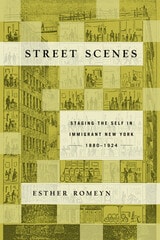
Street Scenes
Staging the Self in Immigrant New York, 1880–1924Esther Romeyn
University of Minnesota Press, 2008
Street Scenes focuses on the intersection of modern city life and stage performance. From street life and slumming to vaudeville and early cinema, to Yiddish theater and blackface comedy, Esther Romeyn discloses racial comedy, passing, and masquerade as gestures of cultural translation. In these performances she detects an obsession with the idea of the city as theater and the self as actor, which was fueled by the challenges that consumer capitalism presented to notions of an “authentic” self.
It was exactly this idea of “authentic” immigrant selfhood that was at stake in many performances on the popular stage, and Romeyn ultimately demonstrates how these diverse and potent immigrant works influenced the emergence of a modern metropolitan culture.
Superhumanity
Design of the SelfNick Axel
University of Minnesota Press, 2018
A wide-ranging and challenging exploration of design and how it engages with the self
The field of design has radically expanded. As a practice, design is no longer limited to the world of material objects but rather extends from carefully crafted individual styles and online identities to the surrounding galaxies of personal devices, new materials, interfaces, networks, systems, infrastructures, data, chemicals, organisms, and genetic codes.
Superhumanity seeks to explore and challenge our understanding of “design” by engaging with and departing from the concept of the “self.” This volume brings together more than fifty essays by leading scientists, artists, architects, designers, philosophers, historians, archaeologists, and anthropologists, originally disseminated online via e-flux Architecture between September 2016 and February 2017 on the invitation of the Third Istanbul Design Biennial. Probing the idea that we are and always have been continuously reshaped by the artifacts we shape, this book asks: Who designed the lives we live today? What are the forms of life we inhabit, and what new forms are currently being designed? Where are the sites, and what are the techniques, to design others?
This vital and far-reaching collection of essays and images seeks to explore and reflect on the ways in which both the concept and practice of design are operative well beyond tangible objects, expanding into the depths of self and forms of life.
Contributors: Zeynep Çelik Alexander, Lucia Allais, Shumon Basar, Ruha Benjamin, Franco “Bifo” Berardi, Daniel Birnbaum, Ina Blom, Benjamin H. Bratton, Giuliana Bruno, Tony Chakar, Mark Cousins, Simon Denny, Keller Easterling, Hu Fang, Rubén Gallo, Liam Gillick, Boris Groys, Rupali Gupte, Andrew Herscher, Tom Holert, Brooke Holmes, Francesca Hughes, Andrés Jaque, Lydia Kallipoliti, Thomas Keenan, Sylvia Lavin, Yongwoo Lee, Lesley Lokko, MAP Office, Chus Martínez, Ingo Niermann, Ahmet Ögüt, Trevor Paglen, Spyros Papapetros, Raqs Media Collective, Juliane Rebentisch, Sophia Roosth, Felicity D. Scott, Jack Self, Prasad Shetty, Hito Steyerl, Kali Stull, Pelin Tan, Alexander Tarakhovsky, Paulo Tavares, Stephan Trüby, Etienne Turpin, Sven-Olov Wallenstein, Eyal Weizman, Mabel O. Wilson, Brian Kuan Wood, Liam Young, and Arseny Zhilyaev.
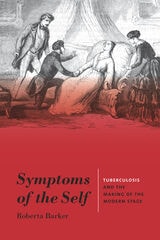
Symptoms of the Self
Tuberculosis and the Making of the Modern StageRoberta Barker
University of Iowa Press, 2022
Symptoms of the Self offers the first full study of the stage consumptive. In the nineteenth and early twentieth centuries in France, Britain, and North America, tuberculosis was a leading killer. Its famous dramatic and operatic victims—Marguerite Gautier in La Dame aux Camélias and her avatar Violetta in La Traviata, Mimì in La Bohème, Little Eva in Uncle Tom’s Cabin, and Edmund Tyrone in Long Day’s Journey into Night, to name but a few—are among the most iconic figures of the Western stage. Its classic symptoms, the cough and the blood-stained handkerchief, have become global performance shorthand for life-threatening illness.
The consumptive character became a vehicle through which standards of health, beauty, and virtue were imposed; constructions of class, gender, and sexuality were debated; the boundaries of nationhood were transgressed or maintained; and an exceedingly fragile whiteness was held up as a dominant social ideal. By telling the story of tuberculosis on the transatlantic stage, Symptoms of the Self uncovers some of the wellsprings of modern Western theatrical practice—and of ideas about the self that still affect the way human beings live and die.