Results by title
64 books match the query 'Self in literature' and 2 start with s
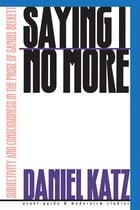
Saying I No More
Subjectivity and Consciousness in the Prose of Samuel BeckettDaniel Katz
Northwestern University Press, 1999
In recent criticism, Samuel Beckett's prose has been increasingly described as a labor of refusal: not only of what traditionally has made possible narrative and the novel but also of the major conventional suppositions concerning the primacy of consciousness, subjectivity, and expression for the artistic act. Beginning from the premise that Beckett never betrays his belief in "the impossibility to express," Saying I No More explores the Beckettian refusal. Katz posits that the expression of voicelessness in Beckett is not silence, that the negativity and negation so evident in the great writer's work are not simply affirmed, but that the valorization of abnegation, emptiness, impotence, or the "no" can all too easily become itself an affirmation of power or an inverted imposition of force.
[more]
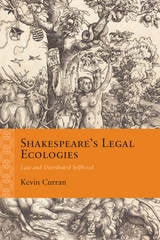
Shakespeare’s Legal Ecologies
Law and Distributed SelfhoodKevin Curran
Northwestern University Press, 2017
Shakespeare’s Legal Ecologies offers the first sustained examination of the relationship between law and selfhood in Shakespeare’s work. Taking five plays and the sonnets as case studies, Kevin Curran argues that law provided Shakespeare with the conceptual resources to imagine selfhood in social and distributed terms, as a product of interpersonal exchange or as a gathering of various material forces. In the course of these discussions, Curran reveals Shakespeare’s distinctly communitarian vision of personal and political experience, the way he regarded living, thinking, and acting in the world as materially and socially embedded practices.
At the center of the book is Shakespeare’s fascination with questions that are fundamental to both law and philosophy: What are the sources of agency? What counts as a person? For whom am I responsible, and how far does that responsibility extend? What is truly mine? Curran guides readers through Shakespeare’s responses to these questions, paying careful attention to both historical and intellectual contexts.
The result is a book that advances a new theory of Shakespeare’s imaginative relationship to law and an original account of law’s role in the ethical work of his plays and sonnets. Readers interested in Shakespeare, theater and philosophy, law, and the history of ideas will find Shakespeare’s Legal Ecologies to be an essential resource.
[more]