Results by title
82 books match the query 'Semantics' and 8 start with s

Samskrta-Subodhini
A Sanskrit PrimerMadhav M. Deshpande
University of Michigan Press, 1999
Saṃskṛta-Subodinī: A Sanskrit Primer marks the culmination of Professor Deshpande’s experience of teaching Sanskrit at the University of Michigan for over twenty-five years. Tested in classes at Michigan and elsewhere and successively improved for over twenty years, the teaching materials in the book now offer an effective tool to learn and teach Sanskrit. The focus is Sanskrit as a language, rather than as a religious or mystical entity. Deshpande’s primer also simplifies the process of learning Sanskrit by dissociating this language-learning process from the heavy burdens imposed both by the tradition of Indo-European linguistics and the tradition of indigenous Sanskrit grammarians in India. By treating Sanskrit as a productive language, rather than as a dead language merely to be deciphered, the book represents a significant advance over the traditional Western approach to the study of Sanskrit.
Work on this book began in 1976, and now almost two generations of Professor Deshpande's students have used successively improved versions. The book’s examples include many modified versions of classical Sanskrit passages from epic texts such as the Mahabharata and the Ramayana. The book also contains examples from Hindu, Buddhist, and Jain traditions, as well as samples of Sanskrit poetry and satire.
[more]
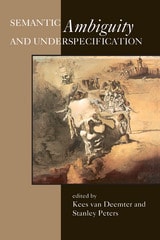
Semantic Ambiguity and Underspecification
Edited by Kees van Deemter and Stanley Peters
CSLI, 1996
Kees van Deemter and Stanley Peters
Subject: Linguistics; Semantics; Ambiguity
[more]
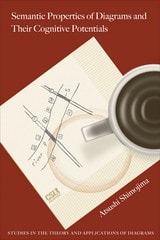
Semantic Properties of Diagrams and Their Cognitive Potentials
Atsushi Shimojima
CSLI, 2015
Why are diagrams sometimes so useful, facilitating our understanding and thinking, while at other times they can be unhelpful and even misleading? Drawing on a comprehensive survey of modern research in philosophy, logic, artificial intelligence, cognitive psychology, and graphic design, Semantic Properties of Diagrams and Their Cognitive Potentials reveals the systematic reasons for this dichotomy, showing that the cognitive functions of diagrams are rooted in the characteristic ways they carry information. In analyzing the logical mechanisms behind the relative efficacy of diagrammatic representation, Atsushi Shimojima provides deep insight into the crucial question: What makes a diagram a diagram?
[more]
Semantics for Descriptions
François Rastier, Marc Cavazza, and Anne Abeillé
CSLI, 2001
In our multimedia age, text description presents many conceptual problems: texts, as cultural objects, cannot be interpreted without descriptions of genre, communicative conditions, and language, which positivist approaches have proved unable to provide. Semantics for Descriptions addresses itself as much to linguists as to computer scientists, arguing that rational hermeneutics can offer better descriptive methods by allowing the theoretical and practical conditions of text interpretation to be defined.
[more]
Shakespeare from the Margins
Language, Culture, ContextPatricia Parker
University of Chicago Press, 1996
In the interpretation of Shakespeare, wordplay has often been considered inconsequential, frequently reduced to a decorative "quibble." But in Shakespeare from the Margins: Language, Culture, Context, Patricia Parker, one of the most original interpreters of Shakespeare, argues that attention to Shakespearean wordplay reveals unexpected linkages, not only within and between plays but also between the plays and their contemporary culture.
Combining feminist and historical approaches with attention to the "matter" of language as well as of race and gender, Parker's brilliant "edification from the margins" illuminates much that has been overlooked, both in Shakespeare and in early modern culture. This book, a reexamination of popular and less familiar texts, will be indispensable to all students of Shakespeare and the early modern period.
Combining feminist and historical approaches with attention to the "matter" of language as well as of race and gender, Parker's brilliant "edification from the margins" illuminates much that has been overlooked, both in Shakespeare and in early modern culture. This book, a reexamination of popular and less familiar texts, will be indispensable to all students of Shakespeare and the early modern period.
[more]
Situations and Attitudes
Jon Barwise and John Perry
CSLI, 1983
In this provocative book, Barwise and Perry tackle the slippery subject of "meaning," a subject that has long vexed linguists, language philosophers, and logicians. Meaning does not exist solely within words and sentences but resides largely in the situation and the attitudes brought to it by those involved. The authors present an unusually lucid treatment of important innovations in the field of natural semantics, contending that the standard view of logic (as derived from Frege, Russell, and work in mathematics and logic) is inappropriate for many of the uses to which it has been put by scholars. In Situations and Attitudes they provide the basics of a realistic model-theoretic semantics of natural language, explain the main ideas of the theory, and contrast them with those of competing theories.
[more]
Spaces, Worlds, and Grammar
Edited by Gilles Fauconnier and Eve Sweetser
University of Chicago Press, 1996
In the highly influential mental-spaces framework developed by Gilles Fauconnier in the mid-1980s, the mind creates multiple cognitive "spaces" to mediate its understanding of relations and activities in the world, and to engage in creative thought.
These twelve original papers extend the mental-spaces framework and demonstrate its utility in solving deep problems in linguistics and discourse theory. Investigating the ties between mental constructs, they analyze a wide range of phenomena, including analogical counterfactuals; the metaphor system for conceptualizing the self; abstract change expressions in Japanese; mood in Spanish; deictic expressions; copular sentences in Japanese; conditional constructions; and reference in American Sign Language.
The ground-breaking research presented in this volume will be of interest to linguists and cognitive scientists.
The contributors are Claudia Brugman, Gilles Fauconnier, George Lakoff, Yo Matsumoto, Errapel Mejias-Bikandi, Laura A. Michaelis, Gisela Redeker, Jo Rubba, Shigeru Sakahara, Jose Sanders, Eve Sweetser, and Karen van Hoek.
[more]
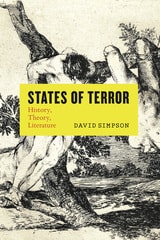
States of Terror
History, Theory, LiteratureDavid Simpson
University of Chicago Press, 2019
How have we come to depend so greatly on the words terror and terrorism to describe broad categories of violence? David Simpson offers here a philology of terror, tracking the concept’s long, complicated history across literature, philosophy, political science, and theology—from Plato to NATO.
Introducing the concept of the “fear-terror cluster,” Simpson is able to capture the wide range of terms that we have used to express extreme emotional states over the centuries—from anxiety, awe, and concern to dread, fear, and horror. He shows that the choices we make among such words to describe shades of feeling have seriously shaped the attribution of motives, causes, and effects of the word “terror” today, particularly when violence is deployed by or against the state. At a time when terror-talk is widely and damagingly exploited by politicians and the media, this book unpacks the slippery rhetoric of terror and will prove a vital resource across humanistic and social sciences disciplines.
Introducing the concept of the “fear-terror cluster,” Simpson is able to capture the wide range of terms that we have used to express extreme emotional states over the centuries—from anxiety, awe, and concern to dread, fear, and horror. He shows that the choices we make among such words to describe shades of feeling have seriously shaped the attribution of motives, causes, and effects of the word “terror” today, particularly when violence is deployed by or against the state. At a time when terror-talk is widely and damagingly exploited by politicians and the media, this book unpacks the slippery rhetoric of terror and will prove a vital resource across humanistic and social sciences disciplines.
[more]