121 books match the query 'Social classes' and 9 start with s
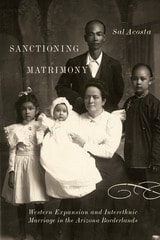
cover of Sanctioning Matrimony: Western Expansion and Interethnic Marriage in the Arizona Borderlands

Sanctioning Matrimony

Western Expansion and Interethnic Marriage in the Arizona Borderlands

Sal Acosta

University of Arizona Press, 2016

Marriage, divorce, birth, baptism, and census records are the essential records of a community. Through them we see who marries, who divorces, and how many children are born. Sal Acosta has studied a broad base of these vital records to produce the largest quantitative study of intermarriage of any group in the West. Sanctioning Matrimony examines intermarriage in the Tucson area between 1860 and 1930. Unlike previous studies on intermarriage, this book examines not only intermarriages of Mexicans with whites but also their unions with blacks and Chinese.

Following the Treaty of Mesilla (1853), interethnic relationships played a significant part in the Southwest. Acosta provides previously unseen archival research on the scope and tenor of interracial marriages in Arizona. Contending that scholarship on intermarriage has focused on the upper classes, Acosta takes us into the world of the working and lower classes and illuminates how church and state shaped the behavior of participants in interracial unions.

Marriage practices in Tucson reveal that Mexican women were pivotal in shaping family and social life between 1854 and 1930. Virtually all intermarriages before 1900 were, according to Acosta, between Mexican women and white men, or between Mexican women and blacks or Chinese until the 1920s, illustrating the importance of these women during the transformation of Tucson from a Mexican pueblo to an American town.

Acosta’s deep analysis of vital records, census data, and miscegenation laws in Arizona demonstrates how interethnic relationships benefited from and extended the racial fluidity of the Arizona borderlands.

[more]
cover of Searching for Democracy: Women, Domestic Work, and Social Reproduction in Latin America

Searching for Democracy

Women, Domestic Work, and Social Reproduction in Latin America

Leda M. Pérez

Temple University Press, 2026

How can we achieve lasting social and political equality for women? Leda Pérez tackles this thorny question in Searching for Democracy by interrogating egalitarianism in Latin America, where nearly 20% of women work in domestic service. She examines how women’s participation in society, labor, and politics continues to be conditioned by their relationship to domestic and care work.

Pérez argues that women’s relationship to these spheres of life is indicative of a nation’s development and democracy. She provides a comparative focus on the socio-cultural valuation of this labor and the experiences of women in Bolivia, Chile, Peru, and Uruguay, among other countries. Pérez asserts that it is only by changing sociocultural views on this “women’s work” that nations can create political change, foster equitable legislation, and ensure implementation of effective policies that benefit women.

Searching for Democracy shows why real and lasting equality cannot be achieved without fully enfranchising women in the lowest tiers of employment and closing the equality gap among women. Pérez’s models for gender equality are relevant for women around the world.
[more]
cover of Social Class: How Does It Work?

Social Class

How Does It Work?

Annette Lareau

Russell Sage Foundation, 2008
Class differences permeate the neighborhoods, classrooms, and workplaces where we lead our daily lives. But little is known about how class really works, and its importance is often downplayed or denied. In this important new volume, leading sociologists systematically examine how social class operates in the United States today. Social Class argues against the view that we are becoming a classless society. The authors show instead the decisive ways social class matters—from how long people live, to how they raise their children, to how they vote. The distinguished contributors to Social Class examine how class works in a variety of domains including politics, health, education, gender, and the family. Michael Hout shows that class membership remains an integral part of identity in the U.S.—in two large national surveys, over 97 percent of Americans, when prompted, identify themselves with a particular class. Dalton Conley identifies an intangible but crucial source of class difference that he calls the "opportunity horizon"—children form aspirations based on what they have seen is possible. The best predictor of earning a college degree isn't race, income, or even parental occupation—it is, rather, the level of education that one's parents achieved. Annette Lareau and Elliot Weininger find that parental involvement in the college application process, which significantly contributes to student success, is overwhelmingly a middle-class phenomenon. David Grusky and Kim Weeden introduce a new model for measuring inequality that allows researchers to assess not just the extent of inequality, but also whether it is taking on a more polarized, class-based form. John Goldthorpe and Michelle Jackson examine the academic careers of students in three social classes and find that poorly performing students from high-status families do much better in many instances than talented students from less-advantaged families. Erik Olin Wright critically assesses the emphasis on individual life chances in many studies of class and calls for a more structural conception of class. In an epilogue, journalists Ray Suarez, Janny Scott, and Roger Hodge reflect on the media's failure to report hardening class lines in the United States, even when images on the nightly news—such as those involving health, crime, or immigration—are profoundly shaped by issues of class. Until now, class scholarship has been highly specialized, with researchers working on only one part of a larger puzzle. Social Class gathers the most current research in one volume, and persuasively illustrates that class remains a powerful force in American society.
[more]
cover of Social Inequality in Oaxaca:  A History of Resistance and Change

Social Inequality in Oaxaca

A History of Resistance and Change

Arthur Murphy

Temple University Press, 1991
"Anthropologists Murphy and Stepick trace urbanization in the capital city of the state of Oaxaca for more than 2,000 years. Their study represents a micro perspective that describes the colonias populares, the poor neighborhoods, and the struggles of Oaxacans to survive and improve life in marginal communities.... The book is well organized, with excellent annotated footnotes and a reading list." --Choice This may be the only book that analyzes the urbanization of one area from its origins more than two thousand years ago to the present. Arthur Murphy and Alex Stepick examine Oaxaca, Mexico, where they have been doing research regularly for the last twenty years. Paying particular attention to neighborhoods, families, and economic activities, they focus on issues of poverty and inequality. Oaxaca is a city marked by socioeconomic inequality that has felt the alternating trends of integration into and isolation from the broader world. It is a city in which tens of thousands of households resolutely try to adapt, to survive and pass on something of themselves to their children. With rich ethnographic material and historical research, Murphy and Stepick describe gender roles, the dynamic nature of households, the importance of compadrazgo (co-godparenthood) as a social institution, class-based political struggles and strikes, and the role of children in redeeming their parents from poverty. Individual life histories emerge from their research, each representing diverse class, familial, and economic structures within Oaxacan society. "Murphy and Stepick catch Oaxaca at a special time in its history. When the illustrious works of theory in the academic disciplines have faded, when Foucault is a footnote and deconstruction derided, books like this one will still be valuable. A portrait of a city during the most difficult period of its country's recent economic history." --Henry A. Selby (from the Foreword)
[more]
cover of Social Organization in South China, 1911–1949: The Case of Kuan Lineage in K’ai-p’ing County

Social Organization in South China, 1911–1949

The Case of Kuan Lineage in K’ai-p’ing County

Yuen-fong Woon

University of Michigan Press, 1984

Bridging the collapse of the Confucian state and the establishment of the People’s Republic of China, the period 1911–49 is particularly fascinating to historians, anthropologists, sociologists and political scientists. Unfortunately, it is also a very confusing period, full of shifts and changes in economic, social, and political organizations. The social implications of these changes, and the relationships between officials on the subdistrict level, the unofficial leaders, and the bulk of the peasantry remain inadequately known. South China, which nurtured the Communist Party in its formative years, is a particularly interesting case. In this study I use the Kuan lineage of K’ai-p’ing as a case study to show the effects of demographic, economic, administrative, and educational changes after the Treaty of Nanking (1842) on patrilineal kinship as a principle of social organization in South China. [vii]
[more]
cover of Spheres of Influence: The Social Ecology of Racial and Class Inequality

Spheres of Influence

The Social Ecology of Racial and Class Inequality

Douglas S. Massey

Russell Sage Foundation, 2014

The black-white divide has long haunted the United States as a driving force behind social inequality. Yet, the civil rights movement, the increase in immigration, and the restructuring of the economy in favor of the rich over the last several decades have begun to alter the contours of inequality. Spheres of Influence, co-authored by noted social scientists Douglas S. Massey and Stefanie Brodmann, presents a rigorous new study of the intersections of racial and class disparities today. Massey and Brodmann argue that despite the persistence of potent racial inequality, class effects are drastically transforming social stratification in America. This data-intensive volume examines the differences in access to material, symbolic, and emotional resources across major racial groups. The authors find that the effects of racial inequality are exacerbated by the class differences within racial groups. For example, when measuring family incomes solely according to race, Massey and Brodmann found that black families' average income measured $28,400, compared to Hispanic families' $35,200. But this gap was amplified significantly when class differences within each group were taken into account. With class factored in, inequality across blacks' and Hispanics' family incomes increased by a factor of almost four, with lower class black families earning an average income of only $9,300 compared to $97,000 for upper class Hispanics. Massey and Brodmann found similar interactions between class and racial effects on the distribution of symbolic resources, such as occupational status, and emotional resources, such as the presence of a biological father—across racial groups. Although there are racial differences in each group's access to these resources, like income, these disparities are even more pronounced once class is factored in. The complex interactions between race and class are apparent in other social spheres, such as health and education. In looking at health disparities across groups, Massey and Brodmann observed no single class effect on the propensity to smoke cigarettes. Among whites, cigarette smoking declined with rising class standing, whereas among Hispanics it increased as class rose. Among Asians and blacks, there was no class difference at all. Similarly, the authors found no single effect of race alone on health: Health differences between whites, Asians, Hispanics, and blacks were small and non-significant in the upper class, but among those in the lower class, intergroup differences were pronounced. As Massey and Brodmann show, in the United States, a growing kaleidoscope of race-class interactions has replaced pure racial and class disadvantages. By advancing an ecological model of human development that considers the dynamics of race and class across multiple social spheres, Spheres of Influence sheds important light on the factors that are currently driving inequality today.
[more]
cover of Split: Class Divides Uncovered

Split

Class Divides Uncovered

Ben Tippet

Pluto Press, 2020

In 1990, John Major hailed 'the classless society'; in 1997, New Labour announced that 'we're all middle class now', yet we live in an age where food banks, pay day lenders and zero-hour contracts proliferate: it's clear that class matters. 

Foregrounding the economic nature of class, Split challenges the idea that class can be reduced to the cultural. From precarious labor to rising debt; from the housing crisis to environmental catastrophe; from an inflated prison population to the welfare state; Ben Tippet traces the class divide at the heart of all exploitation. Myth-busting meritocracy, he exposes the role that tax havens, colonialism and inheritance play in the wealth of the elite. 

Split highlights the potential for a diverse and eclectic working-class bloc to fight back in an age of austerity and uncertainty.
[more]
cover of Staged Readings: Contesting Class in Popular American Theater and Literature, 1835-75

Staged Readings

Contesting Class in Popular American Theater and Literature, 1835-75

Michael D’Alessandro

University of Michigan Press, 2022

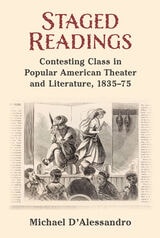
Staged Readings studies the social consequences of 19th-century America’s two most prevalent leisure forms: theater and popular literature. In the midst of watershed historical developments—including numerous waves of immigration, two financial Panics, increasing wealth disparities, and the Civil War—American theater and literature were developing at unprecedented rates. Playhouses became crowded with new spectators, best-selling novels flew off the shelves, and, all the while, distinct social classes began to emerge. While the middle and upper classes were espousing conservative literary tastes and attending family matinees and operas, laborers were reading dime novels and watching downtown spectacle melodramas like Nymphs of the Red Sea and The Pirate’s Signal or, The Bridge of Death!!! As audiences traveled from the reading parlor to the playhouse (and back again), they accumulated a vital sense of social place in the new nation. In other words, culture made class in 19th-century America.

Based in the historical archive, Staged Readings presents a panoramic display of mid-century leisure and entertainment. It examines best-selling novels, such as Harriet Beecher Stowe’s Uncle Tom’s Cabin and George Lippard’s The Quaker City. But it also analyzes a series of sensational melodramas, parlor theatricals, doomsday speeches, tableaux vivant displays, curiosity museum exhibits, and fake volcano explosions. These oft-overlooked spectacles capitalized on consumers’ previous cultural encounters and directed their social identifications. The book will be particularly appealing to those interested in histories of popular theater, literature and reading, social class, and mass culture.
[more]
cover of Struggle for the Soul of the Postwar South: White Evangelical Protestants and Operation Dixie

Struggle for the Soul of the Postwar South

White Evangelical Protestants and Operation Dixie

Elizabeth Fones-Wolf and Ken Fones-Wolf

University of Illinois Press, 2015

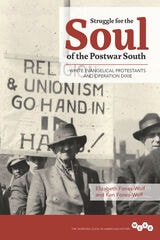
In 1946, the Congress of Industrial Organizations (CIO) undertook Operation Dixie, an initiative to recruit industrial workers in the American South. Elizabeth and Ken Fones-Wolf plumb rarely used archival sources and rich oral histories to explore the CIO's fraught encounter with the evangelical Protestantism and religious culture of southern whites.
 
The authors' nuanced look at working class religion reveals how laborers across the surprisingly wide evangelical spectrum interpreted their lives through their faith. Factors like conscience, community need, and lived experience led individual preachers to become union activists and mill villagers to defy the foreman and minister alike to listen to organizers. As the authors show, however, all sides enlisted belief in the battle. In the end, the inability of northern organizers to overcome the suspicion with which many evangelicals viewed modernity played a key role in Operation Dixie's failure, with repercussions for labor and liberalism that are still being felt today.
 
Identifying the role of the sacred in the struggle for southern economic justice, and placing class as a central aspect in southern religion, Struggle for the Soul of the Postwar South provides new understandings of how whites in the region wrestled with the options available to them during a crucial period of change and possibility.
[more]