Results by title
70 books match the query 'Social conflict' and 4 start with s
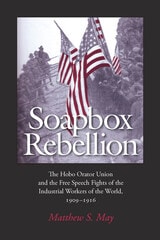
Soapbox Rebellion
The Hobo Orator Union and the Free Speech Fights of the Industrial Workers of the World, 1909-1916Matthew S. May
University of Alabama Press, 2013
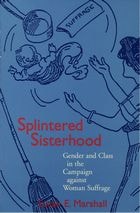
Splintered Sisterhood
Gender and Class in the Campaign against Woman SuffrageSusan E. Marshall
University of Wisconsin Press, 1997
When Tennessee became the thirty-sixth and final state needed to ratify the Nineteenth Amendment in August 1920, giving women the right to vote, one group of women expressed bitter disappointment and vowed to fight against “this feminist disease.” Why this fierce and extended opposition? In Splintered Sisterhood, Susan Marshall argues that the women of the antisuffrage movement mobilized not as threatened homemakers but as influential political strategists.
Drawing on surviving records of major antisuffrage organizations, Marshall makes clear that antisuffrage women organized to protect gendered class interests. She shows that many of the most vocal antisuffragists were wealthy, educated women who exercised considerable political influence through their personal ties to men in politics as well as by their own positions as leaders of social service committees. Under the guise of defending an ideal of “true womanhood,” these powerful women sought to keep the vote from lower-class women, fearing it would result in an increase in the “ignorant vote” and in their own displacement from positions of influence. This book reveals the increasingly militant style of antisuffrage protest as the conflict over female voting rights escalated. Splintered Sisterhood adds a missing piece to the history of women’s rights activism in the United States and illuminates current issues of antifeminism.
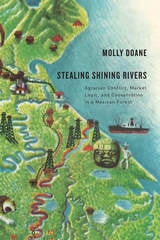
Stealing Shining Rivers
Agrarian Conflict, Market Logic, and Conservation in a Mexican ForestMolly Doane
University of Arizona Press, 2012
What happens to indigenous people when their homelands are declared by well-intentioned outsiders to be precious environmental habitats? In this revelatory book, Molly Doane describes how a rain forest in Mexico’s southern state of Oaxaca was appropriated and redefined by environmentalists who initially wanted to conserve its biodiversity. Her case study approach shows that good intentions are not always enough to produce results that benefit both a habitat and its many different types of inhabitants.
Doane begins by showing how Chimalapas—translated as “shining rivers”—has been “produced” in various ways over time, from a worthless wasteland to a priceless asset. Focusing on a series of environmental projects that operated between 1990 and 2008, she reveals that environmentalists attempted to recast agrarian disputes—which actually stemmed from government-supported corporate incursions into community lands and from unequal land redistribution—as environmental problems.
Doane focuses in particular on the attempt throughout the 1990s to establish a “Campesino Ecological Reserve” in Chimalapas. Supported by major grants from the World Wildlife Foundation (WWF), this effort to foster and merge agrarian and environmental interests was ultimately unsuccessful because it was seen as politically threatening by the state. By 2000, the Mexican government had convinced the WWF to redirect its conservation monies to the state government and its agencies.
The WWF eventually abandoned attempts to establish an “enclosure” nature reserve in the region or to gain community acceptance for conservation. Instead, working from a new market-based model of conservation, the WWF began paying cash to individuals for “environmental services” such as reforestation and environmental monitoring.
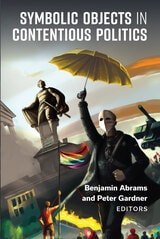
Symbolic Objects in Contentious Politics
Benjamin Abrams and Peter Gardner, Editors
University of Michigan Press, 2023
When we observe protest marches, striking workers on picket lines, and insurgent movements in the world today, a litany of objects routinely fill our field of vision. Some such objects are ubiquitous the world over, like flags, banners, and placards. Others are situationally unique: Who could have anticipated the historical importance of a flower placed in the barrel of a gun, a flaming torch, a sea of umbrellas, a motorist’s yellow vest, a feather headdress, an AK-47, or a knitted pink hat? This book explores the “stuff” at the heart of protests, revolutions, civil wars, and other contentious political events, with particular focus on those objects that have or acquire symbolic importance. In the context of “contentious politics” (disruptive political episodes where people try to change societies without going through institutions), certain objects can divide and unite social groups, tell stories, make declarations, spark controversy, and even trigger violent upheavals.
This book draws together scholars from a variety of fields to discuss symbolic objects in contentious politics: their meanings, uses, functions, and social responses. In bringing these phenomena together, this book offers a serious, distinctive, and cohesive theoretical contribution that draws upon diverse scholarly work in order to form the building blocks for future inquiry in the field. The aim is not merely to “close the gap” in the literature, but to create space in the field for further and more fruitful inquiry.