Results by title
100 books match the query 'Sociolinguistics' and 15 start with s
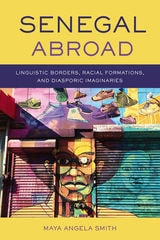
Senegal Abroad
Linguistic Borders, Racial Formations, and Diasporic ImaginariesMaya Angela Smith
University of Wisconsin Press, 2020
The Senegalese are notable, Smith suggests, both in their capacity for movement and in their multifaceted approach to language. She finds that, although the emigrants she interviews express complicated relationships to the multiple languages they speak and the places they inhabit, they also convey pleasure in both travel and language. Offering a mix of poignant, funny, reflexive, introspective, and witty stories, they blur the lines between the utility and pleasure of language, allowing a more nuanced understanding of why and how Senegalese move.
Shelter for the Night
On Afghanistan, Language, and DetoursFatima Mojaddedi
Duke University Press, 2026

Signed Language Corpora
Jordan Fenlon
Gallaudet University Press, 2022
The ability to search corpora to obtain information about the frequency of patterns in language is an important step forward for signed language research. Access to large datasets will expand scholarly understandings of signed language structure in ways never before possible. Through reflective discussions on the processes of creating, using, and utilizing corpora, the editors and contributors hope that other linguists will be inspired to take similar steps. The descriptions provided in this book have been written to provide a framework for those eager to develop or make use of signed language corpora for their respective signed language varieties. Creating signed language corpora is significant not only for linguistic research, but for the long-term preservation of collected texts that include the stories and histories of signed language communities.
Additional areas of focus include the use of signed language corpora in applied settings, the ethics of working with signed language communities, and the future of this methodology in research.
Signs of Deference, Signs of Demeanour
Interlocutor Reference and Self-Other Relations across Southeast Asian Speech CommunitiesEdited by Dwi Noverini Djenar and Jack Sidnell
National University of Singapore Press, 2022
A study of interlocutor reference that significantly deepens our understanding of the ways in which self-other relations are linguistically mediated in social interaction, based on the analysis of Southeast Asian languages.
Terms used by speakers to refer to themselves and their interlocutors form one of the ways that language expresses, defines, and creates a field for working out social relations. Because this field of study in sociolinguistics historically has focused on Indo-European languages, it has tended to dwell on references to the addressee—for example, the choice between tu and vous when addressing someone in French. This book uses the study of Southeast Asian languages to theorize interlocutor reference more broadly, significantly deepening our understanding of the ways in which self-other relations are linguistically mediated in social interaction. As the authors explain, Southeast Asian systems exceed in complexity and nuance the well-described cases of Europe in two basic ways. First, in many languages of Southeast Asia, a speaker must select an appropriate reference form not only for other/addressee but also for self/speaker. Second, in these languages, in addition to pronouns, speakers draw upon a range of common and proper nouns including names, kin terms, and titles, in referring to themselves and the addressee. Acts of interlocutor reference, therefore, inevitably do more than simply identify the speaker and addressee; they also convey information about the proposed relation between interlocutors. Bringing together studies from both small-scale and large, urbanized communities across Mainland and Insular Southeast Asia, this is an important contribution to the regional linguistic and anthropological literature.
Social Constructions of Deafness
Examining Deaf Languacultures in EducationThomas P. Horejes
Gallaudet University Press, 2012
Thomas P. Horejes’s new book focuses on revealing critical knowledge that addresses certain social justice issues, including deafness, language, culture, and deaf education. He conveys this information through discourses about his own experiences being deaf and through his research in which he “stresses the contingency of the social” in educational institutions.
In Social Constructions of Deafness: Examining Deaf Languacultures in Education, Horejes contends that schools as social institutions play powerful and exacting roles in the creation and maintenance of social constructions such as language and culture for deaf children. He subscribes to Michael Agar’s concept of “languaculture,” defined as the inextricable relationship between language and culture in which a specific language will shape and influence culture. His approach employs other anthropological terminology as he connects his personal experience as a deaf student (emic) to academic research on deafness (etic) to bring understanding to the multidimensional aspects of his own negotiated identities.
Horejes extends his inquiry through his analysis of two kindergarten classes for deaf students, one orally oriented and the other conducted using sing language. His findings are sobering evidence of the myriad challenges educators face in defining appropriate academic, linguistic, and cultural pedagogy for deaf children in schools and other social institutions.
Social Functions of Language in a Mexican-American Community
George Carpenter Barker
University of Arizona Press, 1972
Data were drawn from observational studies of individuals and families; observation of group activities; and observation of, supplemented by questionnaires on, the cultural interests of Mexican children and their families. Some conclusions of the study were that Spanish came to be identified in the Mexican community as the language of intimate and family relations, while English came to be identified as the language of formal social relations and of all relations with Anglos. It was also found that the younger American-born group reject both Spanish and English in favor of their own language, Pachuco. Tables depicting the characteristics of 20 families, the language usage of families, and the language usage in personal relationships of English and Spanish are included. Suggestions for further research are made.

Society as Text
Essays on Rhetoric, Reason, and RealityRichard Harvey Brown
University of Chicago Press, 1987
Sociolinguistic Pathways in Sign Languages
Studies in Honor of Ceil LucasJoseph C. Hill
Gallaudet University Press, 2026
Sociolinguistic Variation in American Sign Language
Ceil Lucas
Gallaudet University Press, 2001
Sociolinguistics in Deaf Communities
Ceil Lucas
Gallaudet University Press, 1995
The first volume in the new Sociolinguistics in Deaf Communities series presents a rich collection of essays showcasing the breadth and depth of this exciting discipline. Topics of inquiry in the premiere volume include fingerspelling in Langue des Signes Quebecoise (LSQ) in Quebec, Canada; language used by a Navajo family with deaf children; language policy, classroom practice, and multiculturalism in deaf education; aspects of American Sign Language (ASL) discourse and of Filipino Sign Language discourse; and the nature and role of rhetorical language in Deaf social movements.
Among the noted contributors are Dominique Machabee, Arlene Blumenthal-Kelly, Jeffrey Davis, Melanie Metzger, Samuel Supalla, Barbara Gerner de Garcia, Liza B. Martinez, Kathy Jankowski, and also Ceil Lucas. Sociolinguistics in Deaf Communities affords an invaluable opportunity to assess up-to-date information on sign language linguistics worldwide and its impact on policy and planning in education, interaction with spoken languages, interpreting, and the issues of empowerment.
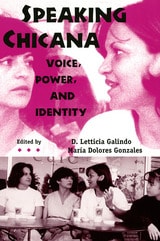
Speaking Chicana
Voice, Power, and IdentityD. Letticia Galindo
University of Arizona Press, 1999
Part 1. Reconstruction: Language Varieties, Language Use, and Language Attitudes
1. Crossing Social and Cultural Borders: The Road to Language Hybridity, María Dolores Gonzales
2. Fighting Words: Latina Girls, Gangs, and Language Attitudes, Norma Mendoza-Denton
Part 2. Reflection: Testimonios
3. Speaking as a Chicana: Tracing Cultural Heritage through Silence and Betrayal, Jacqueline M. Martínez
4. The Power of Language: From the Back of the Bus to the Ivory Tower, Christine Marín
5. Challenging Tradition: Opening the Headgate, Ida M. Luján
6. Mexican Blood Runs through My Veins, Aurora E. Orozco
Part 3. Innovation: Speaking Creatively/Creatively Speaking
7. Searching for a Voice: Ambiguities and Possibilities, Erlinda Gonzales-Berry
8. Sacred Cults, Subversive Icons: Chicanas and the Pictorial Language of Catholicism, Charlene Villaseñor Black
9. Caló and Taboo Language Use among Chicanas: A Description of Linguistic Appropriation and Innovation, D. Letticia Galindo
10. Máscaras, Trenzas, y Greñas: Un/Masking the Self While Un/Braiding Latina Stories and Legal Discourse, Margaret E. Montoya
Speaking of Crime
The Language of Criminal JusticeLawrence M. Solan, Peter M. Tiersma, and Tammy Gales
University of Chicago Press, 2025
An essential introduction to the use and misuse of language within the criminal justice system, updated for a new generation.
Does everyone understand the Miranda warning? Why do people confess to a crime they did not commit? Can linguistic experts identify who wrote an anonymous threatening letter? Since its first publication, Speaking of Crime has been answering these questions. Introducing major topics and controversies at the intersection of language and law, Lawrence M. Solan, Peter M. Tiersma, and Tammy Gales apply multidisciplinary insights to examine the complex role of language within the US justice system.
The second edition features in-depth discussions of recent cases, new legislation, and innovative research advances, and includes a new chapter on who interprets the laws governing linguistic contexts. Thoroughly updated and approachable, Speaking of Crime is a state-of-the-art survey that will be useful to scholars, students, and practitioners throughout the criminal justice system.

Speech and Song at the Margins of Global Health
Zulu Tradition, HIV Stigma, and AIDS Activism in South AfricaSteven P. Black
Rutgers University Press, 2019
Storytelling and Conversation
Discourse in Deaf CommunitiesElizabeth A. Winston
Gallaudet University Press, 1999
In this intriguing book, renowned sociolinguistics experts explore the importance of discourse analysis, a process that examines patterns of language to understand how users build cooperative understanding in dialogues. It presents discourse analyses of sign languages native to Bali, Italy, England, and the United States.
Studies of internal context review the use of space in ASL to discuss space, how space in BSL is used to “package” complex narrative tasks, how signers choose linguistic tools to structure storytelling, and how affect, emphasis, and comment are added in text telephone conversations. Inquiries into external contexts observe the integration of deaf people and sign language into language communities in Bali, and the language mixing that occurs between deaf parents and their hearing children.
Both external and internal contexts are viewed together, first in an examination of applying internal ASL text styles to teaching written English to Deaf students and then in a consideration of the language choices of interpreters who must shift footing to manage the “interpreter’s paradox.” Storytelling and Conversation casts new light on discourse analysis, which will make it a welcome addition to the sociolinguistics canon.
Streets of a Million Martyrs
Everyday Poetics and Politics in Urban AlgeriaStephanie Love
University of Chicago Press, 0
Follows ordinary people as they move through the Algerian city of Oran, navigating the politically charged context of postcolonialism.
In this book, anthropologist Stephanie Love examines ordinary Algerians’ hope for a better future through what she calls “everyday urban poetics,” focusing on the country’s second-largest city of Oran. Examining linguistic forms including placenames, jokes, metaphors, anecdotes, and code-switches along with urban forms including monuments, buildings, and street layouts, Love shows how popular imaginaries of resistance are inscribed in Oran’s language and cityscapes.
Love argues that these everyday urban poetics constitute a street-based language that has helped Algerians find ways around oppressive censorship, reckon with painful pasts, and develop what she views as a politically fertile creative insurgency. This is particularly true in the wake of the 2019 uprising known as Hirak (“the movement”) that found Algerians challenging the legitimacy of the postcolonial regime through large-scale demonstrations and protests. Analyzing phenomena as diverse as efforts to preserve buildings and monuments, the informal renaming of streets and landmarks, and the development of women-led associations encouraging education and open discourse, Love shows how new forms of political life can be developed and sharpened in everyday speech.