Results by title
74 books match the query 'Sociology, Urban' and 7 start with s

Saigon’s Edge
On the Margins of Ho Chi Minh CityErik Harms
University of Minnesota Press, 2010
Unlike the idealized Vietnamese model of urban space, Hóc Môn is between worlds, neither outside nor inside but always uncomfortably both. With particular attention to everyday social realities, Harms demonstrates how living on the margin can be both alienating and empowering, as forces that exclude its denizens from power and privilege in the inner city are used to thwart the status quo on the rural edges.
More than a local case study of urban change, Harms’s work also opens a window on Vietnam’s larger turn toward market socialism and the celebration of urbanization—transformations instructively linked to trends around the globe.
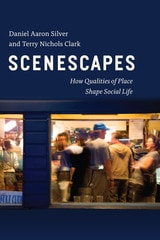
Scenescapes
How Qualities of Place Shape Social LifeDaniel Aaron Silver and Terry Nichols Clark
University of Chicago Press, 2016
In Scenescapes, Daniel Aaron Silver and Terry Nichols Clark examine the patterns and consequences of the amenities that define our streets and strips. They articulate the core dimensions of the theatricality, authenticity, and legitimacy of local scenes—cafes, churches, restaurants, parks, galleries, bowling alleys, and more. Scenescapes not only reimagines cities in cultural terms, it details how scenes shape economic development, residential patterns, and political attitudes and actions. In vivid detail and with wide-angle analyses—encompassing an analysis of 40,000 ZIP codes—Silver and Clark give readers tools for thinking about place; tools that can teach us where to live, work, or relax, and how to organize our communities.
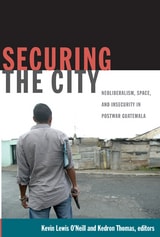
Securing the City
Neoliberalism, Space, and Insecurity in Postwar GuatemalaKevin Lewis O Neill and Kedron Thomas, eds.
Duke University Press, 2011
Contributors. Peter Benson, Manuela Camus, Avery Dickins de Girón, Edward F. Fischer, Deborah Levenson, Thomas Offit, Kevin Lewis O’Neill, Kedron Thomas, Rodrigo José Véliz
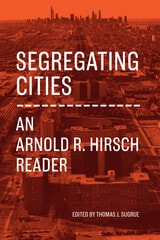
Segregating Cities
An Arnold R. Hirsch ReaderArnold R. Hirsch
University of Chicago Press, 2026
Arnold R. Hirsch (1949–2018) was one of the preeminent urban historians of his generation, a reputation cemented by his landmark book, Making the Second Ghetto. With compelling clarity, Hirsch demonstrated that segregation is not the inevitable result of individual choices, natural tendencies, or cultural traits—it is a structural phenomenon, reinforced on every level by state power.
Segregating Cities collects the author’s key essays, some previously unpublished, to reveal a more complete picture of a remarkable scholar and his exploration of race, place, politics, and policy in the twentieth-century American city. Together, these essays can help us see segregation for what it is, so that we can then begin to truly work to overcome it.
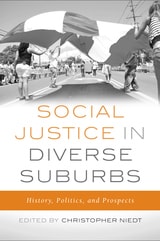
Social Justice in Diverse Suburbs
History, Politics, and ProspectsChristopher Niedt
Temple University Press, 2013
Editor Christopher Niedt and his contributors shed light on organizing and conflict in the suburbs with historical and contemporary case studies. Chapters address topical issues ranging from how suburbanites actively fought school segregation to industrial pollution and displacement along the suburban-rural fringe. Social Justice in Diverse Suburbs also considers struggles for integration and environmental justice as well as efforts to preserve suburban history and organize immigrant communities.
Contributors include: Douglas R. Appler, Aaron Cavin, Nancy A. Denton, Lisa Feldstein, Casey Gallagher, Anne Galletta, Joseph Gibbons, Robert Gioielli, Lucas Owen Kirkpatrick, JoAnna Mitchell-Brown, Manuel Pastor, john a. powell, Jason Reece, Alex Schafran, June Williamson, and the editor.

Step by Step
Everyday Walks in a French Urban Housing ProjectJean-Francois Augoyard
University of Minnesota Press, 2007
The street riots that swept through France in the fall of 2005 focused worldwide attention on the plight of the country’s immigrants and their living conditions in the suburbs many of them call home. These high-density neighborhoods were constructed according to the principles of functionalist urbanism that were ascendant in the 1960s. Then, as now, the disparities between the planners’ utopian visions and the experiences of the inhabitants raised concerns, generating a number of sociological studies of the “new towns.” One of the most sophisticated and significant of these critiques is Jean-François Augoyard’s Step by Step, which was originally published in France in 1979 and famously influenced Michel de Certeau’s analysis of everyday life. Its examination of social life in the rationally planned suburb remains as cogent and timely as ever.
Step by Step is based on in-depth interviews Augoyard conducted with the inhabitants of l’Arlequin, a new town on the outskirts of Grenoble. A resident of l’Arlequin himself, Augoyard sought to understand how his neighbors used its passages, streets, and parks. He begins with a detailed investigation of the inhabitants’ daily walks before going on to consider how the built environment is personalized through place-names and shared memories, the ways in which sensory impressions define the atmosphere of a place and how, through individual and collective imagination, residents transformed l’Arlequin from a concept into a lived space.
In closely scrutinizing everyday life in l’Arlequin, Step by Step draws a fascinating portrait of the richness of social life in the new towns and sheds light on the current living conditions of France’s immigrants.
Jean-François Augoyard is professor of philosophy and musicology and doctor of urban studies at the Center for Research on Sonorous Space and the Urban Environment at the School of Architecture of Grenoble.
David Ames Curtis is a translator, editor, writer, and citizen activist.
Françoise Choay is professor emeritus in the history and theory of architecture at the University of Paris VIII and Cornell University and the author of numerous books and essays.
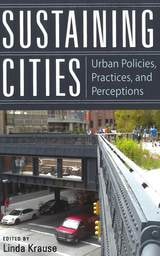
Sustaining Cities
Urban Policies, Practices, and PerceptionsKrause, Linda
Rutgers University Press, 2012
What has happened to cities after the global economic recession? Sustaining Cities answers this question by explaining how failed governmental policies contributed to urban problems and offering best practices for solving them.
From social scientists and urban planners to architects and literary and film critics, the authors of this unique collection suggest real responses to this crisis. Could the drastic declines in housing markets have been avoided? Yes, if we reframe our housing values. Do you want to attract corporate investment to your town? You might want to think twice about doing so. The extinction of the “Celtic Tiger” may be charted in statistics, but the response in popular Irish mystery novels is much more compelling. China, while not immune to market vicissitudes, still booms, but at a considerable cost to its urban identities.
Whether constructing a sustainable social framework for Mexican mega-cities or a neighborhood in London, these nine essays consider some strikingly similar strategies. And perhaps, as the contributors suggest, it’s time to look beyond the usual boundaries of urban, suburban, and exurban to forge new links among these communities that will benefit all citizens. Accessible to anyone with an interest in how cities cope today, Sustaining Cities presents a cautionary tale with a hopeful ending.